Making Coexistence Possible Through Time
Mickey7Making Coexistence Possible Through Time is the idea that a meeting between different peoples need not become a conflict simply because they are different: the conditions and timing of first contact matter. Long Shot supplies the clearest example. Its colonists and native inhabitants lived on the same world for decades without knowing one another, and the narrator suggests that this delay gave the human settlement time to become less afraid. Against the Niflheim crisis, where humans and creepers misread one another’s ideas of life and hostility, time becomes a possibility for coexistence rather than a guarantee of it.
Long Shot and the conditions of first contact
The natives of Long Shot are tree-dwelling cephalopods whose population is concentrated in the central highlands of the planet’s only continent. They can move from branch to branch and change color to blend into the canopy; their camouflage is so effective that they are most visible in infrared recordings. At the time humans landed, they were scientifically and culturally advanced, although their material technologies remained at a level comparable to humanity before agriculture. Their relative lack of technology was not a sign of incapacity. They had mastered their environment so thoroughly that they had no need for rifles or the tools humans developed to compensate for being, in the narrator’s phrase, poor at surviving as ordinary animals.
Geography helped keep the two populations apart. The human beachhead was on the coast, hundreds of kilometers from the natives’ mountain home. The cephalopods were shy, localized, and difficult to see; the colonists did not know they existed for the first twenty years after landing. The natives ignored the distant settlement, and the colonists, unaware of the natives, did not seek them out. This was not an agreement or a deliberate act of diplomacy. It was an extended interval in which neither side’s presence became a source of immediate fear or competition for the other.
Why delay matters
The narrator notes that the histories offer little explanation for why this encounter unfolded differently from other human encounters with native sentient life. The proposed explanation is explicitly a theory, not a recorded fact: by the time the two groups finally came into contact, the colonists had become sufficiently established that they were no longer constantly afraid. Time matters here through the material and psychological security it allows a community to develop. The passage does not claim that security automatically produces understanding, only that a less fearful community may meet an unfamiliar people under different conditions from a vulnerable settlement still preoccupied with survival.
The repeated emphasis on time gives the idea its force. The two populations did not first meet at the moment of human arrival; twenty years passed before the colonists even knew the natives were there. That separation is more than a pause in the story. It distinguishes Long Shot from encounters in which discovery immediately becomes a problem of danger and control. The colonists’ distance from the highlands and their growing stability created room for a different first meeting, even though the passage does not describe its later details. The narrator’s conclusion that time is the key is therefore hopeful but qualified: time makes another outcome imaginable; it does not itself settle what either people will choose.
The Niflheim contrast
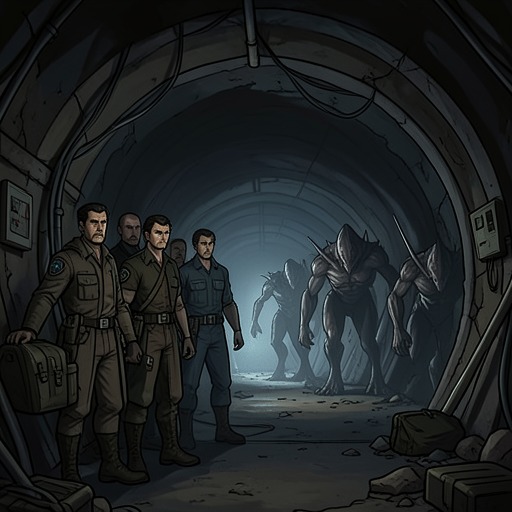
On Niflheim, the difficulty is not simply that humans and creepers have encountered one another, but that they assign different meanings to what happens between them. Mickey Barnes describes the creepers as a communal intelligence with little apparent concept of individual life. They do not seem to care about the creepers humans have killed, and they do not understand why humans care about people taken by the creepers. The dissection of several smaller creepers, which humans might regard as aggression, appears to the creepers to have been only an exchange of information. Their understanding of the smaller creatures as parts of a whole also helps explain why they assume that individual humans are likewise parts rather than independent persons.
That mismatch makes the Long Shot theory harder, not easier, to apply. Time spent near another people cannot by itself resolve a disagreement about what counts as a person, a death, or an act of war. During a conversation about someone who has died, Mickey Barnes confirms that the dead person did not trigger a weapon. That detail distinguishes a fatal outcome from a deliberate triggering of violence, but does not establish that either side shares the other’s interpretation of the encounter. In another exchange about whether communication was possible, Mickey says that he thinks the difficulty lay in both speaking and understanding, and hopes that both were involved. The hope depends on uncertainty: a failure of communication may belong to both sides, rather than being proof that contact is impossible.
Hope without assurance
The idea links the rare history of Long Shot to the unsettled human-creeper relationship without treating the situations as identical. On Long Shot, distance and time allowed a human colony to become established before it encountered native sentients. On Niflheim, contact has already brought death and mistrust, while a profound difference in social understanding complicates any attempt to name the conflict. The Long Shot example offers a reason to resist assuming that every encounter must end in war, but it does not erase the harms or guarantee that hostility will pass.
The concept’s final emphasis is therefore both practical and fragile. Time can change the circumstances under which peoples meet, and continued communication may expose where their assumptions diverge. Yet the hope that understanding can grow remains a hope, not a settled outcome. Coexistence is possible in the account because fear, distance, knowledge, and time shape contact; it is not presented as an automatic reward for simply waiting.