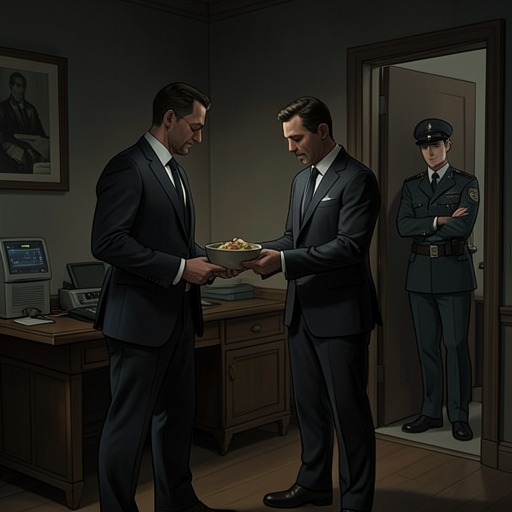
Multiple Copies Existing Simultaneously
Mickey7Multiple Copies Existing Simultaneously names the condition in which more than one living instance of a person exists at once. For Mickey Barnes and Mickey8, duplication is not merely a question of whether two bodies can share one past: it creates an immediate struggle over food, shelter, recognition, and survival in a colony already short of all four. The taboo against multiples makes their private predicament dangerous before either instance can decide what should happen next.
Definition and Social Stigma
The possibility of multiple instances follows from a society in which bodies can be bio-printed and personalities downloaded. But technical possibility does not make simultaneous copies socially acceptable. Mickey Barnes describes the Union’s attitude as so hostile that, on most colonies, a person would be better off being a serial killer or child stealer than a multiple. The comparison conveys the severity of the stigma; it does not establish that the Union treats those offenses and duplication under identical rules.
That hostility has a history. Mickey Barnes refers to serious abuses in the early days of bio-printed bodies and personality downloads, placing present-day suspicion against the background of past harm. The evidence does not detail those abuses, but it does show how their legacy shapes what people fear: a second instance is not received as an ordinary person with an unusual origin. The prospect of two copies makes identity itself socially threatening, regardless of what either individual has done.
Scarcity Makes Duplication Material
The colony’s conditions give the taboo an immediate material edge. At landfall, the base ration was fourteen hundred kilocalories a day, with bonuses tied to lean body mass and work schedule. Those rations had already been cut twice because even the hydroponic tanks struggled to grow crops. Most colonists were gaunt, and the prospect of a surplus Expendable meant another claimant on food that was already running short.
The pressure is not abstract. Mickey Barnes and Mickey8 share one berth, one ration card, and one registered identity. At the same time, neither can assume that the other will simply disappear for the benefit of the original. Mickey8 rejects the idea that he should be sent back into the biological recycler merely because the duplication was not his fault; Mickey Barnes recognizes that the dispute cannot be resolved by taking turns or casually yielding. Their existence as multiples therefore exposes a mismatch between a person’s continued life and the colony’s administrative capacity to accommodate it.
The food shortage sharpens that mismatch into a practical calculation. Mickey8 points out that discounted paste, selling for twenty-five percent less in the cafeteria, could provide twelve hundred and fifty kilocalories each if they ate nothing else. It might postpone starvation, but it cannot solve the problem of a single ration card and one berth. Material scarcity does not create the stigma, yet it gives the colony an immediate reason to treat a second Mickey as an intolerable surplus.
Concealment and the Threat of Authority
For Mickey Barnes, disclosure carries a specific danger: Hieronymus Marshall already regards him with hostility. Mickey Barnes recalls that Hieronymus Marshall learned of his encounter with Darius Blank about a week after the Drakkar left orbit around Midgard and took it as evidence that criminals had infiltrated the colony. Hieronymus Marshall also comes from a religious tradition that considers even a single person’s emergence from a tank an abomination. When Mickey Barnes first faced possible expulsion through an air lock, Mara Singh reminded Hieronymus Marshall that he did not command the mission until it made landfall on Niflheim.
That history gives Mickey8 reason to oppose taking their existence to Command. He expects Hieronymus Marshall to regard a multiple as an abomination and predicts that both copies could be killed if their status became known. Mickey Barnes likewise judges that Hieronymus Marshall might demand that Mickey8 be turned back into slurry, on the grounds that he should never have left the tank. Their decision to keep the duplication between themselves is thus not simply a refusal to follow procedure: it is a response to a credible threat from the authority that could determine which of them is permitted to live.
The danger also reaches beyond Command. After being left in the tunnels beneath the ice, Mickey Barnes considers whether Nasha should have been told that he was walking and not simply waiting to freeze. He cannot contact her through the bedrock and worries that she might attempt a rescue if she knew he was still alive. He fears that discovery of his status as a multiple could expose her to danger as well. Concealment, in this instance, is presented as both self-protection and an effort to keep someone he loves out of the consequences of his existence.
The Human Conflict Inside the Concept
The concept is most sharply dramatized not as a dispute over which copy is authentic but as a conflict between two individuals who each have a claim to continue. Mickey8’s objection is direct: the duplication is not his fault, and he does not consent to being destroyed for Mickey Barnes’s convenience. Mickey Barnes does not dismiss that claim. He recognizes the unfairness of sending Mickey8 back into the void before he has even recovered from the effects of the tank, while also fearing that disclosure would make the recycler the best outcome they could hope for.
Their predicament brings social judgment, biological technology, and colonial rationing into the same cramped space. The colony has only one registered identity for them, yet there are two people insisting on their separate survival; it has only one berth, while neither is willing to treat the other’s life as disposable. Multiple Copies Existing Simultaneously therefore signifies more than a forbidden technical accident. It names a condition in which the systems meant to classify and sustain a person cannot recognize two living claimants—and in which the taboo threatens to turn that administrative failure into a sentence of death.