Creeper Collective Consciousness
Mickey7Creeper Collective Consciousness is Mickey Barnes’s explanation for a fundamental mismatch between human and creeper ideas of life, individuality, and aggression. He understands the creepers not as a collection of separate persons but as a communal intelligence whose smaller members are parts of a whole; because they have mistaken individual humans for something similar, the two species have been interpreting encounters through incompatible social concepts.
A communal model of life
Mickey’s account is deliberately qualified: as far as he can tell, the creepers are a communal intelligence, and they do not appear to have much concept of individual life. The distinction is not simply that the creatures communicate or cooperate. In his interpretation, the small creepers seen around the dome are ancillaries—parts of the whole, not independently intelligent beings. What appears to a human observer as an encounter with a separate creature may therefore be an encounter with a component of a larger intelligence.
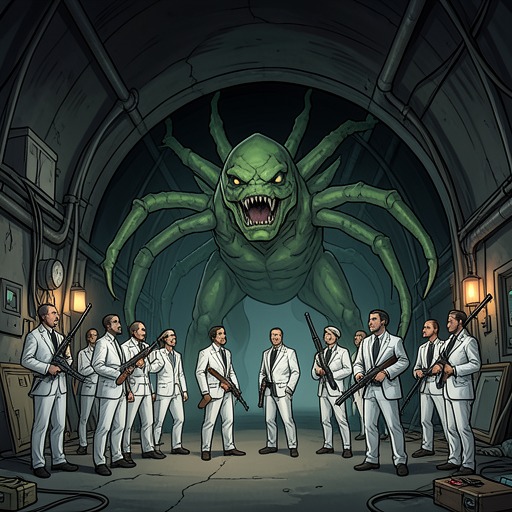
That model helps explain why the creepers seem not to care about creepers killed by humans. Mickey contrasts this with human responses to loss: Hieronymus Marshall counts five of his people killed and tells Mickey that the creepers have killed him twice, treating those deaths as evidence that the species are at war. Mickey’s answer is not that no one has died, but that the deaths do not carry the same meaning for both sides. Human concern for particular lives cannot simply be assumed to have a counterpart in the creepers’ communal way of understanding themselves.
Prime and Ancillary
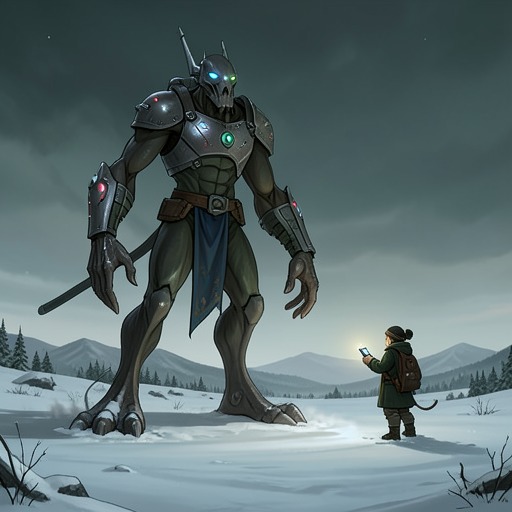
The difference becomes concrete in a tunnel exchange involving Mickey8. The creeper says that its side has destroyed the human’s Ancillary and asks whether the human is Prime. Mickey Barnes recognizes the implication: the destroyed Ancillary is Mickey8. The exchange exposes a category error between the species. The creepers appear to have placed an individual human in the position of a subordinate part, analogous to the smaller creatures they regard as members of their own whole.
Mickey8 answers that he is Prime. The creeper’s head settles onto the tunnel floor, and its mandibles close slowly, inner ones first and outer ones afterward. The account records the gesture but does not establish a definitive meaning for it. Mickey8 then says that he is also Prime and proposes that they talk. The apparent contradiction—being Prime while another Mickey is also Prime—does not prevent communication from beginning. Instead, the exchange gives both sides a chance to encounter a form of personhood that their initial categories do not readily accommodate.
Communication across a conceptual gap
The developing conversation makes clear that language alone cannot resolve the misunderstanding. Mickey Barnes says the creepers have learned surprisingly much language by snooping on his communications, but vocabulary acquired from messages does not guarantee access to the concepts behind it. He has tried to explain that humans are individuals rather than ancillary parts of a larger whole; where the creepers lack the relevant concepts, he finds that translation has limits.
The word ancillary is therefore a provisional bridge, not proof that the two species share a settled taxonomy. Mickey uses it as his best translation for what the creepers call the smaller beings observed around the dome. His explanation preserves an important distinction: those beings are, in his account, parts of the creepers’ collective and are not intelligent in themselves. The human mistake would be to hear a familiar label and assume a familiar understanding of agency, identity, or responsibility.
The exchange also leaves room for a limited act of recognition. The creepers say they are sorry, although the record does not establish that they have come to understand human individuality or the full human meaning of the harm they have caused. Their apology follows Mickey’s attempt to explain the difference; it signals communication, but not a completed translation of one species’ moral world into the other’s.
Conflict and significance
The concept changes how the preceding violence can be read. Hieronymus Marshall interprets deaths on both sides as grounds to declare war. Mickey counters that the creepers do not seem to value individual lives in the same way humans do, and that they may not understand why humans care about the people they have taken. He says that, from the creepers’ perspective, the parties have so far exchanged some information; even the dissection of several ancillaries has not registered for them as an act of aggression. The same acts can thus form a human sequence of losses and reprisals while remaining, to the creepers, something else.
This interpretation does not erase the violence or establish that the creepers are harmless. It identifies the danger of treating human social assumptions as universal: Marshall’s accounting of individual deaths and Mickey’s account of collective intelligence lead to sharply different conclusions about what has happened and what the conflict means. The Prime–Ancillary misunderstanding gives that difference a visible form, while the limits of translation prevent a quick or complete resolution. Creeper Collective Consciousness matters, then, not as an all-knowing explanation of the creatures, but as Mickey’s careful working model for why the two sides can meet, injure one another, and still fail to recognize that they are describing the same encounter.