Ship of Theseus Thought Experiment
Mickey7The Ship of Theseus Thought Experiment gives Mickey Barnes a concrete way to confront an abstract and personal question: how much can a body change before the person inhabiting it is no longer the same? Jemma uses the puzzle to explain the logic behind becoming an Expendable, comparing the body’s ordinary renewal over time with the much faster reconstruction that takes place in a tank. The ship’s replacement boards are not merely a philosophical curiosity; they make the continuity of a person’s identity feel like a practical question about accepting the job.
The Ship and Its Replacements
Jemma tells Mickey about Theseus, an ancient Earth hero who sails around the world in a wooden ship. During the voyage, damaged or worn-out boards and timbers are replaced one at a time. By the time Theseus returns, none of the ship’s original pieces remain. Jemma asks whether it is still the same ship that set out. Mickey answers immediately that it is, treating gradual repair as compatible with continuity.
She then changes the circumstances. If a storm destroys the vessel and Theseus rebuilds it all at once before sailing again, Mickey says the rebuilt ship is different: “Ship of Theseus II, the Sequel.” The distinction initially seems obvious to him, but Jemma presses on the reason for it. If every component can be replaced gradually without changing the ship’s identity, why should replacing all the components at once produce a different answer? Mickey starts to respond and realizes that he cannot explain the difference.
The contrast makes timing, rather than the material itself, the puzzle’s pressure point. In both versions, the original ship’s parts have ultimately been replaced; what changes is whether that transformation is spread across years or concentrated in a single reconstruction. Mickey’s confident first judgment gives way to uncertainty when Jemma asks him to defend the boundary he has intuitively drawn.
Jemma’s Analogy to the Expendable
Jemma connects the ship directly to Mickey’s decision to take the job. She argues that a person is also continually rebuilt, one living cell at a time: no cell in her body, she says, was alive and part of her ten years earlier, and the same is true of Mickey. Ordinary bodily change is therefore presented as a gradual version of the ship’s replacement process, not as proof that the person has disappeared.
The analogy becomes more provocative when Jemma turns from natural change to the Expendable’s trip to the tank. A reconstruction that happens all at once may look like a sharp break, but she casts it as an unusually rapid version of the remodeling that a body undergoes over time. Her conclusion depends on memory being preserved: if memory survives, she argues, the Expendable has not really died. The tank thus becomes the puzzle’s equivalent of rebuilding the ship after the storm, while the preserved memory supplies the proposed link between the former person and the reconstructed one.
Jemma does not present the analogy as a neutral abstraction. She calls it “the key to accepting this job,” making the thought experiment part of Mickey’s preparation and asking him to consider the consequences of his own future reconstruction. Her reasoning offers him a way to regard the job as continuity through accelerated change rather than as repeated death. The argument is clear, but the earlier exchange has already shown that intuitions about sameness can falter when asked to explain themselves.
Identity, Memory, and the Unsettled Question
The thought experiment distinguishes physical sameness from continuity of identity without fully resolving how either should be measured. Mickey’s answer treats gradual replacement as harmless but sudden replacement as decisive; Jemma’s challenge exposes how difficult it is to justify that distinction when the final material condition may be the same. Their conversation shifts the issue from counting original pieces to asking what makes an entity persist through change.
Memory becomes Jemma’s stated criterion for the Expendable’s survival. Her account does not establish that memory settles every version of the Ship of Theseus puzzle; instead, it applies the analogy to the specific decision before Mickey and offers continuity of memory as a reason to accept reconstruction as survival. The distinction matters: the ship puzzle creates the problem, while Jemma’s claim about memory supplies a proposed answer for the job.
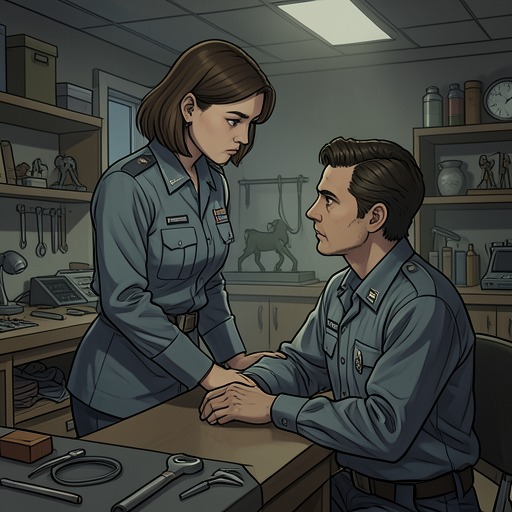
The episode also marks a change in the tenor of Mickey and Jemma’s training. After discussions of technical schematics and radiation poisoning, she turns to philosophy, which Mickey finds more suited to him. Her story first draws out his unexamined confidence, then leaves him unable to articulate its basis, and finally makes that uncertainty relevant to his choice. The Ship of Theseus Thought Experiment therefore functions both as a classic puzzle about persistence and as a rehearsal for the question Mickey must face about whether a reconstructed body can still be called his own.