Backup-Based Immortality
Mickey7Backup-Based Immortality is the system by which an Expendable’s memories are uploaded before death and used to create a successor in a biological printing tank. It keeps a person’s experiences available to the next instance, but Mickey Barnes’s account steadily separates that practical continuity from literal survival. A new body can remember the dead person’s life and take up its place among the living; for the instance facing death, that does not prove that it will wake again.
The Promise of Immortality
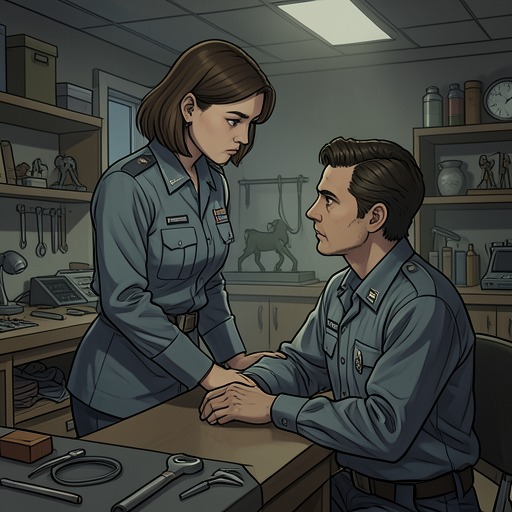
The system is presented to recruits as a route to becoming an Immortal, a reassuring label for work that may repeatedly kill its occupant. Mickey volunteered as an Expendable because he needed passage off Midgard and had no useful specialist skills to secure a berth another way. In the recruiter’s office, Gwen Johansen read through the hazards listed in his contract: external repairs in interstellar transit, exposure to local flora and fauna, medical experiments, and combat. Mickey understood, more or less, what he was signing, but the need to leave made the risk difficult to refuse.
That sales language depends on treating successive instances as one enduring person. If a body dies and a later version emerges from the tank with its predecessor’s memories, friends and colleagues can recognize the successor as the same Mickey. The procedure therefore offers a workable social and occupational continuity: the next instance can learn from the last one’s experience and resume the work. But the promise of immortality rests on an additional assumption—that the remembered life belongs to a continuously surviving self, rather than to a new person who inherits its memories.
What the Backup Preserves
Mickey describes the process through the unsettling possibility that ordinary sleep might actually mean dying while a memory-bearing replacement wakes the next morning. In his work, that imagined exchange becomes literal: crushing, vaporization, fire, or other lethal hazards can end one instance, after which another can be made. Memory is the bridge across the deaths, but it is not evidence available to the dead instance that its own consciousness has crossed with it.
His recollection of the earliest deaths makes the uncertainty concrete. Mickey remembers being Mickey1, apart from the final minutes before that instance died in a hull breach during transit. Hours later, Mickey2 woke from the tank convinced he was thirty-one and had been born on Midgard. The successor possessed the memories and convictions that made the previous life feel like his own. Mickey cannot tell whether the original Mickey Barnes was somehow looking out through those new eyes, or whether Mickey2 was simply a new person who sincerely believed he was the old one.
The system preserves what can be uploaded, not an uninterrupted record of every death. Mickey says that he remembers only what gets uploaded. Of six deaths in eight years, one was a surprise, one occurred in an emergency, and one instance refused to upload before dying; for those iterations, he knows what happened only through Nasha, Berto Gomez, or surveillance footage. The other three deaths were planned, and standard procedure placed the upload as close as possible to termination so the next Mickey could learn what had happened and perhaps avoid the same fate. The practical value of a backup is thus also a limit: the successor’s knowledge depends on what the departing instance managed to transmit.
Repetition and the Double
Repeated death does not resolve the question of identity. Mickey’s six deaths have made the sensation of approaching termination familiar, but familiarity is not immunity. Before a second Mickey existed, he could partly accept the comforting picture in which one instance closed its eyes and the next opened them. The expected gap between death and a successor allowed him to imagine the change as a single life continuing through a pause.
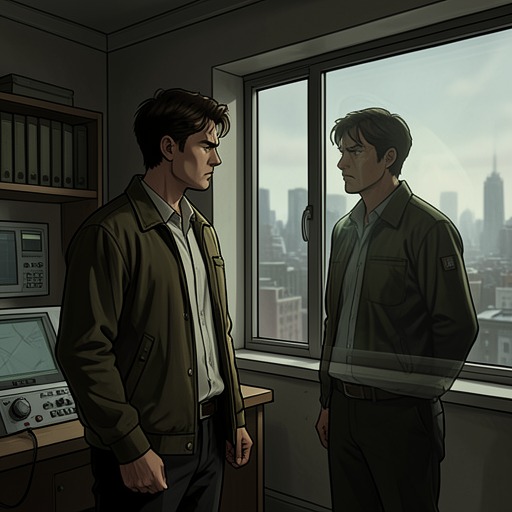
The arrival of Mickey8 breaks that picture. This time, the potential successor is already present, so Mickey must confront two instances who share a past but cannot both be the same living individual in the ordinary sense. He considers the possibility that either could die, and finds that uncertainty offers little comfort: there is hope of surviving, but also anxiety about whether he will be the one who remains. Mickey does not take the other instance’s existence as proof that his own life has been extended. He insists that Mickey8 is not his continuation, despite their shared memories and outward resemblance.
A conversation about whether he is the same person who boarded the shuttle from Midgard sharpens the distinction. Mickey first notes that the body has changed. Later, he rejects the idea that another backup would make his death inconsequential: the life he regards as his own is limited, and a future instance would be another person living in his place. His description of the two versions as mayflies turns the supposed immortality into a sequence of brief, bounded lives rather than one life indefinitely prolonged.
Consequences for the Meaning of Survival
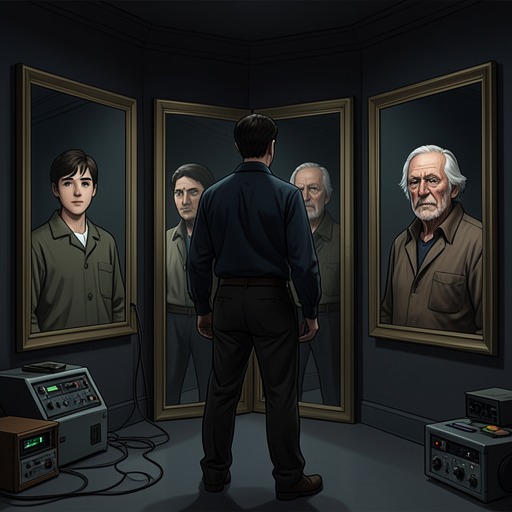
Backup-Based Immortality separates several things that ordinary language tends to fuse: bodily survival, memory, recognition by others, and continuity of consciousness. A successor may remember a predecessor, share that predecessor’s hopes and fears, and be accepted by friends as the same person. Those continuities matter to the functioning of the system, but Mickey’s doubts show why they do not settle whether the person who faced death survives it. Other people may be unable to tell the difference; Mickey nevertheless suspects that, at some level, he would know if he were the one who had died.
The concept changes in force when duplication becomes simultaneous rather than sequential. A backup produced after death can be imagined as a continuation because no competing instance is present to claim the same life. With Mickey8 already alive, that consoling interpretation becomes harder to maintain: the shared past belongs to two distinct present beings, each facing a separate future. The procedure may preserve memories and allow work to continue, but it cannot guarantee that either instance inherits the other’s first-person experience.
By the time Mickey considers what will happen if Hieronymus Marshall sends him down the corpse hole, the original promise has lost its power over him. Whether another version might later emerge from the tank no longer answers the question that matters to the instance now confronting death. Backup-Based Immortality is therefore both a survival technology and a crisis of definition: it can reproduce a life’s memories, while leaving unresolved whether memory’s bearer is the person who lived that life—or a successor who has inherited its story.