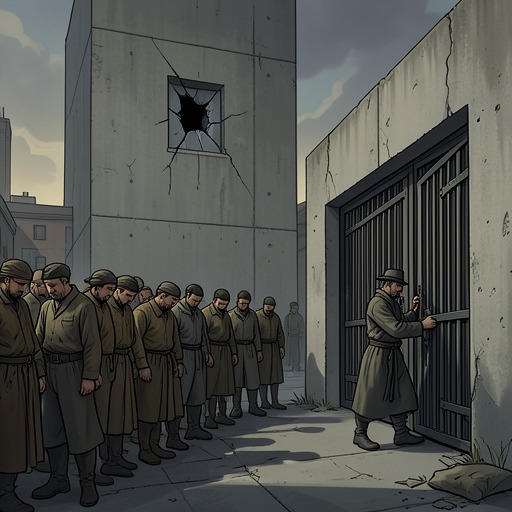
Natalist Doctrine of the Unitary Soul
Mickey7The Natalist Doctrine of the Unitary Soul makes the conflict over copied lives more than a technical or personal dispute: it treats the death of an original body as the death of the person’s soul, and a restored copy as something less than human. Through Hieronymus Marshall’s faith and Mickey Barnes’s uncertainty about surviving his own deaths, the doctrine turns the mechanics of backup into a question of who counts as a person—and who has the power to decide.
The Doctrine and Its Meaning
The doctrine is presented as a prime tenet of the Natalist Church: the soul is unitary, belonging to one body rather than passing into a replacement. Its consequence for backup-based revival is stark. Once the original body dies, the soul is considered dead too; a bio-printed body carrying a personality imprinted from backup is consequently regarded as soulless, an abomination, and not fully human. The disagreement is therefore not simply about whether a copy remembers the original life. It is about whether memory and personality can preserve the person when the original body has ended.
Mickey Barnes initially does not understand why Hieronymus Marshall’s religion matters to him. Dugan calls the Natalists a cult, while Bree corrects him, insisting that it is a serious religion and that she had checked the beliefs of the command staff before signing on. Her explanation supplies the doctrine’s practical force: to an adherent, a restored individual is not the original person returned to life, but a body inhabited by a copied personality without that person’s soul. The difference between those descriptions is the difference between a legitimate human life and an existence the doctrine rejects.
Hieronymus Marshall and the Threat of Enforcement
The belief affects Mickey Barnes’s standing in the colony because Hieronymus Marshall is not merely acquainted with Natalist ideas; he is described as a serious believer. Before the mission reaches Niflheim, Marshall already interprets Mickey Barnes’s encounter with Darius Blank as evidence that a criminal element has entered the colony. Set alongside his rejection of pulling people out of the tank even one at a time, that suspicion brings Mickey Barnes close to being expelled through an air lock.
That outcome is prevented when the Drakkar’s captain, Mara Singh, reminds Marshall that he is not yet in command of the mission: his authority begins only after the ship makes landfall on Niflheim. The intervention blocks immediate action but does not reconcile the disagreement or remove the danger. Later, when Mickey Barnes and Mickey8 are both present, Mickey Barnes expects that discovery of the second instance would make their position worse. He understands that Hieronymus Marshall already resents having even one Mickey Barnes in the colony; the possibility of two makes the cycler seem like their best-case outcome. The doctrine thus becomes a material threat through the commander’s authority, not just a theological judgment about what a backup means.
Backup, Memory, and the Question of Survival
Mickey Barnes’s own account gives the doctrine a competing, intimate frame. He describes a life in which death can follow crushing, vaporization, fire, or dangerous tests, after which another version can be made. He remembers what Mickey1 did and feels that he remembers being him, apart from the final minutes before death. After a hull breach during transit, Mickey2 woke hours later believing himself to be thirty-one and to have been born on Midgard. Mickey Barnes cannot determine whether that continuity makes Mickey2 the original person or only someone who possesses his memories.
The apparent continuity is substantial but incomplete. Mickey Barnes says that he has died six times in eight years. Some deaths were planned, while others were unexpected or occurred in emergencies; one instance refused to upload before dying. Since he remembers only what is uploaded, the missing experiences reach him through Nasha, Berto Gomez, or surveillance recordings. Planned termination therefore includes an upload close to the moment of death, so the next instance can learn what happened and perhaps avoid repeating it. The procedure preserves information and a chain of remembered experience, but it cannot make every death an experience the later Mickey Barnes remembers from the inside.
That gap keeps the doctrine’s central claim unsettled for Mickey Barnes. Friends and loved ones might be unable to distinguish a replacement from the person they knew, and the replacement might sincerely possess the same memories and hopes. Yet social recognition and psychological resemblance do not answer whether the original consciousness continues. Mickey Barnes imagines that another instance could wake with his memories, while suspecting that he himself would know, beneath reason, that he had died. The doctrine gives religious form to this fear without proving it; the lived evidence of memory supports continuity, while the possibility of an unrecorded final moment threatens to break it.
The Crisis of Personal Identity
The contrast becomes explicit when Mickey Barnes is asked whether he is the same person who boarded the shuttle from Midgard. His first answer is that the body is obviously different, but this does not settle the deeper question. When he turns to Mickey8, he rejects the idea that their shared past makes them one person: Mickey8 is not him. The distinction does not depend on a lack of shared memories. Rather, each has a separate present and a life that can end independently of the other’s.
Mickey Barnes consequently comes to regard the promise of immortality through repeated backups as false. He describes his own recent weeks, and Mickey8’s shorter span, as finite lives rather than stages in an uninterrupted existence. Even if another version is printed after their deaths, that future instance will not, in Mickey Barnes’s view, be either of them. This is close to the Natalist Doctrine’s refusal to equate a backup with the original person, but the grounds differ: the doctrine makes the soul’s attachment to the original body decisive, while Mickey Barnes reaches his conclusion through his sense of individual experience and the limits of what memory can carry.
The doctrine’s narrative significance lies in this unresolved opposition. Backup technology asks whether memory, personality, and causal connection are enough to sustain identity; Natalist belief supplies a firm answer by denying that a copy can inherit the original soul. Mickey Barnes’s repeated deaths make that answer personally urgent, while his reflections expose what neither religious certainty nor technical procedure can demonstrate: whether the person who wakes after a death is the one who went to meet it.