Personal Identity and Continuity of Consciousness
Mickey7Personal Identity and Continuity of Consciousness is the problem at the heart of Mickey Barnes’s existence as an Expendable: when a body dies and a new one wakes with its memories, has the same person survived, or has a successor inherited the conviction that he is the original? The colony’s procedures and Jemma’s philosophical reassurance treat memory as a bridge across death; Mickey’s experience makes that bridge uncertain. The distinction becomes urgent when Mickey8 is already alive beside him, turning an abstract question about backups into a conflict between two people who each claim a life as their own.
Memory as a Test of Survival
Mickey frames the dilemma through an imagined nightly death and replacement. The next person would wake with the sleeper’s hopes, fears, wishes, and memories, and would be accepted by friends and loved ones as the same individual. From the outside, there might be no practical way to tell that the first person had ceased to exist. Mickey connects this thought experiment directly to the Expendable’s work: he is sent into lethal situations, from reactor trouble to testing a questionable vaccine, because another version can be made if he dies. The arrangement makes continuity appear operationally simple while leaving the identity of the person who pays the cost unresolved.
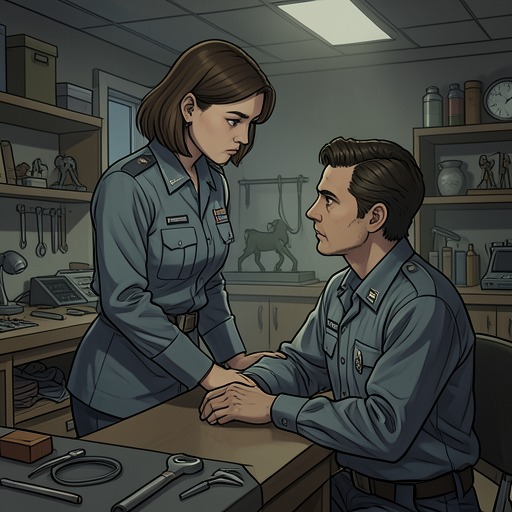
His own history seems at first to support the system’s promise. Mickey recalls that Mickey1 died after a hull breach in transit and that Mickey2 woke hours later believing himself to be thirty-one and to have been born on Midgard. Mickey can remember being Mickey1, though not the final minutes of that life. He cannot establish whether those memories mean the original Mickey Barnes continued, or whether a new person began with a convincing record of the past. The memories preserve an account of a life; they do not settle who experienced it.
That uncertainty is not merely theoretical for him. At one point, alone in a cavern, Mickey considers that if he dies there he might wake as Mickey8, but doubts that this would make the transition real. Nasha and Berto might not detect a difference, he thinks, yet he believes that at some level he would know he had died. The contrast is crucial: recognition by others and the successful transfer of memories may establish social and psychological continuity without answering whether the consciousness that ends is the consciousness that resumes.
The Colony’s Reassurance and Its Limits
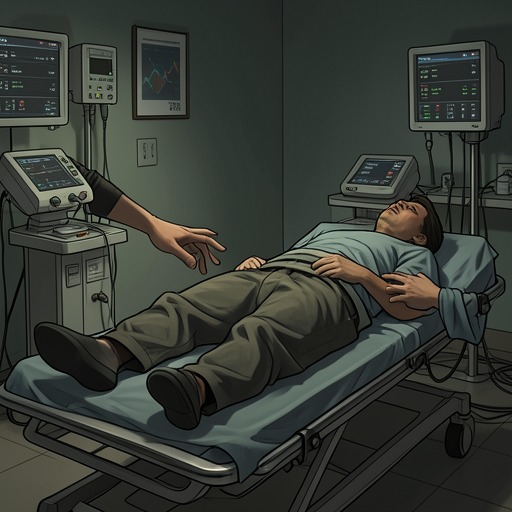
The colony’s working model relies on uploads and regeneration. Mickey reports six deaths over eight years. Of those, one was a surprise, one an emergency, and one involved an iteration who refused to upload before dying. Mickey therefore knows only what Nasha or Berto told him, or what surveillance footage showed, about those lives. In the other three cases, death was planned, and procedure called for the Expendable to upload as close to termination as possible so the next iteration could learn what happened and, ideally, avoid repeating it. Memory transfer serves a practical purpose: it gives the successor information from the predecessor’s experience. It does not provide Mickey with direct access to the moments that were not uploaded.
Jemma supplies a more reassuring analogy when explaining the job. Every living body changes over time, she argues; a person is rebuilt one component at a time, like the Ship of Theseus. An Expendable’s trip to the tank could then be understood as the same remodeling compressed into a single event. If memory is preserved, she reasons, the person has not really died. This account makes bodily continuity less decisive: gradual replacement and sudden reconstruction differ in speed, not in kind.
The analogy offers a way to accept the work, but it does not resolve the difference between one changing person and two simultaneous claimants. Mickey’s earlier deaths could be imagined as closing his eyes and opening them again after a successor emerged from the tank. With Mickey8 already present, that imagined gap no longer holds. Mickey describes a fifty-fifty chance of surviving their confrontation, and finds the uncertainty unsettling: the possibility of survival offers hope but also anxiety, whereas a known death had at least been definite. More fundamentally, if he dies now, another version does not need to emerge later; the other Mickey is already there. For Mickey, that makes the colony’s assurance harder to believe, not easier.
The Duplicate as a Direct Challenge
The question is tested again in a conversation about whether Mickey is the same person who boarded the shuttle from Midgard. He acknowledges that the body is not the same. That answer leaves open the possibility that some other continuity—memory, character, or consciousness—preserves identity across bodily change, but the exchange does not establish which one. The colony’s practical confidence and Mickey’s personal uncertainty remain side by side.
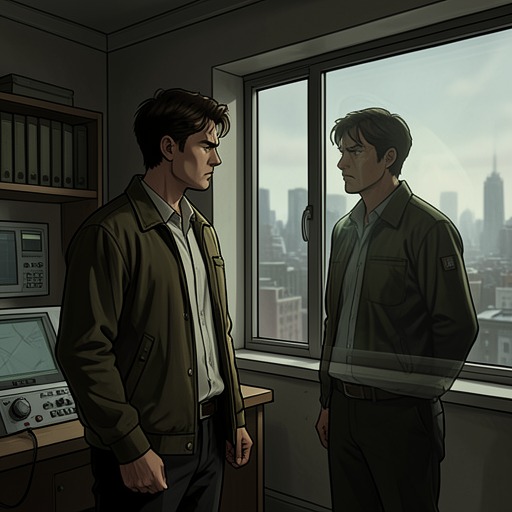
Mickey eventually states the distinction to Mickey8 without relying on the claim that they merely look different: Mickey8 is not him. He rejects the earlier reassurance that memory-preserving regeneration amounts to immortality and treats the two copies as separate lives. In his account, the past six weeks are the only life he gets, while the last few days are the only life Mickey8 gets. The difference in their remembered spans underscores that shared origins do not make their present experiences interchangeable. Each has a life that can end.
That conclusion acquires material force in Mickey’s reference to Marshall sending them down the corpse hole. Whether or not another Mickey is later brought out of the tank, Mickey says, that successor would be another person, one who slept in his bed, ate his rations, and handled his belongings. The ordinary objects sharpen the philosophical distinction: continuity cannot be established simply by inheriting someone’s place, possessions, or social identity. A restored person may occupy the predecessor’s world while remaining, in Mickey’s judgment, someone else.
Continuity Without Certainty
The novel does not supply an external test that proves whether an uploaded consciousness is numerically identical to its predecessor. Instead, it presents several kinds of continuity that overlap without becoming equivalent: bodily change over time, preserved memories, the stories other people tell about a person, and the first-person conviction that a life is one’s own. The colony’s routines depend on the first three being enough to make restoration workable. Mickey’s fear of death and his refusal to call Mickey8 a continuation insist that these practical measures cannot guarantee the fourth.
The concept also changes with circumstance. Before another copy exists at the same time, regeneration can be imagined as a break bridged by memory; the successor’s apparent seamlessness makes the question difficult to test. Once Mickey8 is present, the break has a visible counterpart, and the two versions’ claims cannot be collapsed into a single body or a single ongoing experience. The resulting crisis is not only whether memory survives, but whether survival belongs to the person who remembers or merely to the person who wakes.
Mickey’s account remains a judgment grounded in his own experience, not a proof that every restored iteration lacks continuity. That unresolved tension is the point: he can remember earlier Mickeys, yet cannot verify that he is the original; the colony can restore an information-rich successor, yet cannot make the death of the predecessor disappear. Personal Identity and Continuity of Consciousness thus turns the Expendable’s apparent immortality into a dispute over what memory can carry—and what it cannot promise to preserve.