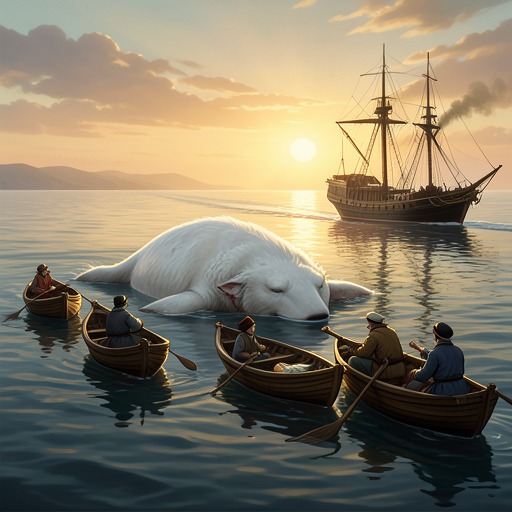
Ahab's harpoon
Moby-DickAhab's harpoon is the weapon Captain Ahab commissions for his final pursuit of the White Whale, and its making converts personal obsession into a tangible instrument. It is not an ordinary harpoon taken from the ship's stores: Ahab demands that Perth forge it from exceptional materials, joins his own labor to the blacksmith's craft, and gives the finished weapon a ritual tempering in human blood. The harpoon therefore belongs simultaneously to the worlds of maritime technology, bodily violence, religious inversion, and tragic destiny.
Purpose and Commission
Ahab orders the weapon when the ordinary instruments of the fishery no longer seem adequate to his purpose. Speaking to Perth, he asks for a harpoon that a thousand demons could not separate from its target and produces the gathered nail-stubs from the steel shoes of racing horses as its raw material. He directs Perth first to forge twelve rods for the shank, then to wind, twist, and hammer them together like the strands of a tow-line. The comparison is practical as well as symbolic: the weapon is meant to possess the binding strength of the very line that will connect Ahab's body and will to the whale.
Ahab tests the rods individually by spiraling them around a heavy iron bolt and rejects one as flawed, requiring Perth to rework it. When the rods are ready to be welded into a single shank, Ahab stops the blacksmith and undertakes the welding himself. His strenuous hammering makes the manufacture a scene of personal investment rather than delegated labor. The weapon is being made under his authority, but also through his body, as though the captain must physically impress his purpose into the metal before it can be trusted.
Materials and Construction
The harpoon's design combines iron, steel, wood, and rope into one inseparable apparatus. The twelve rods become a single shank; Perth fashions its barbs from Ahab's razors, the finest steel available to him, and sharpens them to the needle-like keenness Ahab demands. A hickory pole, still covered with bark, is fitted into the iron socket. New tow-line is then unstranded at one end, braided around the socket, and secured along half the pole with intertwined twine. The completed weapon thus consists not merely of a point and shaft but of a connected system: pole, iron, and rope are made to remain together like the Three Fates.
The construction also exposes the danger that Ahab is manufacturing for himself. When Perth plunges the heated shank into water for tempering, the resulting steam strikes Ahab's face, and Ahab momentarily wonders whether he has forged his own branding iron. The accident folds the captain's damaged body into the weapon's history. His ivory leg already records an earlier encounter with the White Whale; the new harpoon, made amid pain and pressure, threatens to become another mark of the same pursuit.
Blood Tempering and Ritual Inversion
Ahab refuses ordinary water for the final tempering of the barbs. Instead, he calls for Tashtego, Queequeg, and Daggoo and asks them to provide enough blood to cover the iron. The three harpooneers puncture their flesh, and the barbs are tempered in their blood. This collective act gives the weapon a shared material origin, but Ahab's command also makes their bodies instruments of his private vendetta. The harpoon is consequently both communal and authoritarian: it bears the blood of the crew, yet exists to serve the captain's singular purpose.
Ahab then gives the process an openly blasphemous form. Rather than baptizing the weapon in a Christian name, he deliriously declares that he baptizes it in the name of the devil. The language reverses a sacrament and replaces spiritual consecration with murderous dedication. Blood, iron, heat, and speech combine to make the harpoon a counter-religious object, one whose sacred value lies in its promised capacity to reach the White Whale rather than in any power of redemption.
Use in the Pursuit of the White Whale
Once completed, the harpoon accompanies Ahab through the Pequod's expanding pursuit. The weapon's significance is sharpened by the ship's technical environment: the crew handles whale-lines, tackles, buckets, and other instruments whose materials and failures determine whether human bodies live or die. Against this practical background, Ahab's harpoon is unusually personalized. It is built for one enemy, by one captain's order, and shaped around a single imagined strike.
Ahab later presents the harpoon as if it already contains the White Whale's death. When Perth speaks of the danger surrounding the dead men being buried, Ahab seizes the blacksmith's iron and insists that, in his hand, he holds the whale's death. He claims that the barbs have been tempered in blood and lightning and vows to temper them again in the place behind the whale's fin where the White Whale most feels its life. The weapon is therefore treated not as a possibility but as a material guarantee, even though its power remains dependent on aim, distance, rope, whale, and chance.
During the climactic pursuit, Ahab casts the harpoon into the White Whale. When the line is lost and the weapon disappears into the fish, he reacts as though both his instrument and the meaning of the chase have been torn away. He quickly recognizes that the forged iron is still in the whale and orders the men to keep the creature nailed while they gather the boats, oars, and harpoons. The lost or embedded weapon does not end his pursuit; it intensifies it, driving him to promise that he will circle the globe and dive through it if necessary to kill the whale.
Symbolic and Narrative Significance
Ahab's harpoon condenses the captain's relation to the White Whale into an object that is at once tool, weapon, relic, and extension of the body. Its horse-shoe steel carries the violence of racing animals; its razors are surrendered from Ahab's own daily use; its blood tempering binds it to the harpooneers; and its hickory shaft and whale-line make it part of the ship's wider apparatus. Each material is practical, yet the assembled object exceeds practical whaling because Ahab has loaded it with a private metaphysics of revenge.
Its relation to the whale-line also exposes the paradox of Ahab's power. The harpoon appears to make him sovereign over the White Whale, but it can only act through connection, and that connection can recoil upon the men who create and cast it. The same technological chain that allows Ahab to strike the whale can entangle the crew and drag a man beneath the sea. In this sense, the weapon embodies the broader danger of the voyage: human skill does not abolish dependence on the whale, the sea, or the unpredictable behavior of rope and body.
By the end, the harpoon has become inseparable from Ahab's self-conception. He speaks as though the weapon contains the White Whale's death and as though the completed act has been ordained before the ocean existed. The harpoon's physical construction and its final use thus mirror the captain's tragic logic: carefully made, intensely controlled, and ceremonially charged, it is nevertheless carried into a field where control collapses. Its failure to secure victory does not make it insignificant. It is the material form of Ahab's refusal to accept limitation, and it helps turn a piece of whaling equipment into the emblem of a pursuit that consumes the captain, the crew, and the ship.