Yojo
Moby-DickYojo is Queequeg’s small black wooden idol, a portable figure that gives material form to his religious life and becomes one of the most revealing objects in the early narrative. Ishmael first encounters it as an unfamiliar sacred image, but Yojo soon proves to be more than a curiosity: it organizes Queequeg’s ritual practice, influences the choice of the ship on which the two men will sail, accompanies Queequeg through illness and the preparation of his coffin, and helps transform Ishmael’s fear of the unfamiliar into fellowship across religious and cultural difference.
Appearance and First Ritual
Yojo appears as a “curious little deformed image with a hunch on its back,” small enough to be carried in the pocket of Queequeg’s heavy grego. Its dark color and polished ebony-like surface initially confuse Ishmael, who briefly mistakes it for an embalmed infant. Queequeg places the figure between the andirons in the inn’s empty fireplace, turning a sooty domestic recess into a temporary shrine. The setting is improvised but treated as sacred: the ordinary fireplace becomes a chapel, and the black wooden figure becomes the center of a deliberate rite.
Queequeg lays shavings before Yojo, places ship biscuit on them, and kindles the shavings into a sacrificial blaze. After repeatedly reaching into the fire and scorching his fingers, he retrieves the biscuit, blows away the heat and ashes, and offers it to the idol while making guttural, chant-like sounds. The biscuit is not accepted in any visible way, yet the offering remains meaningful as an act of devotion. When the rite ends, Queequeg extinguishes the fire and returns Yojo to his pocket as casually as a sportsman putting away a tool. The contrast between elaborate ritual and practical concealment makes the idol both sacred object and traveling possession.
Yojo and Ishmael’s Change of Perspective
After Ishmael returns from the Whaleman’s Chapel, he finds Queequeg alone at the Spouter-Inn, holding Yojo close to his face and gently whittling the idol’s nose with a jack-knife while humming in his own manner. The scene preserves the intimacy of Queequeg’s devotion but also shows that Yojo is not treated as an untouchable museum piece. The idol can be inspected, altered, carried, and handled within an everyday routine; its sacredness is lived through repeated contact rather than separated from ordinary life.
Yojo becomes central to Ishmael’s moral reconsideration of religious difference. Queequeg invites Ishmael, through signs, to join the evening worship. Ishmael hesitates because he has been raised in the Presbyterian Church and regards participation before a wooden idol as incompatible with Christianity. He then reasons that worship consists in doing God’s will, that God’s will is expressed through treating one’s fellow human being as one wishes to be treated, and that Queequeg is his fellow man. On that basis, Ishmael lights the shavings, helps support Yojo, offers the burnt biscuit, salutes the figure, and kisses its nose alongside Queequeg. The action does not erase the difference between their beliefs; it converts that difference into an occasion for reciprocal respect.
The object therefore exposes the instability of Ishmael’s initial classifications. He first reads Yojo as proof of heathenism and Queequeg as a threatening savage, but the idol becomes part of the evidence through which he recognizes Queequeg’s honest heart, courage, dignity, and capacity for friendship. Yojo’s presence does not simply mark Queequeg as foreign. It also reveals the prejudicial assumptions through which Ishmael has been interpreting him.
Prophecy and the Choice of a Ship
Yojo is not only an image used in sacrifice; Queequeg also treats it as a source of counsel. While Ishmael and Queequeg are planning how to choose a whaling vessel, Queequeg explains that he has consulted Yojo repeatedly. The idol has strongly instructed him that the selection of the ship should rest wholly with Ishmael rather than with Queequeg, because Yojo intends to befriend them and has already determined that Ishmael will, apparently by chance, choose the proper vessel.
Ishmael dislikes this arrangement. He has relied on Queequeg’s practical judgment to identify the ship best suited to carry them and their fortunes safely, and he finds it unsettling that a wooden idol should displace that judgment. Nevertheless, Queequeg’s confidence in Yojo’s foresight prevails, and Ishmael agrees to act according to the instruction. Yojo thus enters the causal structure of the voyage: the idol’s supposed prophecy shapes the men’s immediate decision and helps place Ishmael on the Pequod. Its authority operates through Queequeg’s faith, but its consequences are concrete and nautical rather than merely ceremonial.
The episode also complicates the distinction between chance and providence. Yojo promises that Ishmael’s selection will look accidental even though it has been divinely guided. The result is a layered form of causation in which personal choice, religious consultation, and apparent coincidence coexist. Yojo’s power is never established as an objective supernatural fact, but the belief in its power changes behavior and therefore changes the course of the narrative.
Crisis, Stillness, and the Coffin
Yojo remains with Queequeg during another striking ritual episode at the inn. When Ishmael and the landlady force open the locked room, they find Queequeg sitting perfectly composed in the middle of the room, squatting on his haunches with Yojo balanced on top of his head. He appears almost like a carved image himself, motionless and scarcely alive. The arrangement reverses the usual relation between worshipper and idol: Queequeg’s body becomes a pedestal, while Yojo is visibly enthroned above him. The scene makes his religious concentration appear at once comic, mysterious, and unnerving to observers who do not understand it.
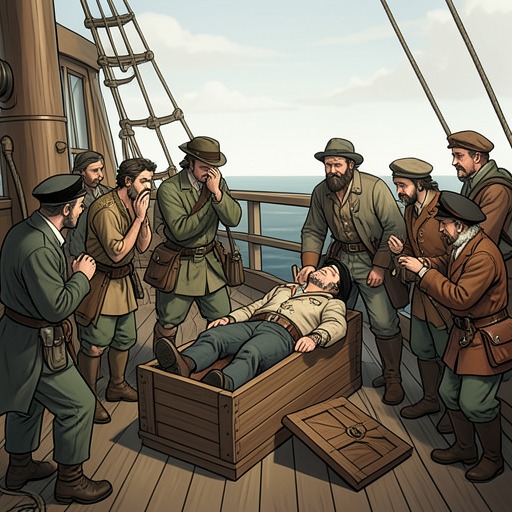
Yojo’s deepest association with mortality appears when Queequeg, believing himself near death, claims the coffin that has been built for him. He places the iron part of his harpoon inside it with one of his boat paddles, orders biscuits around the sides, has fresh water set at the head, and adds a small bag of woody earth from the hold at the foot. He then asks for Yojo and lies in the coffin with the idol between his crossed arms. With the lid closed over him, he calmly declares that the arrangement will do and is easy before returning to his hammock.
Here Yojo is not an ornament placed beside the dying man but a companion carried into the imagined final passage. The coffin contains tools, food, water, earth, and the idol: practical provisions and sacred protection occupy the same compact space. Queequeg’s ritual gives the coffin an immediate trial as both burial vessel and possible dwelling, while Yojo remains the intimate center of that preparation. Pip’s approach, hand clasped in one hand and tambourine in the other, further frames the scene as one of emotional recognition rather than mere superstition.
Meaning and Narrative Function
Yojo’s narrative importance lies in the way it makes religion material, portable, and relational. Unlike the institutional preaching heard in the Whaleman’s Chapel, Queequeg’s worship is conducted with an idol, fire, food, chant, bodily gesture, and repeated handling. The contrast does not simply establish a hierarchy between Christianity and paganism. Ishmael’s response to the chapel’s account of Jonah already places sea life within a dense field of biblical and prophetic imagery, while the wider discussion of whaling connects the profession with Jonah, Perseus, St. George, Hercules, and Vishnoo. Against that comparative religious background, Yojo becomes one local and personal form within a much larger human tendency to interpret the sea through sacred stories and ritual objects.
The idol also stands beside the book’s recurring uncertainty about what can be known. Ishmael cannot master Queequeg’s liturgies, cannot determine whether Yojo truly predicts events, and cannot convert the figure into a stable category such as “mere wood” or “true god.” Its meaning is produced through use: it directs attention, organizes conduct, authorizes decisions, accompanies friendship, and steadies Queequeg before death. Even when its supernatural status remains unverified, its practical effects are unmistakable.
Finally, Yojo helps turn Ishmael and Queequeg’s friendship into an ethical experiment. Ishmael does not become a permanent idolator, nor does Queequeg abandon Yojo for Ishmael’s Presbyterian faith. Instead, each man enters the other’s ritual world sufficiently to acknowledge the other’s humanity. The small black figure that first intensifies Ishmael’s fear ultimately participates in the friendship that carries both men toward the sea, making Yojo a compact emblem of the narrative’s challenge to rigid divisions between civilized and savage, Christian and pagan, object and living presence.