quadrant
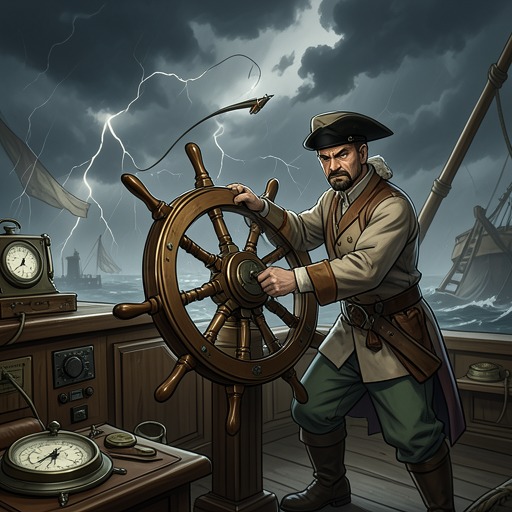
Moby-DickThe quadrant is a shipboard instrument for taking the sun’s altitude and calculating a vessel’s latitude. On the Pequod, it serves Captain Ahab not merely as practical equipment but as a contested instrument of knowledge: it can establish where the ship is, yet it cannot disclose where the ship will be or where Moby Dick is. Ahab’s destruction of it therefore marks a crucial reversal in his relation to navigation, science, and uncertainty.
Definition and Shipboard Use
The instrument belongs to the practical apparatus of ocean travel. The Pequod ordinarily relied on several means of determining her position, including the compass, dead reckoning, the log, and the line. The quadrant offered a different kind of authority by directing the navigator’s sight upward toward the sun. Its operation depended on a precise observation: Ahab watched the sun until it reached the meridian, then used the instrument’s readings to calculate his latitude.
The quadrant’s function is sharply distinguished from the instruments and practices that surround it. Ahab’s charts allowed him to plot courses through the four oceans, while knowledge of tides, currents, seasons, and the migration of the Sperm whale enabled him to estimate where Moby Dick might appear. The quadrant could locate the Pequod on the planet; it could not locate the whale, predict the next day’s drift of a grain of sand, or convert possibility into certainty. Its technical usefulness thus coexists with an inescapable epistemic limit.
Ahab’s Meridian Observation
As the Season-on-the-Line approached, Ahab brought the Pequod toward the equator and took his customary observation from a high-hoisted boat. The Japanese sea was described as intensely radiant, so the quadrant was fitted with coloured glasses to protect his eyes while he sighted the sun. Seated in the boat and holding the instrument to his eye, Ahab waited for the exact meridian moment; after making the observation, he used a pencil on his ivory leg to calculate the ship’s latitude.
The scene places the instrument within a charged arrangement of bodies and technologies. Ahab’s ivory leg, itself made from the jaw of a Sperm whale, supports the hand that performs the calculation, while Fedallah kneels below him and watches the same sun with a different, inwardly controlled attention. The quadrant appears to promise disciplined orientation, but the scene also makes visible the material substitutions and vulnerabilities beneath that promise: Ahab’s body is altered, the ship rolls, the sun scorches, and the observer must rely on a device whose accuracy cannot exceed the question it is asked to answer.
The Instrument’s Destruction
After determining his latitude, Ahab turns from location to destiny. He addresses the sun as a guide that can tell him where he is but cannot offer the least hint of where he will be or where Moby Dick is living at that instant. The quadrant has answered its proper navigational question, yet that answer intensifies rather than satisfies Ahab’s larger demand. He wants not only position but knowledge of an absent creature and mastery over the future.
Ahab therefore condemns the instrument as a foolish toy, a plaything of Admirals, Commodores, and Captains. In his judgment, it can report only the point where the observer happens to stand and the hand that holds it. He rejects its upward orientation as an insult to the sun and declares that he will instead guide the Pequod by the level ship’s compass, dead reckoning, log, and line. He then dashes the quadrant onto the deck and tramples it with both his live and dead feet.
The destruction is not a quiet abandonment of one method for another. It is a theatrical act before the crew, combining contempt for scientific limitation with an assertion of command. The seamen gather in awe, while Fedallah silently withdraws. Ahab’s action attempts to make the broken instrument a proof of his sovereignty, but its smashed tubes remain as material evidence that his will has collided with the world it seeks to command.
Failure, Recurrence, and Consequence
The quadrant does not disappear from the narrative when it breaks. The next day, after the compasses have been mysteriously inverted, Ahab notices the crushed copper sight-tubes on the deck and recalls his previous oath concerning the level log and line. He interprets the reversal as a contest between instruments: the quadrant had been wrecked by his own hand, while the compasses now seem to have turned against him. Even so, he insists that he remains master of the level loadstone and orders tools with which he can address the damaged navigation equipment.
The episode exposes a chain of dependence that Ahab’s defiance cannot escape. He destroys the upward-looking instrument, then must confront the failure of the horizontal compass; afterward, the neglected log and line are brought back into use. The Pequod had long relied on alternative estimates and had allowed the wooden reel and angular log to decay beneath the after bulwarks, but Ahab’s remembered oath makes the old equipment newly significant. The quadrant’s destruction consequently redirects attention toward the ship’s other instruments without restoring certainty.
Its loss also belongs to the voyage’s larger sequence of damaged or inadequate material supports. The Pequod’s boats are battered in the Typhoon, Ahab’s boat is stove at the stern, and a life-buoy later shrinks and fills with water before sinking with a fallen sailor. In this world, equipment is never merely background: its material condition can expose human confidence, frustrate rescue, or alter the course of action. The quadrant is distinctive because its break is deliberate, yet the consequences resemble those of accidental failure. It becomes conspicuous precisely when it ceases to function.
Symbolic and Narrative Significance
The quadrant embodies the tension between measurable position and unknowable destiny. Ahab’s charts and navigational calculations allow him to make the search for Moby Dick methodical: currents, feeding grounds, migratory veins, and the Season-on-the-Line transform the open ocean into a partially legible field. The quadrant belongs to that same project of ordering space. But unlike the charts, which Ahab repeatedly revises in solitude, it cannot be forced to yield more than its design permits.
Its destruction therefore crystallizes Ahab’s monomania. He does not reject navigation because the instrument is useless; he rejects it because it is useful only within boundaries that his revenge refuses to accept. The quadrant can tell him where he is, but not where his enemy is, what the future holds, or whether the next encounter will occur. Ahab converts that limitation into an insult and responds by breaking the device rather than accepting the incompleteness of knowledge.
The object also binds bodily damage to technological authority. Ahab calculates on his ivory leg, made from the jaw of a Sperm whale, then crushes the quadrant while standing on that same transformed limb. His prosthesis and his instrument are both products of material substitution, but they carry opposite meanings in the scene: the ivory leg sustains his command, while the quadrant becomes the defeated emblem of a system he believes has failed him. Through that contrast, the instrument helps stage Ahab’s fatal pride—not as the absence of knowledge, but as the refusal to recognize where knowledge ends.