whale-line
Moby-DickThe whale-line is the essential working rope of the whaleboat and one of the most powerful objects in the Pequod’s world. It fastens the hunters to their prey, but its connection is never merely secure: the same line that makes pursuit possible can seize a limb, drag a boat under, or turn an ordinary rowing crew into a company already wearing “hangman's nooses.” Its material construction, elaborate deployment, and lethal volatility make it both a technology of whaling and a figure for the invisible dangers binding human lives together.
Construction and Storage
The whale-line was originally made from the best hemp, lightly treated with tar rather than saturated with it. Ordinary tar made rope more pliable and glossy, but excessive tar stiffened the line and did not reliably improve its strength or durability. In the American fishery, Manilla rope increasingly replaced hemp because it was stronger, softer, and more elastic, as well as more visually attractive aboard the boat.
Despite its formidable function, the line was only two-thirds of an inch thick. Its fifty-one yarns could each suspend one hundred and twenty pounds, giving the whole rope a carrying capacity of nearly three tons. A common line for a Sperm whale measured more than two hundred fathoms. It was coiled in the stern tub into a dense, cheese-shaped mass of concentric layers, with a minute central tube rather than an open hollow. Any wrinkle or kink could become fatal when the rope ran out, so harpooneers might spend almost an entire morning lifting it aloft and feeding it downward through a block to remove every twist.
American boats generally carried one large tub, nearly three feet across and proportionately deep; English boats used two smaller tubs, which fitted the craft more easily and distributed the weight more safely. The American tub could look like a great wedding cake beneath its painted canvas cover, but the appearance concealed a severe structural problem: the whale-boat’s thin bottom could bear distributed weight while resisting concentrated pressure only poorly.
Deployment and Mechanical Danger
Both ends of the whale-line remained exposed. Its lower end ended in an eye-splice that hung free from the side of the tub. This allowed another boat to attach an additional line if a whale sounded deeply enough to exhaust the first one. It also prevented the boat from being directly tied to the whale: if the animal ran out the entire line in a single burst, an attached boat would be dragged into the depths with it.
Before the boat was lowered, the upper end was taken aft around the loggerhead, then carried forward across the handles of the oars. It passed between the alternating rowers, entered the chocks at the sharply pointed bow, crossed the bows in a slight festoon, and returned inside the boat as box-line before joining the short-warp connected with the harpoon. The rope therefore did not simply lie in one place. It folded the entire boat into a network of crossings, turns, and suspended lengths, putting every oarsman within reach of its motion.
This arrangement made the line resemble a living danger before the hunt had even begun. To an inexperienced observer, the rowers appeared like jugglers festooned with deadly snakes. The danger increased when the line ran out: the boat rocked unpredictably, and the men could not remain motionless while rowing and adjusting themselves to the motion. A moment of failed coordination could make a sailor a human projectile, carried away beyond recovery. The line’s quiet repose before the harpoon was thrown was therefore more terrifying than its later violence, because its apparently harmless coils already contained the storm.
The Line in the Chase
During Stubb’s pursuit of a whale, the whale-line becomes an immediate instrument of speed, pain, and disciplined improvisation. After Tashtego throws the harpoon, Stubb catches two additional turns around the loggerhead. The increased circling sends blue hempen smoke into the air, while the line burns through both of Stubb’s unprotected hands after his hand-cloths fall away. Holding it is compared to gripping a sharp two-edged sword by the blade while an enemy tries to wrench it free.
Stubb orders the tub oarsman to wet the line with seawater. The water helps control its friction as additional turns are taken, and the boat surges through the boiling surface. Stubb and Tashtego then exchange positions in the rocking boat, a difficult maneuver performed while the line is already under violent strain. The scene shows that the whale-line is not passive equipment. It demands constant bodily judgment, distributes danger among the crew, and converts the whale’s movement into a chain of reactions involving rope, loggerhead, hands, oars, boat, and water.
Its danger also explains the repeated accidents in which sailors are taken from their boats and lost. When the line darts outward, the boat becomes like the interior of a moving engine, filled with beams, shafts, and wheels passing close to the body. The sailor must survive not only the rope’s speed but also the boat’s rocking, and the line can transform a hunter into a captive of the very apparatus meant to secure the whale.
Possession, Connection, and Consequence
The whale-line also participates in the whalemen’s legal distinction between Fast-Fish and Loose-Fish. A fish is technically fast when connected to an occupied ship or boat by any controllable medium, whether mast, oar, cable, telegraph wire, or even cobweb; it is likewise fast when marked by a waif that demonstrates both an intention and an ability to bring it alongside. The line thus gives physical form to possession. It is a practical connection, but it also becomes evidence in disputes over ownership, pursuit, abandonment, and seizure.
That rule reveals the instability beneath the apparent simplicity of the hunt. A whale connected to a boat belongs, within the fishery’s code, to the party controlling the connection; a whale whose connection has been lost may become available to whoever can seize it first. Yet the text acknowledges that rigid claims can become morally unjust when one crew has endured the chase, danger, or initial harpooning and another merely arrives at the decisive moment. The whale-line therefore links technology to law: the rope does not only catch the whale, but helps define who may call the catch theirs.
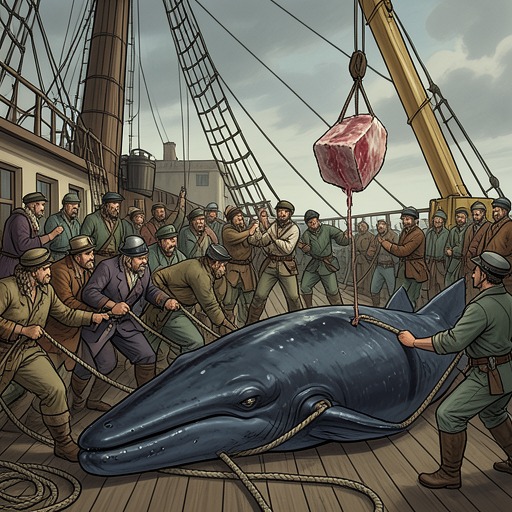
The line’s networked logic recurs throughout the ship’s material life. Ropes and tackles surround the elevated head of a Sperm whale when its valuable contents are extracted. A bucket descends into the whale’s head by a light tackle while men on deck control its movement. The whale-line belongs to this larger world in which whale bodies, ship structures, tools, and sailors are joined through tension-bearing materials. Even the construction of Captain Ahab’s replacement leg depends on carefully selected Sperm-whale jaw ivory and iron fittings, showing how the whale is transformed into the materials of the ship’s continued authority.
Metaphor and Narrative Significance
The whale-line finally exceeds its technical function. Its coils around the rowers become an image of the conditions shared by all mortals: every person is bound to unseen risks, and ordinary calm may conceal the force of an approaching catastrophe. The line makes this philosophy tangible. Death is not represented as a distant abstraction but as a dormant mechanism lying across wrists, oars, and gunwales, ready to move with sudden speed.
Its symbolism is not only fatalistic. The whale-line also represents interdependence. It joins hunter to hunted, one boat to another, individual sailor to crew, and human action to the unpredictable strength of the sea. A connection can establish possession, enable rescue, or make an additional line possible; the same connection can become a snare. In this double capacity, the whale-line condenses the novel’s larger understanding of life: human beings act through bonds they cannot fully control, and the structures that give them power also expose them to forces greater than themselves.
The object therefore stands between mastery and vulnerability. Its measured thickness, yarn count, length, storage, and handling testify to technical knowledge, while its sudden motion defeats any confidence that knowledge alone can make danger intelligible. The whale-line is a rope, a weapon, a legal sign, and a material emblem of universal peril. Its most decisive lesson is that no one encounters the sea—or life—from outside the network of forces already tightening around them.