Rachel
Moby-DickRachel is a whaling ship whose decisive significance lies in the contrast between its humane mission and the obsessive pursuit that governs the Pequod. It first appears as a ship searching for a lost whale-boat and a missing son, and it ends as the vessel that rescues Ishmael after the Pequod sinks. Through that reversal, Rachel becomes both a figure of parental grief and the practical means by which a remnant of the catastrophe survives.
Identity and Setting
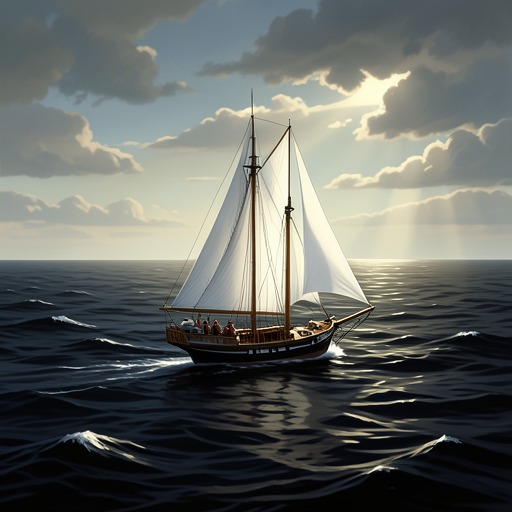
Rachel enters the narrative as a large ship encountered at sea after the Pequod has passed through the world-spanning routes of the whale fishery. The encounter belongs to the same maritime system that the narrator presents as economically powerful, technologically capable, and historically expansive. Whaling vessels carry their own water, weapons, provisions, and crews across immense distances; they may cross the Pacific, approach the Japan whaling grounds, pass through the Sunda Strait, and remain for years without touching land. Rachel therefore belongs to a mobile oceanic world in which ships are at once workplaces, instruments of commerce, and temporary communities isolated from ordinary society.
The wider account of whaling gives Rachel a historical and material background. The whale-ship is described as a pioneer that explored uncharted seas, opened routes toward remote harbors, carried missionaries and trade, and helped connect Europe, America, Australia, Polynesia, and the Pacific coast of South America. Rachel is not presented as an abstract symbol detached from this network: she is one working vessel within the global traffic of whale ships, whose searches, encounters, and rescues are governed by distance, weather, sails, boats, and the limited visibility of the sea.
The Meeting with the Pequod
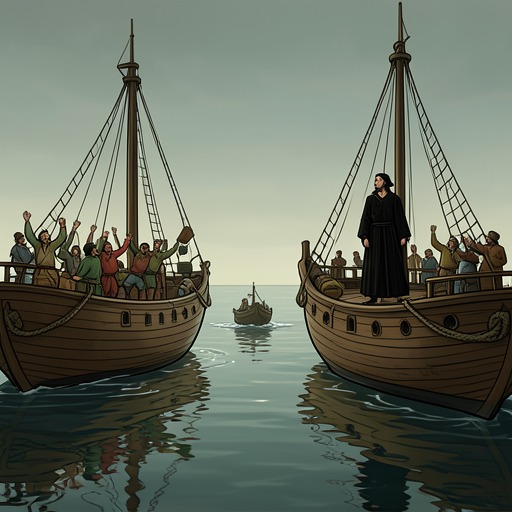
Rachel approaches the Pequod with men crowded upon her spars. As she draws near, her sails collapse and the apparent vitality of the ship gives way to a stricken stillness. Before her commander can complete a hopeful hail, Captain Ahab demands to know whether the crew has seen the White Whale. The question reveals the difference between the two vessels immediately: Ahab measures every encounter by its usefulness to his pursuit, while Rachel arrives burdened by an emergency that has nothing to do with the Pequod's single-minded quest.
Rachel's captain reports that his ship saw the White Whale the previous day, but he is not chiefly seeking information about Moby Dick. He asks whether the Pequod has seen a whale-boat adrift. The missing boat contains his son, and the captain pleads for the Pequod to join the search for forty-eight hours, offering to pay generously if necessary. His request places a human life and a father's desperate responsibility before Ahab, yet Ahab rejects it unconditionally. The refusal is especially stark because the Pequod is already pursuing a creature whose trail has been seen, whereas Rachel is trying to recover people who may still be alive.
The proposed search would have required the two ships to sail several miles apart on parallel courses, sweeping a double horizon over the sea. Rachel's captain has a practical plan, sufficient resources, and the emotional authority of a parent, but Ahab will not interrupt his pursuit. The rejection turns a possible alliance between ships into a moral separation. Rachel continues searching alone, while the Pequod preserves its course toward the encounter Ahab has chosen above every competing obligation.
Rachel as a Ship of Mourning
After the refusal, Rachel moves away in a halting and winding course. She tacks repeatedly, swings her yards from side to side, beats against a head sea, and then allows the sea to push her forward. Men remain clustered upon her masts, watching the water for any sign of the missing boat. Her movement is not simply inefficient navigation; it makes the ship's unresolved grief visible through its repeated turns and hesitations.
The narrator presents Rachel as a ship weeping for children who are absent. The image joins the vessel to the biblical figure of Rachel, whose mourning stands for bereavement that cannot be consoled. Yet the comparison remains grounded in physical action: the ship is still searching, and its course continues to change whenever a dark spot appears on the sea. The vessel's grief is therefore active rather than merely elegiac. It becomes a form of fidelity, expressed through continued attention to the water and refusal to accept disappearance as final.
Rachel's sorrow also exposes the ethical cost of Ahab's command. The Pequod is capable of helping, but its captain treats the rescue as an interruption of his private war. Rachel's continuing search becomes an implicit judgment on that decision. Where Ahab converts the ocean into the stage of a feud, Rachel recognizes it as a place containing vulnerable, missing persons. Her identity is shaped less by conquest than by the obligation to look again.
Rescue and Aftermath
Rachel returns to the narrative after the Pequod has been destroyed. When the Parsee has disappeared and the last men have been thrown from the rocking boat, Ishmael is drawn toward the vortex of the sinking ship. The coffin life-buoy rises from the sea with great force, floats beside him, and keeps him alive for almost an entire day and night. This improvised buoy, originally associated with death, becomes the material condition of survival.
On the second day, Rachel approaches and picks Ishmael up. The rescue is not an accidental reversal of the earlier encounter. Rachel is still engaged in the search for her own missing children, but in retracing that search she finds another orphan instead. The ship that the Pequod refused to assist becomes the only vessel to save the narrator. Its humanitarian purpose survives even though its original search has not achieved the recovery described in the narrative.
This ending gives Rachel a distinctive place in the structure of the novel. The Pequod's pursuit ends in total destruction: its captain, officers, crew, and ship are lost, while the object of pursuit remains beyond mastery. Rachel, by contrast, remains oriented toward recovery. She cannot undo the deaths already suffered, and she does not rescue the Pequod's crew, but her continuing search makes Ishmael's survival possible. The vessel's name thus acquires a double force: it carries the image of mourning, yet it also carries the possibility that grief may still produce an act of care.
Narrative and Thematic Significance
Rachel is the strongest maritime counterpoint to Ahab's monomania. Both ships move through the same dangerous ocean and belong to the same whaling economy, but they embody opposed purposes. Ahab seeks the White Whale across a carefully planned circuit of cruising grounds, intending to pass through the Java Sea, approach the Philippines and Japan, and descend toward the Pacific waters where he expects to fight Moby Dick. Rachel's captain seeks a missing son. The first pursuit is organized around vengeance; the second around rescue.
The contrast also complicates the narrator's defense of whaling. Whaling is praised as a powerful global enterprise that illuminates the world with whale oil, opens unexplored routes, and connects distant peoples and markets. Yet Rachel's appearance shows what the same oceanic system cannot guarantee: ships may possess enormous geographic reach while remaining helpless before a small missing boat. The ocean permits global circulation but conceals individual lives. Rachel's search makes that tension concrete.
Finally, Rachel's rescue completes a pattern in which objects and vessels reverse their apparent meanings. The Pequod, a ship built for labor and pursuit, becomes a wreck; the coffin life-buoy, an emblem of death, preserves Ishmael; and Rachel, introduced as a grieving ship unable to obtain Ahab's help, becomes the agent of the survivor's return to the human world. Her final action does not erase the catastrophe. It gives the catastrophe a witness, allowing Ishmael to tell what happened while Rachel continues, in the background of the ending, to search for those who are still missing.