try-works
Moby-DickThe try-works is the Pequod’s onboard rendering plant: a massive structure of brick, mortar, oak, hemp, iron, fire, water, and two capacious try-pots, installed so that the ship can convert a dead whale’s blubber into marketable sperm oil at sea. Its practical function governs an entire chain of labor, but its nightly flames also change the moral and visual character of the vessel. When the try-works are burning, the Pequod appears less like an ordinary ship than like a moving furnace, carrying the violence of whaling into the darkness and reflecting the consuming purpose of Captain Ahab.
Structure and Operation
The try-works occupy the broadest part of the deck, between the foremast and mainmast. Their masonry mass measures about ten feet by eight and rises five feet above the deck, requiring unusually strong timbers beneath it. Iron knees brace the structure from every side and screw it down to the ship’s framework; wooden casing protects its flanks, while a large sloping, battened hatch covers the top when the apparatus is idle. Beneath that hatch are two iron try-pots, each capable of holding several barrels. They are kept remarkably clean when not in use, sometimes polished with soapstone and sand until they shine like silver punch-bowls.
The apparatus is designed as a carefully controlled system rather than a simple open fire. Removing the fire-board exposes the bare masonry and the two iron furnace mouths beneath the pots. Heavy iron doors regulate those openings, while a shallow reservoir under the enclosed works prevents the heat from passing directly into the deck. Because evaporation continually consumes the water, a tunnel at the rear replenishes the reservoir. There are no external chimneys: the smoke escapes directly through openings in the rear wall, bringing the rendering process into immediate contact with the ship’s air and working space.
Labor and the First Fire
On the present voyage the try-works are first started at about nine o’clock at night, under Stubb’s supervision. The first fire must be fed with wood, including shavings supplied by the Carpenter. After the process begins, however, the ship uses no ordinary wood except for quick ignition. The blubber, once rendered, leaves crisp scraps or fritters that still retain enough oil to feed the flames. The whale therefore becomes both the material being processed and the fuel that sustains its own destruction.
The work is performed by the harpooneers, who serve as the whale-ship’s stokers. Standing on the broad hearth in front of the works, they use large pronged poles to pitch hissing masses of blubber into the scalding pots and to stir the furnaces beneath them. The ship’s motion makes every task hazardous: oil boils eagerly toward the workers’ faces, flames curl from the furnace doors toward their feet, and smoke gathers in heavy masses. Once the hot oil is ready, it is received into six-barrel casks; sailors then become coopers as they maneuver, head over end, the rolling casks across the slippery deck and hammer their hoops into place. When the last pint has been casked and cooled, the filled barrels are lowered into the hold and the hatches are sealed again.
Fire, Darkness, and the Pequod
By midnight the try-works are in full operation. The Pequod has cleared the whale’s carcass and made sail while the wind freshens, so the rendering plant burns as the vessel drives through an intensely dark ocean. Flames fork from the sooty flues and illuminate the rigging like Greek fire. The ship seems to carry a red furnace into the night, its fire suggesting a mission of vengeance rather than an ordinary commercial voyage.
The harpooneers become nearly theatrical figures in this illumination. Their faces are blackened by smoke and sweat, their beards are matted, and their teeth flash with a contrasting brightness as they move between smoke and flame. They narrate frightening adventures in words of mirth, gesture with forks and dippers, and laugh with a force compared to the upward leap of the fire. Around them the sea leaps, the ship groans and dives, and the Pequod continues forward while burning a whale’s body. The try-works thus produces not only oil but an image of a vessel converted into a furnace, a battlefield, and a floating inferno.
This transformation becomes explicitly connected with Ahab. From Ishmael’s position at the helm, the rushing ship, filled with harpooneers, laden with fire, and burning a corpse, appears to be the material counterpart of its commander’s monomaniac soul. The apparatus makes Ahab’s inward obsession visible in physical form: the ship’s labor, heat, smoke, and forward motion seem organized around the same relentless combustion that governs his pursuit of the White Whale.
Vision, Error, and Moral Ambiguity
The try-works also alters perception. Ishmael warns that a person should not gaze too long into the fire or dream while holding the helm. Under its red glare, familiar objects become ghastly and the sailors resemble devils; the artificial fire is therefore a deceptive lamp, unlike the natural sun, which promises a gentler revelation. The warning is practical because drowsiness at the helm can become fatal, but it is also interpretive: the try-works can make the ship’s violence appear magnificent while exposing the distortion required to sustain that magnificence.
Ishmael’s own brief sleep demonstrates the danger. Awakening in confusion amid darkness and red flashes, he cannot see the compass and imagines that the tiller has somehow been inverted. In fact, he has turned himself around and is facing the stern, with his back to the prow and compass. He corrects his position just in time to prevent the Pequod from flying into the wind and possibly capsizing. The fire has not merely decorated the night; it has helped produce a hallucination capable of turning industrial labor into navigational catastrophe.
Yet the chapter does not reduce the try-works to a simple emblem of evil. Its fire illuminates truths as well as disguises them. The sun does not hide the world’s deserts, griefs, or the ocean’s darkness, and the ship’s clean daylight appearance cannot erase what its nighttime labor requires. The try-works concentrates that tension: it is efficient and necessary, but its efficiency depends on blood, burning flesh, toxic smoke, and disciplined exposure to danger.
Cleansing and Significance
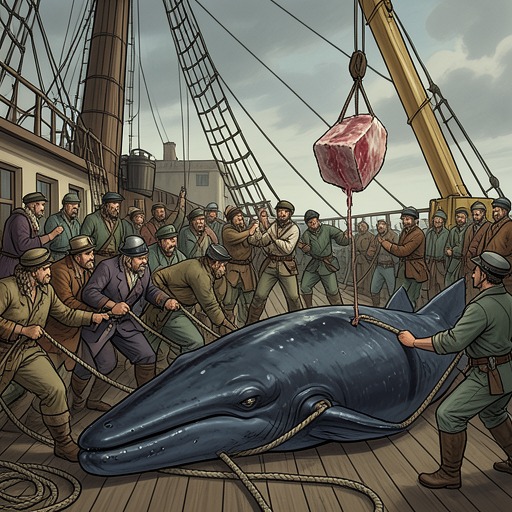
The try-works participates in the remarkable cycle by which the whale ship moves from slaughter to cleanliness. During the operation, the deck streams with blood and oil, masses of the whale’s head lie on the quarter-deck, casks crowd the ship, soot blackens the bulwarks, and the mariners are covered in grease. The entire vessel seems to have become the whale itself. A day or two later, however, the same ship can look like a silent and meticulously ordered merchant vessel. Unmanufactured sperm oil has a cleansing quality; lye made from the ashes of burned scraps removes adhesive residue, while the crew scrubs the bulwarks, cleans the rigging, hides the pots beneath the hatch, coils away the tackles, stores the casks, and finally washes and changes clothes.
This reversal gives the try-works a distinctive place in the material culture of the Pequod. It is simultaneously a factory, furnace, storage system, workplace, source of light, source of smoke, and instrument of discipline. Its masonry is fixed to a wooden sailing ship, joining heavy architecture to a mobile vessel and turning the deck into a specialized industrial space. The clean deck that follows does not cancel the violence that produced it; instead, the ship’s immaculate surface depends on an organized process of combustion, labor, and concealment.
The apparatus therefore embodies the larger reach of whaling. The whale fishery is presented as a global economic force whose oil supplies lamps and candles across the world, whose vessels number in the hundreds, and whose voyages connect ports, colonies, exploration, commerce, and imperial expansion. The try-works is the point at which the whale becomes a portable commodity: flesh and fat enter the pots, oil enters casks, and the product eventually reaches distant consumers. But within the narrative, the machine also refuses to remain merely productive. Its flames expose the danger of confusing commercial power with moral nobility, and its red illumination reveals how the Pequod’s technological order has been commandeered by Ahab’s private vengeance.