Town-Ho
Moby-DickTown-Ho is a Nantucket Sperm Whaler encountered by the Pequod near the Cape of Good Hope, and its story supplies one of the most important indirect revelations about Moby Dick. Manned almost wholly by Polynesians, the ship is first presented through a short gam and news of the White Whale; it then becomes the setting for an escalating conflict between the mate Radney and the Lakeman Steelkilt, a mutiny, Radney’s death in the jaws of Moby Dick, and the later dispersal of much of the crew. The account is not delivered as transparent shipboard fact: Ishmael preserves the public version, the secretly transmitted version, and the strange route by which the hidden material reaches the Pequod.
Encounter and Narrative Transmission
Town-Ho is met after the Pequod has spoken the Goney in the waters around the Cape of Good Hope, a maritime crossroads where ships encounter more travelers than in almost any other region. The brief gam produces strong news of Moby Dick, but the encounter also carries a darker implication. The Town-Ho’s story appears to involve an inverted form of divine judgment, in which violence intended by one man is completed by the whale itself. The captain of Town-Ho does not know the private portion of the tragedy. Three white seamen of the ship possess it among themselves, and one communicates it to Tashtego under strict secrecy; Tashtego later reveals much of it while wandering in sleep. The Pequod’s sailors who learn the full account keep it confined among themselves, so that it never passes aft of the main-mast or reaches Captain Ahab and his mates.
Ishmael frames the tale as a story previously narrated at the Golden Inn in Lima to Spanish companions, Pedro and Sebastian. Their occasional questions remain part of the presentation, while Ishmael explicitly preserves the style of that earlier telling. This layered form matters because Town-Ho is both a ship and a contested object of knowledge: its official account, its sailors’ secret, Tashtego’s involuntary disclosure, and Ishmael’s retrospective reconstruction do not occupy the same level of certainty. The vessel therefore carries not only men and cargo, but also a rumor whose significance expands as it moves between crews, languages, places, and degrees of secrecy.
Leak, Discipline, and Mutiny
Some two years before Ishmael learned the events he recounts, Town-Ho was cruising in the Pacific north of the Line. During the routine handling of the pumps, the crew discovered that the ship was making more water than usual. A sword-fish was suspected, but the leak could not be found, even after the hold was searched as far down as the heavy weather allowed. The captain, believing that unusual good luck awaited the ship in those latitudes, was reluctant to leave the cruising ground. Because the leak initially seemed manageable, the crew continued working the pumps at wide intervals; when the water increased, the captain finally made for the nearest island harbor to have the hull repaired.
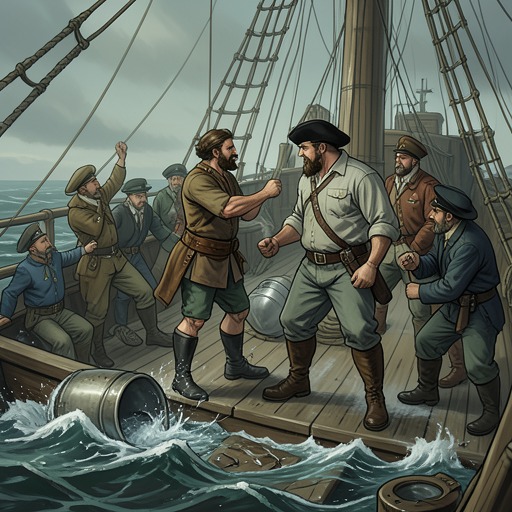
The ship was not yet in immediate danger. Its pumps were considered excellent, and thirty-six men, periodically relieved, could keep the vessel free even if the leak doubled. Prosperous winds made a safe arrival likely. The decisive danger came instead from shipboard authority. The mate Radney, a Vineyarder, behaved with brutal overbearing force toward Steelkilt, a Lakeman and desperado from Buffalo, whose exhausting labor at the pumps had already strained his forbearance. Radney shook a hammer close to Steelkilt’s face and commanded him to obey. Steelkilt retreated slowly around the windlass while repeatedly refusing, but when retreat ceased to protect him he stopped on the hatches and confronted the mate.
Steelkilt warned Radney that he would not obey and told him to remove the hammer or look to himself. Radney advanced, continued his abuse, and shook the heavy tool within an inch of Steelkilt’s teeth. Steelkilt then threatened to murder him if the hammer touched his cheek. It did touch him. In the next instant Steelkilt stove in Radney’s lower jaw and head; the mate fell on the hatch spouting blood. Steelkilt immediately reached for the backstays toward two of his comrades at the mastheads, transforming a private confrontation into an organized resistance. The episode becomes the concealed mutiny at the center of Town-Ho’s story: discipline has produced the revolt it claims to prevent.
Moby Dick and Radney’s Death
The mutineers’ plans do not immediately end the conflict. Steelkilt secretly prepares an iron ball, closely netted, and imagines using it to crush Radney’s forehead during a later watch at the silent helm. Yet the intended murder is interrupted by an external fatality. Between daybreak and sunrise, while the decks are being washed, a Teneriffe sailor suddenly cries out that a whale is rolling. It is Moby Dick, the very white and famous monster whose appearance transforms the ship’s internal crisis into a whale hunt.
The crew’s earlier compact is forgotten in the excitement. Captain, mates, and harpooneers cry out for the White Whale and eagerly seek the valuable capture, while the more apprehensive sailors regard the creature’s beauty with curses and dread. Steelkilt is placed in a position that makes the encounter especially charged: he is Radney’s bowsman, and when fast to a fish he must sit beside the mate while Radney stands in the prow with his lance. The mate’s boat gains the start, and Steelkilt rows with fierce delight, carrying the mutineer directly into the service of the man he has sworn to resist.
After the boat’s harpooneer fastens to Moby Dick, Radney springs to the bow and orders Steelkilt to beach him on the whale’s back. Steelkilt hauls him upward through blinding foam, where the whiteness of whale and spray becomes almost indistinguishable. The boat strikes as though against a submerged ledge and heels over, throwing Radney into the sea on the whale’s far side. Moby Dick turns in a sudden maelstrom, seizes the swimming mate between its jaws, rises with him, and plunges down. Steelkilt, who has already slackened the line so that the boat drops astern of the whirlpool, cuts the line when the boat is jerked downward. The whale escapes, later surfacing with tatters of Radney’s red woolen shirt caught in the teeth that killed him. The other boats pursue, but Moby Dick finally disappears.
Desertion and Consequences
Town-Ho eventually reaches its port, described as a savage and solitary place without a resident civilized population. There, led by Steelkilt, nearly all the foremastmen except five or six deliberately desert among the palms. The deserters ultimately seize a large double war-canoe belonging to the local inhabitants and sail toward another harbor. The mutiny thus outlasts Radney’s death: the mate’s removal does not restore the ship’s former order, but instead leaves Town-Ho radically depleted.
With only a handful of sailors remaining, the captain calls on Islanders to help heave the ship down and stop the leak. The reduced white crew must keep constant watch over these dangerous allies while performing extreme labor. By the time Town-Ho is ready for sea, the remaining men are so weakened that the captain dares not take the heavy vessel onward with them. He anchors as far from shore as possible, runs out two cannon from the bows, stacks muskets on the poop, and warns the Islanders not to approach. Then, taking one man with him, he sails a whale-boat five hundred miles to Tahiti to obtain reinforcement. The original leak, which first appeared as a technical problem, has therefore produced a chain of social and strategic consequences: failed discipline, mutiny, death, desertion, labor exhaustion, armed isolation, and a desperate voyage for help.
Maritime and Thematic Significance
Town-Ho’s story gives Moby Dick a presence before the Pequod meets him directly. The whale is not merely an animal sighted by chance; he enters the narrative through testimony, rumor, secrecy, and a death that appears to answer a human quarrel. The story’s timing makes the effect especially powerful: the ship’s violence is already moving toward murder when Moby Dick appears, and the whale’s intervention seems to take the planned act out of Steelkilt’s hands. Whether this is providence, coincidence, or a retrospectively imposed pattern remains unresolved, but the narrative deliberately makes the alternatives difficult to separate.
The ship also enlarges the novel’s picture of whaling as a global system. Town-Ho is a Nantucket vessel cruising in the Pacific, encountered near the Cape of Good Hope and eventually driven toward Tahiti for men. Its crew is almost wholly Polynesian; its captain, Vineyarder mate, Lakeman, Teneriffe sailor, and Islander auxiliaries embody the mixed human traffic of the whale fishery. In this sense, the vessel exemplifies the broader claim that whaling opened unknown seas, connected distant harbors, and carried labor, information, and power across imperial boundaries. Yet the same mobility exposes unequal authority and precarious dependence: the ship’s oceanic reach cannot protect it from an abusive mate, mutinous labor, an unmanageable leak, or the need to arm itself against the people it recruits for survival.
Town-Ho finally stands as a compact model of the novel’s larger world. Its physical vulnerability is joined to institutional vulnerability; its official story is shadowed by a secret; and its pursuit of a profitable whale becomes inseparable from the destruction of human order. The ship does not simply report that Moby Dick exists. It demonstrates how the White Whale’s significance is made socially: through frightened witnesses, withheld knowledge, violent expectation, and the afterlife of a death that the Pequod’s sailors understand as both accident and judgment.