Ahab's oath against Moby Dick
Moby-DickAhab's oath against Moby Dick is the decisive public act by which Captain Ahab seizes the Pequod's voyage and redirects it toward the pursuit and destruction of Moby Dick. What begins as an unexplained assembly of the crew becomes a theatrical declaration of personal injury, a reward-based contract, and finally a quasi-sacred blood-and-spirits league. The oath gives a private obsession the appearance of a common duty, while exposing how the ship's hierarchy, ceremony, and collective excitement can be made to serve one man's revenge.
The Summons and the Shipboard Stage
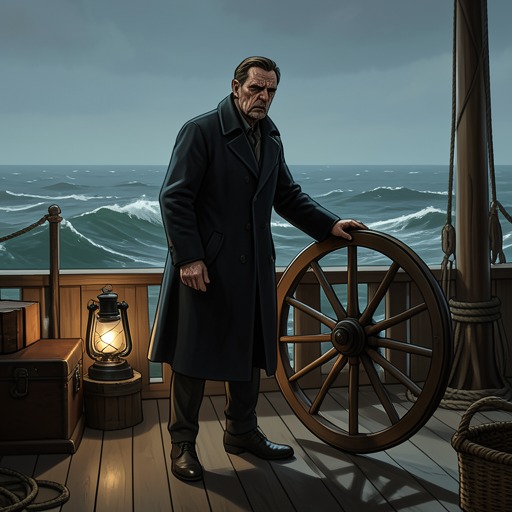
Ahab orders the entire ship's company aft, including the mast-heads, and leaves the assembled men waiting while he paces heavily across the deck. The crew watches him with curious and apprehensive faces, sensing the approach of a storm in his appearance before understanding its cause. Stubb initially suspects that the captain has summoned them merely to witness some pedestrian feat, but Ahab abruptly turns the gathering into a test of the men’s instinctive readiness: he asks what they do when they see a whale, and a score of voices answer that they sing out for it. Their immediate response gives him the emotional opening he wants. His approval intensifies their animation, and the crew’s surprise at its own excitement shows the first value shift of the ceremony: uncertainty becomes eagerness before the object of the oath has even been named.
The scene also depends on the Pequod's formal organization. Captain Ahab normally demands implicit and instantaneous obedience rather than ceremonial homage, yet he remains attentive to the forms and usages of the sea. Those forms provide the external structure through which his private authority becomes collective power. The officers may appear bolder on the open deck, but the artificial etiquette of shipboard life makes them deferential in Ahab's cabin and before his command. The oath exploits that condition. It is not an informal conversation among equal sailors; it is a carefully staged act in which the captain occupies the center, the crew forms an audience and later a circle, and the ordinary chain of command becomes the machinery of a personal dictatorship.
The Gold Ounce and the Naming of the Enemy
Ahab holds up a bright Spanish ounce of gold and identifies it as a sixteen-dollar piece, directing Starbuck to bring him the top-maul. While waiting, he rubs the coin against his jacket to heighten its lustre and hums without articulate words. The small act gives the reward an almost talismanic force: the coin is not merely payment but a visible object around which the crew’s attention can gather. He then offers it to whoever first raises a particular white whale, specifying the animal’s white head, wrinkled brow, crooked jaw, and three holes punctured in its starboard fluke. By nailing the coin to the mast, Ahab turns observation into competition and makes the whale a permanent sign within the ship’s working space.
The officers’ questions allow Ahab to elaborate the creature’s identity through remembered physical evidence. Daggoo asks about the whale’s unusually bushy spout and speed; Queequeg struggles to describe the many iron harpoons twisted and wrenched in its body; and Ahab supplies the word “Corkscrew!” He confirms the large, wheat-shock-like spout and the fan-tail resembling a split jib in a squall. Only then does he name the target as Moby Dick. The naming gathers scattered signs into a single adversary: the whale is no longer an indistinct object of lookout but the specific white animal around which the voyage has secretly been organized.
Starbuck’s question makes the personal history behind the ceremony explicit. He has heard of Moby Dick but asks whether this was the whale that took Ahab's leg. Ahab confirms that Moby Dick dismasted him and reduced him to the “dead stump” on which he now stands. His injury is therefore not background decoration; it is the wound that gives the oath its emotional and political energy. He declares that he will chase the whale around Good Hope, the Horn, the Norway Maelstrom, and the flames of perdition before surrendering. The geographical sweep of the vow is deliberately limitless: the pursuit will cross oceans and the boundaries of ordinary human endurance.
From Private Revenge to Collective Vow
Ahab tells the men that this is what they shipped for: to chase the white whale over both sides of land and over all sides of earth until it spouts black blood and rolls fin out. The claim is false as an account of their original employment, but it is effective as an act of command. By presenting his own objective as the purpose of every sailor’s enlistment, Ahab absorbs the crew’s labor, danger, and future into his personal history. The harpooneers and seamen answer with a sharp eye for the white whale and a sharp lance for Moby Dick, thereby giving audible consent to a mission whose full cost they have not measured.
The oath’s force depends on the wider prestige of whaling. Ishmael argues that landsmen wrongly regard the vocation as unpoetic, disreputable, and merely butcher-like, while its scale and historical reach reveal a powerful global enterprise. Whaling employs eighteen thousand American men, sends more than seven hundred vessels to sea, and sustains a large network of investment and commerce. More broadly, the whale-ship is presented as a pioneer of unknown seas, a mediator in once-hostile harbors, and a precursor of missionaries, merchants, and imperial intercourse. Ahab can therefore cloak revenge in the dignity of the profession: the Pequod appears to be continuing the heroic, world-ranging work of the whale-ship even as its captain diverts that work toward one white whale.
The same global horizon sharpens the extremity of his purpose. The Pequod's planned route leads through the Sunda Strait into the Javan sea, northward toward the Philippine Islands and the Japanese waters, and eventually down to the Pacific Line, where Ahab expects to find Moby Dick. The voyage is designed to sweep across nearly all known Sperm whale cruising grounds before concentrating on the sea where the white whale is most familiar. Unlike ordinary commerce, the whale-ship carries its own provisions, weapons, and crew and may pass years without seeing land. Ahab's oath thus commands not a local expedition but a mobile, self-contained world whose vast circulation has been bent around a single quarry.
The Harpooners’ League
After ordering a great measure of grog, Ahab has the harpooneers bring out their weapons. The harpoons are ranged near the capstan, the three mates stand beside him with their lances, and the rest of the ship's company forms a circle around them. He scans each man as though inspecting a pack ready to charge, then orders the drink passed through the crew. The vessel’s ordinary equipment becomes ceremonial material: the capstan marks the center, the lances flank the captain, and the harpoons are no longer only tools of whaling but participants in a collective pledge.
Ahab next instructs the harpooneers to hold the detached iron parts of their harpoons with the barbs raised. He corrects their position, commands them to turn up the socket, and fills the sockets with spirits from the pewter measure. The weapons become murderous chalices. Their transformation is crucial because it fuses labor and ritual: the instruments by which the crew kills whales now carry the drink by which it swears to kill Moby Dick. The ceremony makes violence seem both practical and sacred, while also placing the harpooneers—the men who will stand at the bows of the whaleboats—at the center of the vow.
Ahab gives the final imperative: the men are to drink and swear death to Moby Dick, with divine judgment invoked against anyone who fails to hunt the whale to his death. The long steel sockets are lifted, and the spirits are swallowed amid cries and curses against the white whale. The league is called indissoluble, but its unity is visibly uneven. The harpooneers and seamen respond frantically, whereas Starbuck pales, turns away, and shivers. His reaction registers the moral cost that the ceremony suppresses. Ahab has produced consent through spectacle, excitement, hierarchy, alcohol, and the contagious pressure of the group, but Starbuck recognizes that the pledge may be a sentence imposed on the entire ship.
Consequences and Tragic Meaning
The oath changes the Pequod's voyage from a commercial search for whales into a pursuit organized around Ahab's monomania. It supplies a standing command behind later movements across the world's cruising grounds and gives every sighting of a white spout the potential to become a fulfillment of the vow. The reward coin, fixed to the mast, makes the target materially present even when Moby Dick is absent; the repeated demand to watch for white water turns the crew’s ordinary lookout into an instrument of obsession.
The ceremony also reveals how Ahab uses institutional forms to mask and enact private ends. His authority is not based only on physical strength or personal charisma. The quarter-deck, the assembled company, the officers' positions, the weapons, the drink, and the language of maritime command provide what appears to be legitimate structure. Yet behind these forms lies what the narrative describes as a sultanism of the brain: an inward absolutism made practical through external usages. The oath is therefore both a dramatic speech and an organizational coup. Ahab does not openly abolish the Pequod's purpose; he colonizes it from within.
Its later consequences make the original triumph ominous. When the pursuit reaches its final crisis, Starbuck sees the armed cabin and remembers that Ahab has threatened the safety of the entire crew; he considers whether the captain’s course makes him the wilful murderer of more than thirty men. Ahab, however, insists that he is the lieutenant of the Fates and that the act has been decreed from before the ocean existed. He tells the men that Moby Dick has risen twice and will rise a third time, converting the whale’s repeated survival into confirmation of destiny. The quarter-deck oath thus culminates not in secure communal purpose but in fatal submission: a wounded captain’s declaration has become the Pequod's governing law, and the ship's collective courage has been harnessed to its destruction.