Guilt over Elise's Death
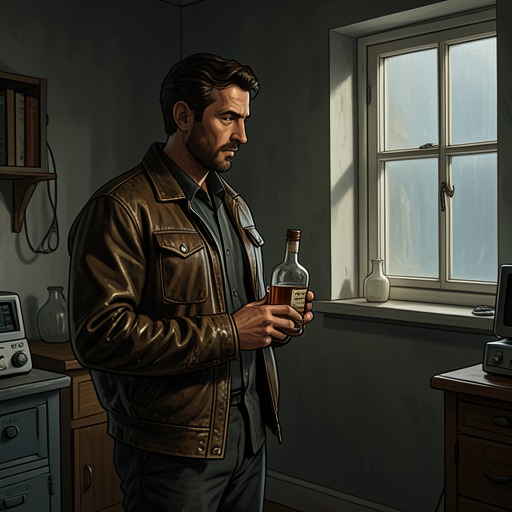
MovingGuilt over Elise's Death is the prolonged, unresolved burden Lucas carries after Elise dies from taking drugs at a party he invited her to. He does not mistake a chain of circumstances for a simple verdict: Elise took the drugs, yet Lucas keeps returning to the fact that his invitation helped bring her to that particular night. For more than thirty years, he asks whether her death was his fault, turning memory into an inquiry whose beginning and end remain difficult to establish.
A chain of responsibility
The guilt takes shape as a sequence of counterfactuals. Lucas reasons that if his mother had not given him money, he would not have bought a car; without the car, he probably would not have bothered with Rowena's party. His mother did give him the money, and he did buy the car. Each step is small enough to seem ordinary on its own, but in retrospect each becomes part of a route leading toward Elise's death.
The car gives that route a concrete, almost celebratory beginning. Lucas remembers posing outside River Walk with his new Triumph TR8, a scarlet convertible he regarded as his pride and joy. His mother encouraged him to take another photograph wearing sunglasses, teasing that he looked like a pop star; the resulting image entered the family album under a caption praising his new wheels. The early-spring scene, with forsythia budding, preserves the pleasure of the purchase. Read against what follows, the photograph also records the object Lucas later places at the start of his chain of blame.
That chain does not make the car, the money, or the party equivalent to the fatal act. Lucas's own reckoning keeps two statements in tension: Elise died because she took drugs, but she was at that party because he had invited her. His guilt lies in the gap between direct cause and the choices that made the circumstances possible. Rather than resolving that gap, he repeatedly follows it backward, asking how many earlier decisions must be included before responsibility can be said to begin.
Memory as recurrence
When Lucas returns to the past, remembering does not produce a settled account. The aftermath of Elise's death resembles shattered glass: even after he thinks he has cleared it away, another fragment surfaces. The image makes his guilt recurrent rather than finished. What returns is not necessarily a new fact; it is the old event becoming newly sharp through another detail or another counterfactual.
The years have not allowed Lucas to process what happened. Memory Lane proves more traumatic and nerve-racking than he expected, and he lies back in his recliner, trying to marshal his emotions. The narrative links this private effort to a larger pattern: Elise's death runs through the lives of those around her, shaping their futures as the River Thames winds through London. Lucas's question is personal, but its consequences are not confined to him; the death remains entangled with the paths taken by the other people in the story.
The inquest, the trial, and what remains unsaid
The later legal proceedings bring Lucas's guilt into contact with facts he could not control. At Elise's inquest, he sees Fern arrive with her parents and notices that her coat has fallen open over a small, neat pregnancy bulge. He learns that Fern's marriage to Captain Frobisher was a shotgun wedding and that she was expecting another man's baby. The discovery adds a different uncertainty to the aftermath: Lucas wonders whether Charlie knew about the pregnancy and, if he did, whether he cared. It does not answer Lucas's question about responsibility for Elise's death, but it shows how many consequences and unresolved relationships converge around the proceedings.
Lucas is relieved when Fern does not attend Charlie's trial, because he will not have to lie in front of her. His judgment that the demand for the whole truth is a joke reveals the pressure he feels between testimony and what he can bear to say. The account does not turn that pressure into a full explanation of what he withheld; instead, it leaves the conflict in his reluctance and in his relief at Fern's absence. Charlie is sentenced to prison and disappears from the courtroom's view, leaving the gallery agape. Three years later, Charlie is released, by which time Lucas has been transferred to his company's New York branch through Paul Landreth's intervention.
An unanswered reckoning
The passage of time changes Lucas's surroundings but does not close the question. He returns to work, avoids speaking to Edwina when he finds her waiting in the foyer, and retreats to the boardroom for biscuits rather than join her for lunch. At other times, he drives around London late at night while the question of why Fern married someone else, if she had been involved with Charlie, circles in his mind. These episodes place his guilt beside other unresolved pressures; they do not supply a single explanation that would settle it.
The concept's force comes from this refusal of a tidy boundary between responsibility and blame. Lucas can identify the decisions that connected him to Elise's party, and he can recognize that her drug-taking was the direct cause of her death. Still, knowing the sequence does not tell him what moral weight to assign each link. His memory keeps returning to the invitation, the car, and the party, while the consequences spread across decades and other lives. Guilt persists not because the story offers no facts, but because the facts cannot yield the certainty Lucas seeks.