Moving and Clearing Out as a Process of Saying Goodbye to the Past
MovingMoving and Clearing Out as a Process of Saying Goodbye to the Past follows Edwina as the possibility of selling 137 Kennington Road changes from a thought she dismisses into a decision she begins to act upon. The move remains a plan rather than a completed departure, but sorting the house gives that plan weight: each drawer and room makes visible both the life she has lived there and the burden of remaining its keeper.
From a House to a Decision
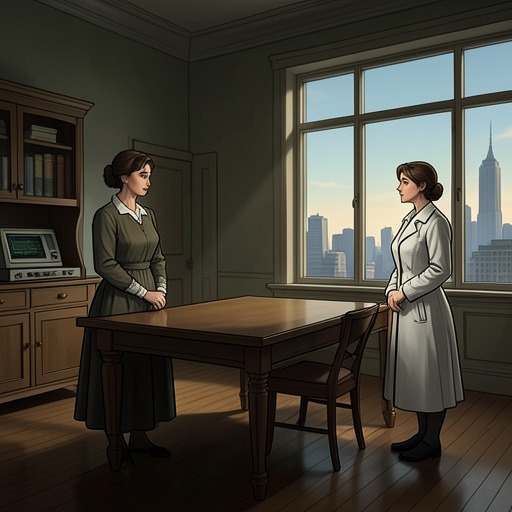
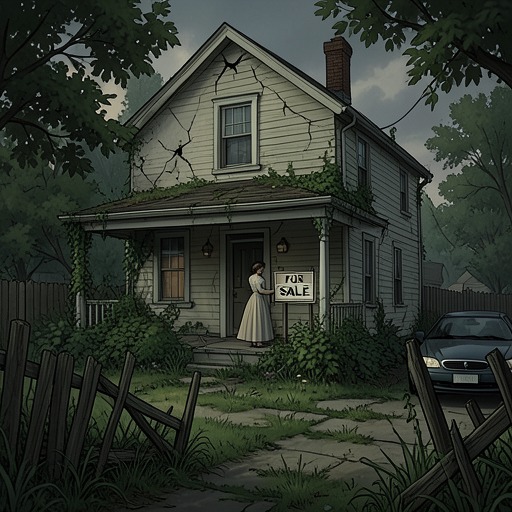
For months, more and more of 137 Kennington Road has stood unused; Edwina has not entered some rooms. The house is no longer simply a home to maintain but a place increasingly organized around absence and memory. She considers seeing it as an outsider might, and considers selling it. She has entertained the idea before, then rejected it as absurd. This time, the thought settles into a different meaning: she no longer wants to be a prisoner of her own past.
The contrast between the house’s former scale and her present life sharpens that change. The candlelit dining room, once bright with silver, belongs to a vanished routine; Edwina now mostly eats in the basement kitchen, where carrying a tray up the stairs feels dangerous. She sleeps late, takes long afternoon naps, and goes to bed early. Even making the bed, with its grimy sheets, becomes an overdue task. Alicia, her former housekeeper, retired a decade earlier, and the pressure of finding someone new has kept Edwina from replacing her. The house’s deterioration is therefore practical as well as symbolic: moth-eaten woollens, limescale, and radiators that need bleeding are among the ordinary demands she has stopped addressing.
Sorting as a Practical Beginning
The first work of leaving is not grand or decisive. Edwina lists cleaning supplies beneath her notes, plans an outing, and then turns to the pine dresser drawers with a bin liner at her feet. She means to be merciless, because she does not want to carry clutter into whatever home comes next. A large house has made postponement easy: there has always been another place to push things, and the family had discovered its hiding places long ago.
When the left-hand drawer sticks, she does not abandon the task. She works a ruler into the narrow gap and dislodges whatever is holding it shut. The contents span the mundane and the intimate: old stamps, string, scissors, parking-permit forms, vitamins, and Sellotape sit alongside Alicia’s last letter from St Lucia and a photograph of Alicia’s youngest grandson in cap and gown, holding his degree. Clearing is not a simple separation of rubbish from useful things. It makes Edwina decide which remnants still connect her to people and which can be left behind.
She intends to tell Alicia that she is moving to Cornwall, perhaps by writing a note. The imagined destination takes shape with unusual clarity: a wooden house above St Ives, a veranda, coffee in the cold and wine in the sun, sardines cooked on a portable barbecue. She pictures herself painting the sea in oils, using blues from cobalt to Prussian. These details make the proposed move more than an escape from domestic disorder: it contains a possible return to painting and a life arranged around her own choices. Yet imagining it exhausts her. Wrapped in an old blanket made of knitted squares, she wonders what her life might have been like if the men in it had not died. The future she pictures thus emerges alongside, not instead of, grief.
The House as a Container of Memory
Edwina’s decision to leave is emotionally difficult because the house preserves sounds and images that ordinary tidying cannot remove. She sits on a wicker chair with a faded pink velvet seat and cannot remember whether she has ever sat in it before. The forgotten chair belongs to the same altered landscape as the unserviced radiators, limescale, and moth: familiar objects have become strange, while the rooms no longer offer the life that once gave them meaning. She resolves to close the door on number 137, taking a small case of good memories but refusing to carry all her baggage.
That resolve meets an involuntary recollection. For a split second, she hears children running up and down the stairs, their tumble and laughter followed by silence. Elsewhere in the house, she sometimes thinks she sees a little dark head holding stolen biscuits, or hears giggling behind the sofa. Such impressions turn the work of clearing into an encounter with the family’s past, not merely with accumulated possessions. Edwina also has difficulty answering how many children she has had: one, two, three, or almost four. The unresolved count gives the apparent simplicity of moving away a painful edge. Leaving the building cannot make its absences straightforward.
Culling and the Return of the Past
A week after Lee visits the house, Edwina is still making herself spend at least two hours a day culling her belongings. She begins with handbags, confronting how many she has collected and how similar many of them are: hard-edged, with clip fastenings and short handles that can be carried over the arm. The repeated forms suggest how much can accumulate without being consciously chosen anew. The task turns the abstract decision to sell into sustained labor, measured in hours and individual objects.
That labor does not proceed in a straight line. Among curtains and National Geographic magazines, Edwina encounters Charlie’s locked trunk and is pulled toward the question of its contents. She has to remind herself that the purpose is to declutter, not sit and dwell on the past, and returns to filling a rubbish sack. The magazines spill out when the sack’s seams split, briefly undoing even this small act of removal. They also recall the different childhoods of Lucas and Charlie: a magazine Lucas once kept under his bed, and Charlie’s popularity with girls at Glennings. Edwina’s memories attach themselves to the objects she is trying to clear, so that sorting repeatedly becomes remembering.
What Can Be Carried Forward
The studio poses a distinct version of the same problem. Edwina leaves its chaos for the relative order of the dining room and closes the folding doors between them. She wonders how an entire career can be packed away, but can identify at least some necessities: an easel and a small stool. She cannot deal with that decision immediately and retreats into the dining room to gather her thoughts. Clearing is therefore also a question of which parts of her former life can continue elsewhere, rather than a demand that every trace be discarded.
Paperwork intrudes on the imagined freedom of departure: Edwina will need to find the deeds proving that the house belongs to her. The practical proof of ownership anchors the house in law and administration just as the rooms anchor it in memory. By the end of these episodes, she has chosen a direction, pictured a possible life in Cornwall, begun the sorting, and identified some things she hopes to take. She has not yet left. The process matters precisely because intention and completion remain separate: each emptied drawer or culled handbag advances the departure, while each remembered voice, photograph, or locked trunk reveals what cannot be made tidy simply by closing the door.