Estrangement and reconciliation
MovingEstrangement and reconciliation are presented not as a single dramatic repair but as a series of belated gestures through which family members begin to acknowledge hurt, responsibility, and the possibility of renewed contact. Rowena’s message to Lucas, Lucas’s confession to Edwina, and Edwina’s eventual readiness to join Rowena in Australia each change what can be said between them. The movements toward reunion remain incomplete: some injuries are named, some apologies are absent, and the family’s future depends on choices still to be made.
Estrangement and the possibility of return
The family’s separations are bound up with bereavement and blame. After Charlie’s death, Edwina blamed Rowena for the loss of her twin and punished her daughter for years. She ignored Rowena’s letters and refused to speak to her. The rupture therefore persists not simply because mother and daughter live apart, but because communication itself has been rejected: letters arrive, but Edwina does not answer them. The estrangement has a history and a repeated practice, sustained through silence.
Rowena’s later contact with Lucas creates a different route back into that family history. After the attacks, she tracks down his email address and sends a long, rambling message full of kindness. She explains that she missed Dickie’s funeral because her partner was being treated for breast cancer and she did not want to leave her. Rowena also tells Lucas that she and Edwina remain estranged, while expressing hope that they might one day reunite. Her explanation gives her absence from the funeral a specific, intimate circumstance; it also makes clear that the older break with Edwina is unresolved, not forgotten.
The email’s appeal rests on the limits of time and the small but consequential act of saying sorry. Rowena writes, “I have no other blood relatives and, as the world has seen recently, life is too short not to say I’m really sorry.” The appeal reaches Lucas even though it does not itself reconcile Rowena and Edwina. For him, its phrase about apologizing remains with him for more than a decade and becomes associated with something he needs to do and find. Reconciliation here first travels sideways, through a message from Rowena to Lucas, before it can return to the mother and daughter between whom the deepest estrangement lies.
Confession and acknowledgment
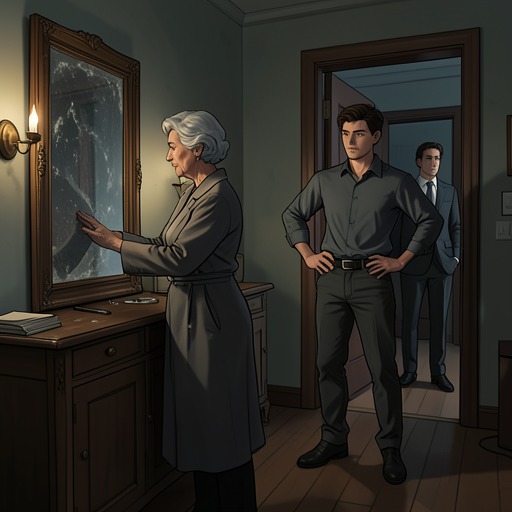
Lucas’s eventual conversation with Edwina turns their own damaged relationship toward a different kind of reckoning. He tells her that he arranged for her jewellery box to be stolen because he was in trouble at school and owed money to someone who threatened not to forget the debt. He had handed over the house keys and told the thieves when it would be safe to enter. The theft succeeded in its immediate purpose: Lucas got the money and nobody was physically hurt. Its consequences, however, spread beyond that moment, and Lucas recognizes that “in the end we all got hurt.” His admission gives Edwina a direct account of a betrayal that had remained hidden and identifies his own role in it without making the harm disappear.
The scene is framed by the object Lucas returns. Edwina first fears that the old, worn red box is too light and discovers that its ordinary compartments are empty. Its hidden bottom drawer still holds the family’s less replaceable remnants: her wedding ring, hair, the children’s baby teeth, and a photograph from the last day. The recovered box thus carries two kinds of truth at once. It is evidence of the theft Lucas confesses, but it also preserves keepsakes that connect Edwina to family life across loss and separation. Returning it cannot undo his action; it makes the confession materially consequential by restoring what can still be restored.
Edwina cannot answer Lucas’s account with speech. She trembles, presses her fingers against her mouth, and cries. As he leaves, she grips his hand fiercely and thanks him. Neither looks at the other, and Lucas does not receive an apology from her. The exchange ends with their business described as done, not with a declaration that every grievance has been settled. Her gratitude recognizes his act of confession and return, while the absence of an apology leaves the scene emotionally asymmetrical. Reconciliation can begin through acknowledgment even when the people involved cannot yet give one another a complete account of forgiveness.
Grief, blame, and changed understanding
Edwina’s reflection after Lucas’s visit broadens the meaning of that encounter. She still will never forgive him for what he did in court, but she can now see how it happened. She connects the consequences of her affair with Dickie to the way people react when they lose someone they love. This recognition does not erase her anger at Lucas; rather, it allows her to hold that anger alongside an understanding of the circumstances in which he acted. The change is a movement away from a single, fixed judgment, not a clean absolution.
That more complicated view turns back on Edwina’s own conduct toward Rowena. She remembers that after Charlie died she behaved irrationally, blamed Rowena for her twin’s death, and punished her daughter by ignoring letters and refusing to speak. She now understands her estrangement from Rowena as something she helped maintain, rather than simply an injury inflicted upon her. Yet recognition arrives alongside doubt: Edwina believes Rowena has no reason to forgive her. The thought prevents the prospect of reunion from becoming an easy reward for belated self-knowledge. Edwina can name the damage without presuming that her daughter must overlook it.
The repeated link between bereavement and estrangement gives apology particular weight. Rowena’s message urges contact because life is short; Edwina’s recollection shows how grief can instead harden into blame, silence, and years of punishment. Neither reflection makes loss reversible. What changes is the possibility of responding to it differently: Lucas tells the truth, Edwina revises her understanding, and Rowena continues to offer a future in which they might meet again.
The keepsake and the promised reunion
The returned box gives Edwina something tangible to carry into that possible future. She can take it to Australia, where Rowena lives near St Kilda beach. Rowena’s letter invites her mother to paint and promises that they will fire up the barbecue; it also says that Rowena wears Edwina’s charm bracelet every day and that she and her household are waiting. The invitation is concrete and domestic, shaped around shared time and familiar possessions rather than a demand that the past be resolved before they meet.
Edwina has already kept her passport and tickets together, checking them each night. She adds the photograph, teeth, rings, and a matchbox of hair to her checklist, and decides to take the battered jewellery box as well. Seeing it reminds her that it is the only thing she has left that belonged to her mother. The box therefore connects several generations and several kinds of absence: Edwina’s mother, her children, and the family members divided by old injuries. Its contents do not substitute for reconciliation, but the act of preserving and carrying them makes family memory part of the journey she is preparing to undertake.
The ending offers readiness rather than a completed reunion. Edwina has the tickets, the keepsakes, and Rowena’s invitation; the estrangement has not been declared over, and the evidence does not show the two women meeting. What has changed is that Edwina no longer treats silence as the only possible response. The novel makes reconciliation depend on ordinary but difficult acts—writing, telling the truth, recognizing one’s part in a rupture, and accepting an invitation—while leaving intact the uncertainty of whether these gestures can repair what years of grief have damaged.