Memory, photographs, and impermanence
MovingMemory, photographs, and impermanence turns the Polaroid into both a record of family closeness and a reminder that an image cannot keep the past intact. The camera seems to offer immediate possession of a moment: a picture appears in the hand as soon as it is taken. Yet those pictures fade, and what survives may be less the original scene than a later person’s longing, embarrassment, or act of recognition.
The birthday photographs
At the twins’ birthday lunch, Dickie insists on commemorative photographs and arranges the three children in different poses. Edwina privately wonders why Lucas is included when the occasion belongs to Rowena and Charlie, but she suppresses the question, plays along, and takes some Polaroids herself with one of the new cameras. The pictures therefore record not simply a birthday but the household as Dickie stages it, including the relationships and tensions that Edwina does not voice.
Edwina is secretly miffed that Dickie’s gift has been so successful. Charlie, especially, is delighted by his instant camera, watching image after image develop before him. The pleasure is immediate and visible; the photograph seems to make the moment available on demand. Lucas, meanwhile, remarks on the expense of Polaroid film and takes satisfaction in being twenty-two, employed, and able to own a car. Edwina notices that he has no girlfriend. The camera brings the family together around a shared novelty, but the scene also preserves their differing positions: Charlie’s wonder, Lucas’s self-conscious pride, and Edwina’s concealed irritation.
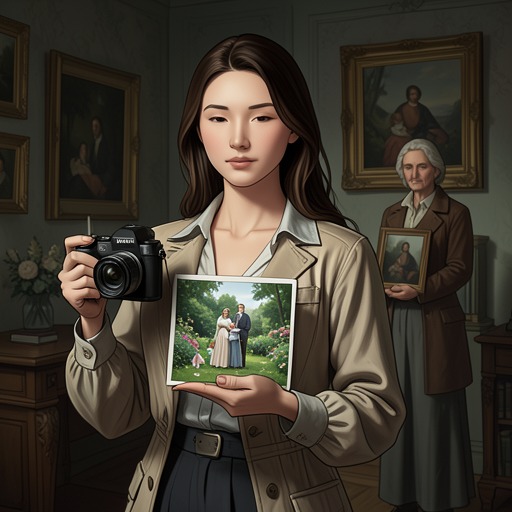
The gathering ends abruptly. Charlie rushes for the station, Rowena leaves soon after to finish an essay, and Dickie and Lucas go upstairs to talk. Edwina remains among the dining-room debris, holding a Polaroid of her children. When the narrative returns to that image, it has faded into weak pastel colours, with blurred outlines. Edwina can no longer recover its original clarity by looking at it, but in her mind she still sees Rowena and Charlie’s freckles and their faces peering through the silver hoops of their christening rings. Charlie wears cufflinks; Rowena wears earrings. The objects and details are remembered with greater sharpness than the photograph can now supply.
The dates that follow, 14.03.60 and 15.03.60, precede Edwina’s sudden recognition. She compares the moment to staring at a crossword clue until its answer abruptly appears. The passage links photographic looking with the delayed work of memory: the faded picture does not transparently explain the past, but it gives Edwina something to look at until a thought clicks into place. The image’s deterioration and the mind’s renewed attention occur together.
The camera and private exposure
The Polaroid has a different charge when Charlie shows Fern Woolbright the birthday present. He explains that Dickie gave one camera to him and another to Rowena, while crediting the idea to his mother. He also mentions cufflinks that Edwina would not let him take back in case they were lost, as well as cash for treats. The camera belongs to a set of birthday gifts, but Charlie singles it out as the best one and carries it into his private life with Fern.
Fern would prefer to go to her own bedroom, where the sheets are clean. Charlie’s room has only a mattress and a stained duvet without a cover, which he calls the Charlie nest. Excited by his new camera, he loads a fresh cartridge of film and tells Fern that it contains ten shots before asking her to take off her clothes. The instant camera turns their encounter into a series of images: not merely an experience shared in the room, but a record that can be kept and shown beyond it.
In the morning Fern asks Charlie to promise not to show anyone the photographs. Her concern is not that she has never been seen unclothed; she has already done life modelling. Rather, she distinguishes a photograph as more permanent. The picture can leave the private situation in which it was made and remain available to other viewers. Her unease marks a shift from the live encounter, which belongs to the people present, to an image whose later circulation she cannot control.
Fading, permanence, and what remains
Charlie responds that Polaroids fade, arguing that in time no one will be able to make out what Fern was doing with her widely spread legs. His reassurance rests on the same material impermanence that shapes Edwina’s memory of the birthday picture. But fading does not make the images harmless or meaningless: Edwina’s old photograph has lost its colours and sharp outlines while still prompting a vivid recollection, and Fern is anxious precisely because the image may persist long enough to be seen by others before it disappears.
Fern’s attention turns to how she looks in the photographs, especially the contrast of her red pubic hair against her very pale legs. Charlie responds with a joke about a burning bush, delighted by his new camera. Their exchange sets his playful excitement against her self-consciousness. For him, the photographs are part of the pleasure of a new object; for her, they make her body fixed in an image that may be judged and retained.
Across the two episodes, the Polaroid offers no simple victory over forgetting. Its instant appearance promises certainty, but its colours weaken; its physical survival can outlast the privacy of the moment it captures, but cannot preserve that moment unchanged. The images instead become occasions for later feeling and interpretation. Edwina’s photograph brings her back to the children she remembers, while Fern’s photographs make her consider who may look at her and for how long. The camera’s small, immediate pictures hold both the desire to keep a moment and the knowledge that neither memory nor possession can keep it still.