Photographs and family memory
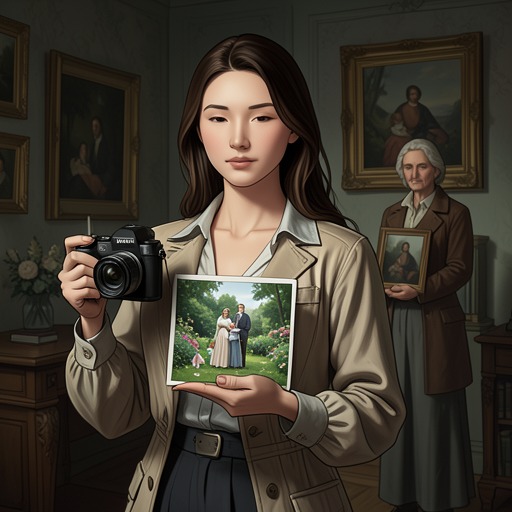
MovingPhotographs and family memory form a fragile record of belonging in the novel: images preserve faces and gestures, yet they cannot settle who belongs to whom or repair what has been lost. Removed from their frames, torn and mended, or kept close at a sickbed, photographs and related keepsakes make family history tangible while showing how painful it can be to look at directly.
Images That Keep and Disturb the Past
In March 1981, as the twins turn twenty-one and return home for a Sunday lunch, Edwina and Alicia prepare the house for a family celebration. Alicia makes a chocolate cake; Edwina brings out the best china, and blue-and-white hyacinths scent the room. The photographs taken that day later become difficult to live with. They are stripped from their frames and put in a cupboard in the Welsh dresser, no longer displayed on desks and mantelpieces. Their details invite questions that the family cannot comfortably answer: one boy seems unlike the other two, Rowena appears painfully thin, and a boy with dark eyes wears a woman’s necklace. The images preserve the gathering, but they also make visible its tensions and uncertainties.
That double force shapes the family’s relationship to photographs. An image can hold a moment still, but it cannot supply a settled explanation for it. The birthday pictures bring the family together as an occasion and divide it into details to be scrutinized. Their removal from public view is not the destruction of memory; the pictures remain, but are kept where Edwina does not have to encounter their questions every day. The cupboard becomes a place for memories that cannot be discarded and cannot be comfortably displayed.
A Postcard of Hope
A postcard from Thailand offers a more deliberate kind of family image-making. Rowena writes of food markets, Buddhist temples, a beach hut close to the sea, and Charlie’s deep tan; she describes him as sober and healthy, making friends wherever he goes. The account presents a hopeful family project: Rowena believes that time, sleep, good food, yoga, meditation, reading, and swimming might help her twin. Charlie adds a jokey scrawl and kisses in the limited space left on the card.
The postcard has been torn in half and repaired with Sellotape. Its damage gives the object a physical history of its own, while the message preserves the optimism of a particular moment. For Lucas, hearing Dickie recount that hope, the postcard sits uneasily beside what he knows and feels. He thinks Charlie spoiled everything and blames him for Elise’s death, but remains silent rather than voicing that accusation. The family’s record of Charlie is therefore not a single account: Rowena’s hopeful description, Lucas’s anger, and the postcard itself carry different versions of the past.
Keepsakes and Confession
When Lucas returns Edwina’s stolen jewellery box, its missing valuables are not the only things that matter. Among the small objects he has recovered are a wedding ring, a lock of hair kept in a matchbox, a creased photograph of a family on a sun-bleached beach, and a Parma violets tin that holds baby teeth instead of sweets. These things make family memory intimate and bodily. They are not valuable in the way the stolen jewellery was, but their meaning lies in the people and relationships they connect to.
The box’s final drawer gathers the keepsakes that Edwina recognizes as its real treasure: her tiny wedding ring, Dickie’s hair, the children’s baby teeth, and the photograph of that last day. The photograph is both evidence of a shared family past and a reminder of its irreversibility. Lucas’s confession makes the return of the objects more than a restoration of property. He explains that he arranged the robbery because he owed money and handed over the house keys, believing that no one would be hurt; in the end, everyone was. Edwina cannot speak at first. The recovered items do not undo the theft or its consequences, but their return gives Lucas a way to act against the shame and blame that have defined their relationship.
Memory Reconsidered
Another image in the house shows Charlie and Rowena as nursery-school children, their tiny hands painted red and blue and crossed over dark grey sugar paper. It offers a memory of the twins before adult conflict and loss, held in a simple record of their shared childhood. Lucas knows that Edwina is looking at it as he stands in the house, and he feels himself slipping back into the quicksand of youth. The picture connects his present visit to the family’s earlier life without making that past easy to revisit.
The movement toward reconciliation comes not through a photograph alone, but through what Lucas does with the objects and what he says about the harm between them. Edwina’s challenge invites another round of blame; Lucas refuses that pattern, recognizing the repeated movement from accusation to revenge to guilt. Later, he hurries to retrieve Barbara’s cheap leatherette album because he understands that the possessions that mattered to her are in its pages, not among the furs and jewellery that have long since disappeared. He places it beside her in the home, sprays Diorissimo around her pillow, and holds her hand. The album’s value is inseparable from its being returned to the person whose memories it holds.
Across these scenes, photographs and keepsakes preserve traces rather than complete histories. The birthday images raise questions; the postcard records hope that could not guarantee an outcome; the beach photograph and children’s teeth give material form to a family past; the album becomes an act of care at the end of Barbara’s life. Their meanings shift with the people who look at, hide, recover, or return them. In Lucas and Edwina’s final exchange, memory does not erase estrangement, but the returned objects help make room for a different relation—one no longer governed only by blame.