Home and belonging
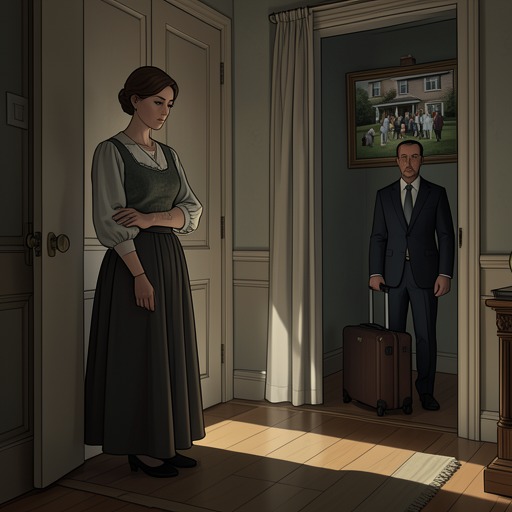
MovingHome and belonging in the novel are measured less by an address than by the fragile ties a place is supposed to shelter. For Lucas, the remembered family house in Chelsea remains a refuge even after it is no longer his; for Edwina, family duties never guarantee affection or safety. Their eventual confrontation brings these meanings together: an old bedroom, a stolen jewelry box, and a confession expose how a home can hold both welcome and resentment, and how belonging may be damaged without being entirely beyond repair.
Houses That Promise Safety
At fifty-six, Lucas returns to London because his beloved mother, Barbara, is dying. The journey from North Carolina has lasted some thirty hours, but the more disorienting distance is between his present life and the question of where home is. His life abroad seems preposterous and dreamlike to him; he has come to think of that version of himself as a cardboard cut-out, a persona over which he had little control. His return does not immediately restore an older identity. Instead, it places him in his mother’s unfamiliar flat, where even finding the bathroom is uncertain.
That discomfort sharpens against his memory of the River Walk house. He misses being able to slip a key into its primrose-yellow door, breathe the polished parquet hallway’s familiar smell, and run upstairs to touch his old Lego, Meccano, bears, cars, and books. These possessions matter as more than childhood keepsakes: in memory, they certify that he once had a room and a place in a household. Bartholomew Lodge, though expensive, feels like a cramped warren of small apartments, not a home he recognizes. The contrast with the spacious properties he has become accustomed to abroad makes the London flat feel still more confining.
A photograph helps recover the house as a scene of security. It shows a whitewashed semi in a quiet Chelsea street, close to the river, with a yellow front door framed by cream-headed roses. Lucas remembers bees in the garden, and how a sting once seemed the worst thing that could happen to him. Behind that door, his mother arranged flowers and his father sat smoking in the sitting room—though Lucas questions whether the pipe is a true memory or a later confusion. The uncertainty does not cancel the refuge. He remembers cycling along the Embankment, boating in Battersea Park, and walking between his parents along the King’s Road, swinging between their hands. The childhood home persists as an image of being held, even when the details of the image may have shifted.
A Childhood Between Households
That image of secure belonging is interrupted by the divided family life that followed. Lucas’s father continued crossing the river to see him, despite Barbara’s anger. For the next eight years, Lucas felt little control over where he should be or with whom. At home with Barbara, he experienced her as distressed; with his step-family, he watched his father pine for Edwina. School could seem preferable because its unpleasantness was consistent. Moving between households did not give him two homes so much as leave him feeling out of context in both.
Edwina’s part in that family arrangement contains its own conflict. She remembers performing the duties of a stepmother to Lucas—remembering birthdays, wrapping Christmas gifts, making breakfast, and washing clothes—while privately feeling as if she were pretending to care. She regards Lucas as Barbara’s child rather than her own and recalls that she and Barbara were bound together by mutual dislike of her. Yet Edwina also tried to make Lucas welcome: after learning of his interest in the Apollo space mission, she painted him a mural and marked the bedroom door with a hand-painted tile bearing his name. The room was prepared in case he wanted to return, even though Edwina could not honestly welcome that possibility without reservation. The tile and the resentment coexist; neither makes the other unreal.
Reinvention and Distance
After Charlie’s trial, Lucas’s departure abroad offers a different answer to the problem of home. Paul Landreth arranges for him to transfer to a company office in New York, placing him where, in Paul’s view, he can do little harm. Lucas calls it a fresh start. In the Big Apple, he finds reinvention easy: his English accent and appearance help him inhabit a new, preppy identity. In his mother’s scrapbook, one photograph shows him raising a bottle of Budweiser, with his own handwriting declaring that he is living the dream. The image records not only a new life but a version of himself presented for an audience.
The distance is also emotional. Lucas describes the past as another country, cold, grey, and miserable, and returns home infrequently because the place makes him bitter and sad. Barbara and his father visit him in the States separately, and Barbara takes readily to New York’s shopping, theatre, and restaurants. These visits keep a connection alive while allowing Lucas to avoid the place associated with his earlier unhappiness. Yet the scrapbook and his return show that distance cannot make the past disappear. The photographs preserve both the polished new persona and the house whose yellow door still carries the force of home.
The House, the Theft, and the Confession
When Lucas and Edwina meet again, the bedroom tile becomes a point of contact between their conflicting memories. Edwina sees the untouched Christmas gifts, the silences, and Lucas’s fear that his absence might leave Barbara free to kill herself. She recognizes that his childhood distress was real, even as she resists being held responsible for it. Her challenge to him is to say whether everything was her fault. Lucas refuses the familiar exchange of blame, revenge, and guilt; he wants that cycle to stop, not to assign the past to a single culprit.
The conversation turns to Edwina’s red leather jewelry box, worn and faded, whose compartments are empty except for a final drawer containing intimate family keepsakes: a wedding ring, hair, baby teeth, and a photograph. Lucas admits that he arranged the theft. In trouble at school and owing money to someone who would not forget the debt, he handed over the house keys and told the thieves when it would be safe to enter. He had obtained money and believed no one was hurt; in retrospect, he acknowledges that everyone was hurt. The house that once signified welcome had also been made vulnerable through his betrayal.
Edwina cannot speak after the confession and trembles as she cries; Lucas rises to leave. The moment does not establish an easy reconciliation, nor does it undo the years of estrangement. It does, however, alter the terms on which they can remember the house and one another. Lucas gives Edwina the truth rather than another accusation, and she receives an account of his action that includes both its motive and its consequence. Home and belonging remain marked by loss, divided loyalties, and damage, but the confession interrupts the inherited contest over who should carry all the blame.