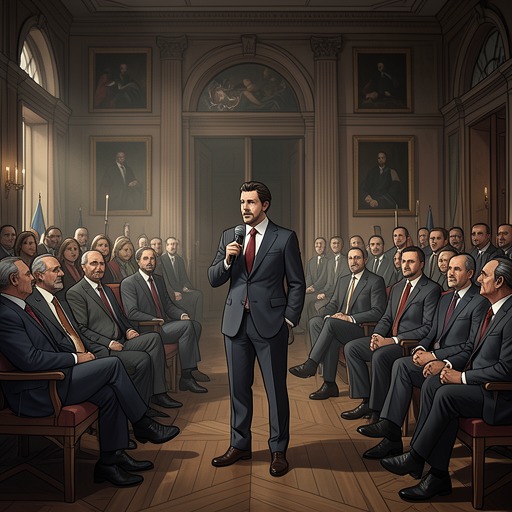
Chamberlain's 28 September 1938 crisis statement to the House of Commons
MunichNeville Chamberlain’s 28 September 1938 crisis statement to the House of Commons was both a public account of his attempts to avert war and a live record of diplomacy under mounting pressure. In the novel, Hugh Legat follows the speech against its text while telegrams and urgent messages arrive, so that the Prime Minister’s orderly narrative is repeatedly overtaken by events it is trying to explain.
The crisis behind the statement
The address followed a worsening confrontation over the Sudetenland. Chamberlain told his Cabinet that the Czech Government had agreed to an orderly transfer of the territory to Germany, subject to a plebiscite, but Adolf Hitler had rejected even a further week’s delay and threatened to invade on Saturday. After Sir Horace Wilson warned him that Britain would support France if France fulfilled its treaty obligations to Czechoslovakia, Hitler’s reported answer was that he was prepared for every eventuality and that the countries would be at war by the following Monday. The immediate stakes were therefore not abstract: a deadline, a threatened invasion and the risk that a French commitment would bring Britain into war.
The Cabinet’s discussion shows why a public declaration of resolve was difficult to separate from the danger of provoking the very conflict it was meant to prevent. Chamberlain recognised that partial mobilisation could demonstrate that Britain was not bluffing and might make Hitler reconsider. He also feared that it could push Hitler into war, particularly because he believed Hitler could not tolerate losing face. Another Cabinet voice argued that Britain’s earlier peace efforts might be mistaken for weakness, invoking the German miscalculation of Britain’s seriousness in 1914. The statement’s account of the crisis thus sat within a live dispute over how to make a warning credible without turning it into an immediate trigger.
The difficulty was political as well as military. Chamberlain later asked how the British public could be persuaded to continue a winter war if Czechoslovakia collapsed before the end of October, when Britain had already accepted that the Sudeten Germans should not have been placed under Czech rule. Lord Halifax, Foreign Secretary, reported that the Dominions would not support a war over so narrow an issue; the United States was not expected to enter, and Ireland would remain neutral. Even the possibility of Soviet support was raised. The speech’s detailed recital of events therefore addressed a public whose willingness to accept the costs of war could not be taken for granted.
A long account delivered in real time
By just after one o’clock, Legat was in the Garden Room at 10 Downing Street as Joan finished typing the Prime Minister’s speech. Chamberlain was due to leave for the House of Commons at two. The statement had grown to forty-two typed pages and more than eight thousand words; it had taken until the early hours to complete, and Legat estimated that delivery alone would occupy the best part of an hour and a half, even without interruption.
The Commons heard the account in absolute silence. Chamberlain reconstructed the crisis day by day and, at points, hour by hour, while House Messengers kept bringing telegrams and pink telephone slips into Westminster. The speech explained why he had made the unprecedented decision to travel to Germany personally and meet Hitler in the hope of saving peace. It retraced his first visit, to Munich on 15 September and then by train to Hitler’s mountain home at Berchtesgaden, and his return to Germany on 22 September for a meeting at Godesberg on the Rhine. Chamberlain presented those journeys as successive efforts to secure an agreement, while acknowledging that his course exposed him to criticism if he returned without one.
Legat checked the delivery against his copy and marked the occasions when Chamberlain departed from the prepared text. The Prime Minister’s manner was unhurried and forensic, but not without theatre: he put on pince-nez to read from documents, removed them to look briefly towards the skylight, and described his meetings in the measured manner of an explorer reporting on an expedition. The contrast between this controlled performance and the crisis outside the speech sharpened as he approached the events of the previous two days.
Messages break into the parliamentary account
When Chamberlain reached the account of sending Sir Horace Wilson to Berlin as a last effort to preserve peace, Legat noticed movement in the Peers’ Gallery. Sir Alexander Cadogan had arrived with a messenger and was urgently trying to attract Lord Halifax’s attention. After Halifax left the gallery to meet him, Cadogan gave Legat a folded sheet marked for the Prime Minister and marked urgent. He said that a direct response had just come from Hitler and needed to reach Chamberlain before he finished speaking. Unable to approach the Prime Minister directly, Legat passed the note along the bench to Lord Dunglass.
The message arrived in a chamber still listening to Chamberlain’s explanation of the crisis. Earlier, Wilson had repeated to Hitler that Britain would feel obliged to support France if French forces became actively involved in hostilities against Germany. In a separate report from Berlin, Sir Nevile Henderson told Legat that Benito Mussolini had sent Hitler a message through the Italian Ambassador. Mussolini promised that Italy would stand by Germany in the event of conflict, but asked Hitler to postpone mobilisation for twenty-four hours while the situation was reconsidered. Hitler had agreed. The temporary pause did not settle the dispute; it placed another narrow interval between the threatened invasion and a possible attempt to avert it.
A public speech beside a secret timetable
The novel sets the parliamentary account beside a secret German opposition effort whose chances also depended on the mobilisation timetable. General Ludwig Beck had resigned as Chief of the General Staff in protest against war with Czechoslovakia, but had kept his action private after promising Hitler he would do so. He told the conspirators that opposition within the high command was strong enough that, if Hitler ordered mobilisation, the Army might disobey and move against the regime. Yet the Army’s oath of loyalty meant its first move against Hitler could not be direct: Beck argued that it could enter the Chancellery to restore order only after some disturbance had begun.
Colonel Hans Oster and Captain Friedrich Heinz estimated that surprise and Army protection against an SS rescue attempt would make an initial force of about fifty men sufficient to arrest Hitler. The conspirators agreed that stopping him from ordering mobilisation mattered more than deciding what government should follow. They would take him alive if he surrendered, but agreed he might have to be shot if he appeared likely to escape. When mobilisation was postponed for twenty-four hours, however, the Army’s willingness to act remained uncertain. Oster later said that everything had depended on Brauchitsch, who was still deciding what to do when Hitler issued the postponement. The pause that gave diplomacy more time also altered the opening the conspirators had been waiting for.
This parallel gives the speech a double significance in the narrative. In the Commons, Chamberlain tried to make the crisis intelligible through a careful public chronology; beyond the chamber, opposition to Hitler was constrained by military loyalties, a deadline and the uncertain response of Army leaders. The statement did not itself resolve those competing pressures. Later, Sir Horace Wilson described Hitler’s demand that Britain, France and Italy guarantee that the Czechs would begin evacuating the disputed territory by Saturday, or face a German invasion. He also reported that Mussolini produced a draft agreement which, in translation, was broadly similar to an earlier proposal. The address is therefore not presented as a conclusion to the crisis, but as a moment when public explanation, diplomatic manoeuvre and the possibility of domestic resistance all remained subject to the next decision.