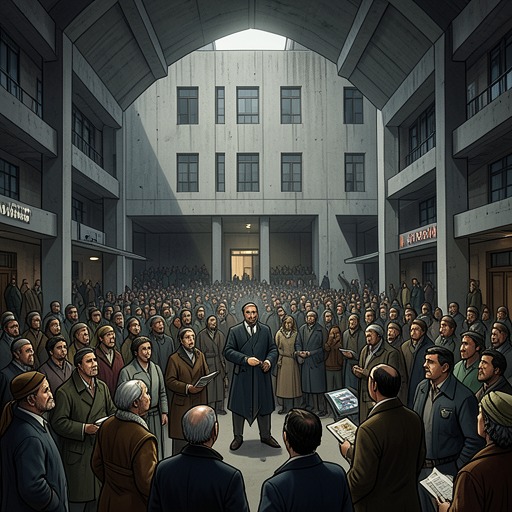
Hitler's Sportpalast speech of 26 September 1938
MunichHitler's Sportpalast speech of 26 September 1938 is presented as a performance whose assurances of peace sharpen, rather than settle, the threat of war. On the following afternoon, Hugh Legat reads its words for a third time in London: a speech that claims to speak for all Germany, promises an end to territorial demands, and warns that Czechoslovakia may be attacked within days. Its force lies in the gap between those assurances and the ultimatum unfolding around them.
The speech in the crisis
Shortly before one o’clock on Tuesday 27 September, Legat sits beside a floor-to-ceiling window in the Ritz Restaurant, with a copy of The Times open to page seventeen. He has ordered a half-bottle of 1921 Dom Perignon he cannot afford and is rereading the account of the address delivered the previous night at Berlin Sportpalast. The repeated reading gives the speech a second life: it is no longer only a mass rally heard in Berlin, but a document Legat studies as the crisis moves towards its deadline.
Legat had listened to the address live on the BBC. The book renders its delivery as metallic, remorseless, threatening, self-pitying, and boastful, with Hitler pounding the podium and fifteen thousand voices roaring approval. For Legat, that roar seems to pour from a black subterranean river. The image makes the audience’s response more than political applause: it is a collective sound, presented as immense and difficult to resist. Yet the very unanimity the speech claims is also part of its argument, not independent evidence that every German agrees.
Assurances and threats
Hitler insists that millions of Germans stand behind every word he speaks. He then says that he is grateful to Neville Chamberlain for his efforts and that Germany wants nothing but peace. The assurance is made conditional on the resolution of the Czechoslovak question: once it is settled, he says, “Germany has no more territorial problems in Europe.” The promise appears comprehensive, but its timing and condition leave the present territorial demand at the centre of the crisis.
Legat underlines that passage with his fountain pen. He also marks an earlier reference to the Anglo-German Naval Agreement, which Hitler describes as morally justified only if both countries solemnly promise never to wage war on each other again. He declares that Germany has this will and expresses the hope that people of the same conviction will prevail in Britain. In this appeal, the agreement becomes evidence for a possible peace between the two countries; alongside the demand over Czechoslovakia, however, it does not dispel the immediate danger.
The address’s threatening register becomes explicit when Erich Syers reports Hitler’s words from Berlin: “Ich werde die Tschechen zerschlagen!” Legat translates the threat as “I will smash the Czechs!” This blunt declaration sits against the speech’s professions of peaceful purpose. The contrast is not a later gloss imposed on the address: the narrative places the threat, the reassurance, and the pledge of no further European territorial problems within the same rapidly worsening confrontation.
The deadline and its diplomatic effects
At the British Cabinet meeting on 27 September, Neville Chamberlain reports that the hoped-for orderly transfer of the Sudeten territory, subject to a plebiscite, has been overtaken by Hitler’s demand for action. Hitler will not wait even a week and, according to the report, intends to invade on Saturday. Chamberlain also recounts Hitler’s response to a warning from Sir Horace Wilson: “It is Tuesday today, and by next Monday we shall all be at war.” The urgency of the speech therefore has a practical counterpart in the government’s deliberations: the language of force is attached to a short timetable.
The Cabinet considers partial mobilisation as a signal that Britain is prepared to fight. Chamberlain warns that such a step might instead push Hitler into war, since he believes Hitler cannot tolerate losing face. The speech’s combination of menace and professed peace thus bears directly on the problem of how to respond: a show of resolve might deter, but might also accelerate the conflict it is meant to prevent.
The immediate debate is not confined to military signalling. Sir Horace Wilson proposes a telegram urging the Czechs to accept Hitler’s terms and withdraw from the Sudetenland before his deadline, arguing that this is the surest way to avoid a wider war. Lord Halifax objects that urging the transfer of territory under threat would amount to complete capitulation. He also doubts that the British House of Commons would accept such a course and stresses that Britain cannot guarantee that the German Army would stop at the Sudetenland rather than occupy the whole country. The speech’s peace claims do not resolve this dispute; instead, the Cabinet must decide whether to treat them as credible while confronting the demand backed by force.
A pause without resolution
The danger appears to ease temporarily when, at 2:07 p.m., Legat hears a telephone call from Berlin. Sir Nevile Henderson reports that Benito Mussolini has sent Hitler a message: Italy will stand by Germany in a conflict, but asks that mobilisation be postponed for twenty-four hours so the situation can be reconsidered. Hitler has agreed. The pause changes the immediate timetable, not the substance of the confrontation. It follows a speech that has promised peace while placing a deadline on the Czechoslovak crisis.
Later, Sir Horace Wilson briefs delegates on the meeting with Hitler and Mussolini. His account includes Hitler’s assertion that 250,000 refugees have fled the Sudetenland into Germany in the preceding days, and his insistence that the matter must be settled by Saturday: either Britain, France, and Italy guarantee that the Czechs begin evacuating disputed territory, or Hitler will march in. Wilson says Hitler repeatedly watched his time, apparently checking the remaining duration of the mobilisation pause, and concludes that he does not appear to be bluffing. The speech’s importance in the novel rests on this accumulating pressure: its promises are repeatedly tested against deadlines, threatened invasion, and the choices those threats force upon others.