BAMA(Boston-Atlanta Metropolitan Axis)
NeuromancerBAMA (Boston-Atlanta Metropolitan Axis), also called the Sprawl, is the immense urban corridor that functions as Case’s home and as the terrestrial counterweight to the orbital worlds of Freeside and Zion. It is not merely a setting but a system of circulation: information pulses through its metropolitan core, trains move beneath its damaged surfaces, corporate power occupies its arcologies, and people cross its borders as easily as data crosses a network. The Sprawl gives the novel a material geography in which technological acceleration and physical ruin coexist.
Definition and Scale
BAMA is introduced through a map rather than a street-level description. When the display is programmed to show the frequency of data exchange, Manhattan and Atlanta burn solid white, then pulse as the simulation approaches overload. Increasing the scale gradually reveals recognizable industrial districts: blocks in midtown Manhattan and the century-old industrial parks surrounding Atlanta. The sequence makes BAMA legible as both territory and information field. Its true unity is not a single civic identity but the intensity of exchange binding distant urban zones together.
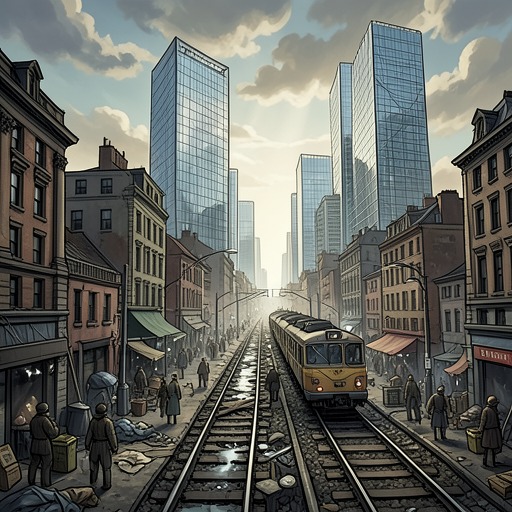
The map’s escalating scale also establishes the Sprawl’s characteristic tension between abstraction and physical density. At one level, BAMA is measured in megabytes per second; at another, it is made of old industrial parks, ferro-concrete roots, tunnels, and crowded platforms. The metropolitan axis therefore joins the disembodied space of the matrix to the damaged material world that Case habitually despises. Data gives the region its coherence, while infrastructure gives that coherence weight.
Case’s Home and Social Landscape
For Case, BAMA is explicitly home. He remembers himself as a Sprawl street boy, a teenager fighting on a rooftop at seventeen, and later one of the most accomplished console cowboys in the region. His professional formation came through McCoy Pauley and Bobby Quine, legendary figures who trained him in the criminal economy of cyberspace. BAMA is thus the place where his identity was made before his employers destroyed his nervous system and forced him into the prison of his own body.
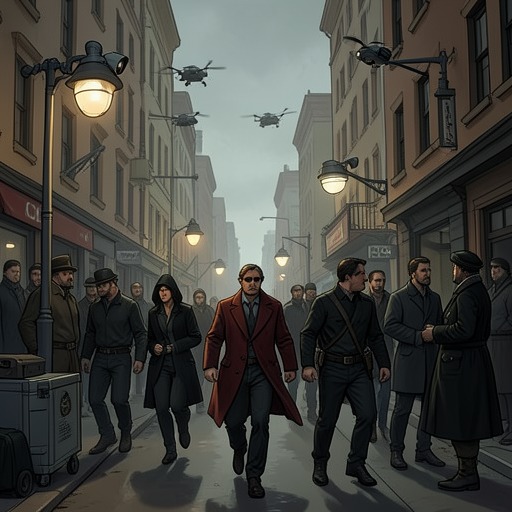
His return to the Sprawl is rendered through a mixture of intimacy and estrangement. He wakes in a factory room with Molly, surrounded by a pink temper-foam bedslab, identical nylon bags, blank walls, and a white-painted steel fire door. The building belongs to the interzone where art is not quite crime and crime is not quite art, a social borderland that mirrors BAMA’s larger instability. The room is technically a homecoming, but its missing floorboards, loose wooden blocks, soot-stained skylight, and improvised cable make clear that home is an improvised condition rather than a secure dwelling.
BAMA’s public life is equally hybrid. In the summer mall, crowds sway as a dense field of flesh, and Case watches faces recapitulate the stages of his life: child, street youth, and teenager. The mall offers a commerce distinct from the electric rhythm of Night City’s Ninsei, with fast food, perfume, and summer sweat replacing neon and cybernetic intensity. Yet the scene remains tied to Case’s technological existence: his Ono-Sendai Cyberspace 7 waits back in the loft beside a Sony monitor, corporate-grade ice, and other newly acquired equipment. The Sprawl’s ordinary commerce and its high-end criminal technology occupy the same continuum.
Infrastructure, Commerce, and Violence
BAMA is held together by transport systems that make distance both vast and negligible. Case waits for a trans-BAMA local on a crowded platform, then rides through an underground world of induction strips, falling grit, and passengers marked by competing subcultures. A white holographic cigar advertising Freeside hangs in the station, linking the terrestrial commuter network to orbital finance and pleasure. Travel to Freeside had once seemed unnecessary to Case because his deck could reach its banks as readily as Atlanta; after his bodily damage, however, the distinction between network access and physical travel begins to matter.
The region is also the operating ground for dispersed interventions. During the Sense/Net operation, nine Panther Moderns spread across two hundred miles of the Sprawl place simultaneous emergency calls from pay phones. Their coordinated deception causes police departments and public-security agencies to absorb a false report that militant Christian fundamentalists have introduced Blue Nine into the Sense/Net Pyramid’s ventilation system. The operation demonstrates BAMA’s political geography: its agencies are separate, but its communications infrastructure allows a small decentralized group to make the entire metropolitan axis respond as one nervous system.
The same attack turns the Sprawl’s communications technology into a weapon of mass perception. After the first misinformation campaign, a second is injected directly into Sense/Net’s internal video system. Screens throughout the building strobe for eighteen seconds at a seizure-producing frequency, then display grotesquely distorted imagery of contamination, laboratories, and the building’s water supply. Although the target is the Sense/Net Pyramid, the action depends on the wider metropolitan culture of terminals, pay phones, corporate systems, and public fear that BAMA embodies.
War Memory and Corporate Reach
BAMA is also the place where military history is processed into exploitable data. Case accesses a London database associated with Armitage and finds recordings of postwar military trials centered on Colonel Willis Corto. The archive reconstructs the Screaming Fist operation: Corto’s team entered Russian defenses over Kirensk in unarmed Nightwing microlights, carrying a prototype deck and the Mole IX virus; Russian pulse guns destroyed their electronics, lasers brought down the aircraft, and Corto eventually emerged blind, legless, and missing most of his jaw. The war ended nine days later, but the consequences continued through military facilities, hearings, and the creation of the damaged persona known as Armitage.
This history reaches BAMA through databases, trains, and rented rooms rather than through monuments. Case reads the archive from the Sprawl, lying beside Molly on a temper-foam slab while trying to assemble a story full of gaps. The metropolitan present becomes a receiver for distant military trauma, and the technological systems that once promised mastery instead preserve mutilation, secrecy, and institutional betrayal. BAMA’s networked scale allows old violence to remain active long after the battlefield has disappeared.
Relation to Orbital Power
BAMA’s terrestrial density contrasts sharply with Freeside, the orbital spindle that Case sees advertised in a station. Freeside is a brothel, banking nexus, pleasure dome, free port, border town, and spa, as well as the home of the Tessier-Ashpool family. Its wealth appears detached from the crowded industrial corridor below, yet the connection is structural: the family owns nearly the whole spindle, corporate and criminal operations depend on terrestrial information, and Case’s crew moves between BAMA, Chiba, Istanbul, and orbital space through the same networks of money and expertise.
The Sprawl therefore occupies an inferior but indispensable position in the novel’s hierarchy. It supplies skilled operators, illicit software, data, transportation, and the human bodies that orbital capital treats as expendable. Even Case’s earlier ruin reflects this relationship. After his nervous system was damaged with the same wartime Russian mycotoxin later used to control him, his remaining assets were converted into New Yen and spent in Chiba’s clinics. His technological life, his medical desperation, and his return to BAMA all belong to a transnational economy whose circuits extend from black-market streets to orbital dynasties.
BAMA’s significance lies in this compression of scales. It is at once a childhood landscape, a criminal labor market, a communications weapon, a transport machine, and a historical archive. Its crowds and ruined factories are not separate from the matrix or from Freeside’s wealth; they are the bodily and infrastructural underside of the same system. By making the Sprawl both intimate home and immense network, the narrative shows how personal identity is formed, damaged, and repeatedly mobilized within structures too large for any single resident to control.