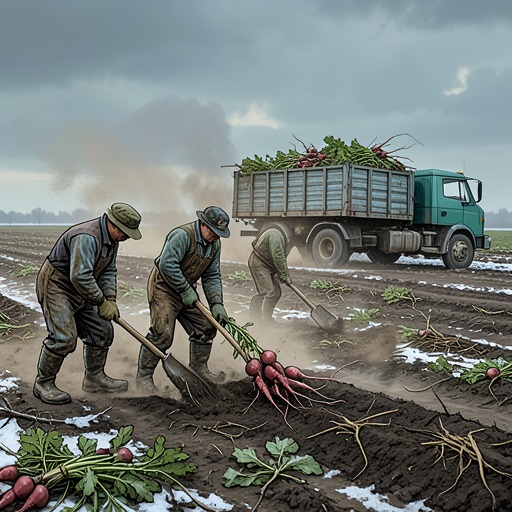
Author leaves after participating in the sugar beets harvest season in North Dakota
NomadlandThe author’s brief stint at Drayton Yard brought him into the sugar beet harvest he had previously known through other workampers’ accounts. He arrived intending to experience seasonal labor firsthand, not to claim the identity of a long-term workamper. The work quickly made the difference between hearing about hardship and feeling its demands concrete: after several shifts, he left the job, carrying away a clearer understanding of the workers’ testimony and of the costs of the harvest’s pace.
Why He Took the Job
At the Quartzsite gathering, a recruiter was seeking workers for the annual harvest, and the author took an application. He had spent many hours interviewing nomads about seasonal employment but had not yet visited their worksites. He did not expect a short trial to transform him into a workamper; he hoped it would deepen his understanding of the lives he was documenting. Months later, Express Employment Professionals accepted his application to hire him on behalf of American Crystal Sugar Company.
The regional scale of the work gave that decision a larger context. The Red River Valley, spanning western Minnesota and eastern North Dakota, contained more than half of the country’s sugar beet acreage: about 680,000 planted acres. Sugar beets accounted for 55 percent of United States manufactured sugar production, and American Crystal Sugar Company was the country’s largest beet sugar company. With employment in the region near full capacity, recruiting itinerant workers who could bring their own homes helped meet the harvest’s seasonal labor needs. The author arrived with two pairs of heavy-duty gloves during the last week of September, just before the rush to bring the crop in ahead of freezing weather.
The Harvest Campaign at Drayton Yard
The opening weeks of October were known locally as a campaign, a word borrowed from military language. The harvest began at midnight on October 1. Farmers hurried to remove beets before frozen ground halted the work, while truckers carried loads around the clock to storage facilities. Trucks crowded local roads, and spilled beets marked the routes. At peak, American Crystal’s more than thirty receiving stations took in about 50,000 truckloads a day. The author’s first view of this system was Drayton Yard, a large storage and processing site near the Canadian border.
He was assigned to the ground crew at Piler Number One, working twelve-hour shifts inside a refrigerated shed built around a growing mound of beets. A trainer estimated that the existing pile already held about 20,000 tons from the preliminary crop; the new beets were reportedly coming in larger than the year before, some as big as basketballs. At the scale house, incoming trucks were weighed and lined up for the piler. The machine received each load through a hopper, shook excess dirt from the beets, then sent them up a conveyor and out along a long boom onto the pile. As the mound grew, the piler moved backward on its treads to make room. The finished heap was expected to stretch the length of two Boeing 747s parked end to end, with a ventilation system keeping it near freezing until the beets could go to the refinery.
Work, Pace, and Risk
The crew’s task was to keep the machinery and surrounding floor clear. Workers shoveled spilled beets back into the hoppers with pitchforks and agricultural scoops, and resorted to smaller handloads when repeated lifting became difficult. They also cleared slippery mud, taking full-body effort to free shovels when they stuck. The pace was relentlessly enforced: one manager’s refrain made clear that even a pause was unwelcome. When the crew fell behind, an overseer in pink cowboy boots sounded a horn from the elevated control booth and gestured for them to shovel faster. Beet pieces and clods of dirt flew from the conveyors, coating workers’ safety gear.
Other duties brought the machinery’s force close to the body. To collect samples, workers held open vinyl sacks beneath a chute and braced as beets rushed into them. Cleaning the piler meant shutting the machine down and climbing inside to scrape out its main chute. The mud there came away in thick, leathery strips, and the crew was given fifteen minutes to clear it because downtime was costly. During one shift, a beet about the size of an apple struck the author’s wrist as he raised a hand to signal a coworker about an approaching truck. The noise was so great that shouting was difficult, making the crew’s reliance on quick signals part of the work’s everyday danger.
After two days of orientation, the author completed his first twelve-hour shift and drove back to his campsite in the dark. His back and shoulders hurt, and old strains had flared up. Though workers had been promised access to bathing facilities, that part of the campground was still being built, so he cooked in his van and fell asleep in his clothes with a splitting headache. The next day brought a serious near miss: a seven-foot metal pole from a broken harvester had arrived hidden in a beet load and was pulled into the piler. An emergency shutdown stopped it partway up the first conveyor, before it reached the tumbler; the pole might otherwise have damaged the machine and endangered workers nearby. That same day, a coworker slipped on the concrete and had to report a swollen knee.
The Workers Around Him
The campsite brought together workers with markedly different circumstances. Dan, sixty-nine, had left truck driving after medical problems and said he needed daylight because he was losing sight in his right eye. He had to ask the foreman to move him off the night shift. His wife, Alice, lived with him in their motorhome and, after an ALS diagnosis, could not work. The campground also held people in their fifties, younger workers, and a couple in their twenties living in a pickup truck. Their presence made visible the variety of people drawn to temporary harvest labor, including older workers and people living in vehicles as they traveled for jobs.
The author also met a worker known as Overdrive, who described choosing an optimistic outlook even on a rainy morning. That attitude existed alongside the physical strain rather than cancelling it. The author himself felt divided: he cared about the people he had met and felt some obligation to continue through the end of the campaign, but he also recognized that he would return home to write, unlike workers who depended on the job. He concluded that no matter how long he stayed, this brief experience would not make him a real workamper. It had, however, let him test firsthand whether the accounts he had collected were true.
Quitting and What the Experience Changed
After a shift, the author told the foreman he would not return. She did not appear surprised; workers leaving was common. A few days later, he learned that most of the people at his piling station had also quit, and heard that a woman at another station had broken her wrist. His relief at having escaped injury carried a trace of guilt, but also underlined how quickly the hazards he had encountered could become more serious.
He drove away from Drayton Yard after dark as trucks carrying beets passed in the opposite direction. In the rearview mirror, the red neon sign for American Crystal Sugar Company glowed through steam rising from the plant. He paid for a hotel in Grand Forks, where he could finally take a hot shower, and fell asleep while trying to watch a movie. The departure ended his participation in the harvest, not his investigation of precarious work. Its decisive result was experiential: he left knowing that the workers he had met had not exaggerated what the job demanded, and that a short visit could reveal the labor’s force without making its risks or dependence his own.