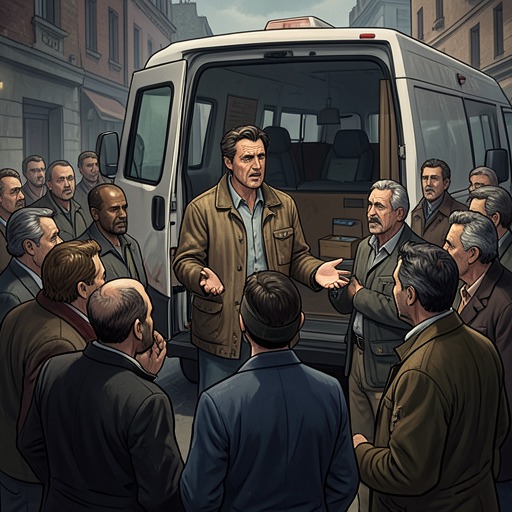
Bob Wells launches CheapRVLiving.com
NomadlandCheapRVLiving.com began as Bob Wells’s modest collection of how-to articles for people hoping to live in a vehicle on a limited budget. After the 2008 financial crisis brought a wave of newly precarious readers to the site, its practical advice took on a broader meaning: vehicle dwelling appeared not only as a way to reduce expenses, but as a possible response to a social contract that no longer seemed to protect people who had followed its rules.
A Practical Guide to Vehicle Living
Wells started CheapRVLiving.com in 2005. Its early purpose was concrete: to explain how people could make a life in a car, van, or recreational vehicle without spending much. A key subject was Boondocking, which, in its stricter sense, meant parking off-grid in the wilderness rather than paying for a site with water, sewage, and electricity hookups. The word was also used more broadly, but city dwellers who parked discreetly were more precisely stealth camping. Wells’s site offered strategies for both kinds of vehicle living, addressing the different conditions of remote camping and urban parking.
That distinction points to the practical character of the project. Living in a vehicle depended on more than choosing a vehicle or leaving conventional housing: where a person could park, access to services, and the costs of a paid site all shaped what was possible. On public land near Quartzsite, Arizona, for example, the Bureau of Land Management allowed free camping for up to two weeks before campers had to move at least twenty-five miles or pay to stay in the La Posa Long Term Visitor Area. Those rules illustrate the landscape in which low-cost living advice mattered, while also showing that mobility was bounded by regulation and expense.
A New Audience After 2008
Traffic to the site surged after the financial crisis. Wells later recalled receiving almost daily emails from people who had lost jobs, were running through their savings, or faced foreclosure. Search queries about budget living and living in a car or van brought some of them to his articles. The audience had changed: what had begun as information for people seeking an unconventional way to live now also served readers trying to cope with economic losses they had not been able to prevent.
Wells offered these readers encouragement rather than treating their hardship as proof of personal failure. His argument was that education, employment, and hard work no longer guaranteed security; someone could do what society expected and still end up broke, alone, and without a home. In that framing, moving into a vehicle could become a form of conscientious refusal of a system that had failed its participants, as well as a route toward a life imagined in terms of freedom and adventure. The site’s significance thus grew beyond its how-to function, although its advice remained rooted in the material problem of finding a place to live.
The book places this response against an earlier period of displacement. In the mid-1930s, during the Great Depression, house trailers entered mass production, and some people discovered that living in them could free them from rent. The parallel is not that the two periods were identical, but that both made mobile housing seem newly compelling when established economic arrangements failed. Wells’s site gave a contemporary audience practical information for a similar turn toward vehicle-based living.
Mobility, Rules, and Limits
The site’s subject existed within a legal and administrative contradiction: full-time travelers had no clear census count, in part because they were required to maintain fixed addresses. A person living on the road still needed an official domicile for matters such as vehicle registration, a driver’s license, taxes, voting, jury service, and health insurance. Some travelers chose states with fewer administrative burdens and used mail-forwarding services; establishing South Dakota residency could require only one night in a local motel and registration with a forwarding service, with receipts presented to the state.
Nor did moving to public land remove the possibility of being treated as a permanent resident and moved along. In Coconino National Forest, rangers questioned campers about their addresses, and people judged to be making residential use of the forest could be ticketed and evicted. A Quartzsite camping sticker could be taken as evidence of a person’s nomadic status; the Forest Service was also developing an app through which members of the public could report suspected long-term campsites. These conditions clarify the limits of the freedom Wells described: vehicle living could reduce dependence on rent, but it still relied on parking access, a paper domicile, and the ability to keep moving.
Advice and a Culture of Mutual Aid
CheapRVLiving.com belonged to a wider culture in which information and material help circulated among vehicle dwellers. Wells later hosted the Rubber Tramp Rendezvous, preparing a schedule of social events and seminars, putting up a sign, and setting aside a free pile where people could leave useful items. The gathering made practical knowledge communal: participants shared haircuts, solar cooking, basic repairs, carpentry, surplus electricity, and lessons in American Sign Language. These exchanges were not all services supplied by the website; they show the face-to-face practices surrounding the kind of mobile life its articles explained.
The same mutual support met immediate needs. At Quartzsite, people contributed ingredients to shared meals, and a morning campfire became a place where Lesa NeSmith offered coffee to whoever arrived with a cup. When the Valentinos ran out of fuel while trying to keep warm, Vincent drove them to town; they returned with food from the local food bank. When Linda May became too ill to cook in Ehrenberg, nearby nomads brought her food. Such scenes give the project’s practical subject a social dimension: an individual might travel alone, but surviving on the road could depend on shared skills, food, and care.
Significance
The launch of CheapRVLiving.com marked a shift from Wells’s own vehicle-living experience to a resource for others. Its reach expanded as economic distress sent readers looking for alternatives, and its message treated mobile life as both a practical adaptation and a challenge to the assumption that conventional work and housing necessarily deliver security. Yet the life it described was neither unrestricted nor self-sufficient. It required ways to park and remain officially documented, was exposed to eviction and seasonal disruption, and often depended on informal networks of help. The site’s importance lies in holding those realities together: it made vehicle living legible as an option while the surrounding evidence shows how much that option depended on rules, infrastructure, and other people.