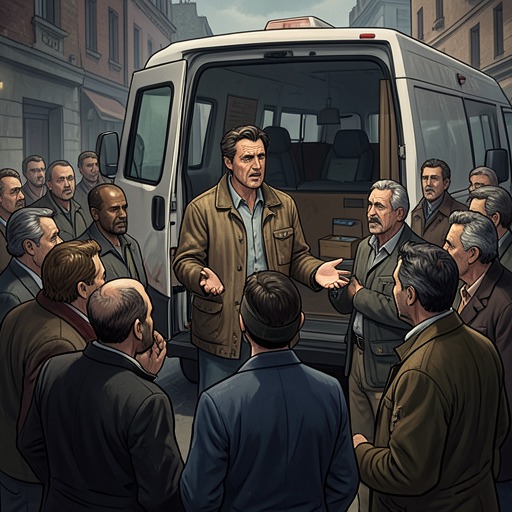
Bob Wells moves into a box truck
NomadlandBob Wells’s move into a box truck began as an improvised response to divorce, debt, and unaffordable housing, but became the decisive experiment through which he discovered a different way to live. At forty, he saw vehicle dwelling as evidence that his life had failed; over six years, he made the truck into a home, found that he could live without many conventional expenses, and came to understand the arrangement as a source of happiness rather than defeat.
Identity and Background
In 1995, Wells was emerging from a bitter divorce after thirteen years of marriage. He and his former wife had two young sons, and he was carrying $30,000 in maxed-out credit-card debt while preparing to declare bankruptcy. When he left the family’s crowded trailer in Anchorage, he went to Wasilla, where he had bought a couple of acres intending to build a house. At that point, the property amounted to a foundation and a floor. He pitched a tent there and used it as a base while traveling the fifty miles to work in Anchorage.
Wells soon wanted to be closer to his sons and to his steady Safeway job. His father had managed a Safeway, and Wells had started at the store as a bagger on his sixteenth birthday. But rent in Anchorage was expensive, and he was trying to sustain two households. Of the $2,400 he took home each month, half went to his former wife. The remaining $1,200 did not make an apartment in Anchorage affordable, while commuting between the city and Wasilla consumed time and gasoline. The distance between his work, his children, and the unfinished house turned an already strained budget into a practical impasse.
From Tent to Vehicle
Wells first tested vehicle living as a way to cut fuel costs. During the workweek he slept in an old Ford Courier pickup with a camper shell, then returned to Wasilla on weekends. In Anchorage he parked outside the Safeway. Managers accepted the arrangement, and because he was already nearby, they sometimes offered him shifts when another employee did not arrive. The extra work brought overtime as well as income, making the truck a place to sleep and a base close to his job. The experiment led him to consider whether he could live this way permanently.
The pickup camper felt too small for full-time use, so Wells began looking for another option. On his commute he repeatedly passed a battered Chevy box truck parked outside an electrician’s shop with a sale sign. The truck had no mechanical problem; its appearance embarrassed the shop owner, who did not want to send it on service calls. The asking price was $1,500, exactly what Wells had left in savings. He spent the money on it.
The truck’s box was seven feet high, with a roll-up rear door and a floor measuring eight by twelve feet. Wells could regard that space as a small bedroom, but the practical dimensions did not immediately make the change feel manageable. On his first night, after laying out a sleeping pad and blankets, he wept. The move seemed to confirm his harshest judgment of himself: he was a working father who had failed to keep his marriage together and was now reduced to living in a vehicle. He thought of himself as homeless and a loser, and crying himself to sleep became routine.
Building a Home
The first emotional shock did not determine what the truck became. Wells stayed in it and gradually made the interior work for daily life. He built bunk beds from plywood and two-by-sixes, sleeping on the lower bunk and using the upper one for storage. A recliner gave the small room another place to sit and sleep; plastic shelving screwed to the walls helped organize what he owned. His makeshift kitchen consisted of an ice chest and a Coleman two-burner stove. For water, he used convenience-store restrooms to fill a gallon jug.
The arrangement also made room for his sons. When they visited on his days off, one slept in the bunk and the other in the recliner. The truck was not only a way to reduce Wells’s expenses; it was the place where he continued to receive his children. As he adjusted it, the modest interior became more usable without requiring the rent and utility bills that had made conventional housing so difficult to sustain.
Savings allowed further changes. Wells insulated the walls and roof, added a catalytic heater connected to a forty-gallon propane tank for winter temperatures as low as thirty below, and installed a fan through the ceiling for summer. A generator, battery, and inverter supplied electricity for lights, and he eventually added a microwave and a twenty-seven-inch tube television. These were practical alterations, but they also marked a change in his relationship to the truck: it was no longer only a vehicle he endured, but a space he could adapt to his needs.
Change and Consequences
When the box truck’s engine blew, Wells did not abandon vehicle living. He sold his Wasilla land and the unfinished shell of the house he had continued building on credit cards, using part of the proceeds to repair the engine. The breakdown made the vehicle’s material dependence unmistakable, but his response showed how thoroughly the truck had become his home: rather than return to the conventional plan, he used the sale to keep it running. It remained his home for six years.
Looking back, Wells described the move as something he might not have chosen without being forced into it, yet he was glad it happened. Living in the truck changed his view of the expected sequence of marriage, a house, work, and happiness postponed until late in life. The change did not erase the distress of the first night or the circumstances that had brought him there. It did, however, reverse the meaning he had assigned to the vehicle: what had first seemed like rock bottom became the first life in which he remembered being happy.
In 2005, Wells began CheapRVLiving.com, a modest collection of practical articles for people seeking to live in vehicles on limited budgets. Its guidance included boondocking, or camping away from paid hookups for water, sewage, and electricity, as well as strategies for discreet overnight parking in cities. His own move therefore became more than a private adjustment to financial pressure. The truck furnished the experience from which he could explain how a vehicle might serve as affordable housing, while the site later offered that knowledge to readers confronting job losses, depleted savings, or foreclosure.
Mobility and Its Limits
Wells’s experience belongs to a broader form of life that can look unrestricted from the road but depends on practical arrangements. Nomads have to maintain an official domicile for vehicle registration and inspection, driver’s licenses, taxes, voting, jury service, and other obligations, even when they do not live at that address. Florida, South Dakota, and Texas are popular choices because they have no state income tax; mail-forwarding services keep travelers connected to an official address. South Dakota makes residency especially accessible: a person can spend one night in a local motel, register with a mail-forwarding service, and present both receipts to the state department of public safety.
Public land can offer room to camp, but not unlimited residence. Near Quartzsite, Arizona, free Bureau of Land Management camping permits stays of up to two weeks before campers must move at least twenty-five miles or pay to stay in the La Posa Long Term Visitor Area. There, a permit costs $40 for two weeks or $180 for as long as seven months. Rules can also make continued vehicle living precarious: in Coconino National Forest, a person judged to be making residential use of the land may be questioned, ticketed, or evicted. The truck offered Wells shelter and control over housing costs, but his story sits within a larger condition in which staying mobile still requires money, a vehicle that runs, an official address, and places where overnight parking is allowed.