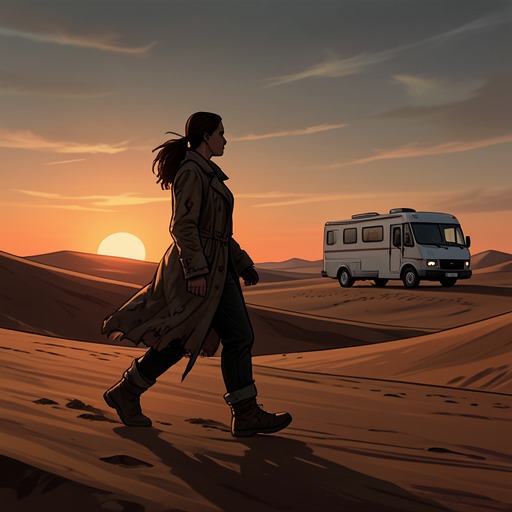
Linda May begins a mobile working life
NomadlandLinda May begins a mobile working life by turning an idea found online into a practical plan: buy a motorhome, move between seasonal jobs, and rely on a community of travelers rather than a conventional home. The transition promised independence, but it rested on fragile supports—savings from temporary work, low-paid employment, access to places to park, and help from family and fellow nomads.
The decision to leave fixed housing
Reading accounts on CheapRVLiving.com changed what Linda considered possible. The stories made extreme frugality seem less like deprivation than a route to freedom, and showed her that solitary travel did not have to mean isolation. Other travelers, including women around her age, shared information and survival strategies; their scattered encounters formed a social world she could imagine joining. Linda’s own hope was not simply to get by, but to make a life that felt active, connected, and creative.
The online community also offered a practical guide to work. Linda learned about seasonal jobs from other travelers’ accounts, including camp-hosting and Amazon CamperForce. She decided that if she could work through successive seasonal jobs, she might later take a break and collect unemployment for a time. The plan gave her a way to connect earning money with travel, and to save for a visit to the Rubber Tramp Rendezvous, where she hoped to meet the community she had encountered online.
Turning a windfall into a vehicle
The immediate means came through a family connection. Collin, Linda’s son-in-law, noticed that a Veterans Affairs hospital project had made no arrangements to remove old signs and repair and paint the walls beneath them. Linda’s daughter, Audra, took on that work and assigned some of it to Linda. The job paid fifty dollars an hour; within a couple of months, Linda had accumulated $10,000. That short-lived opportunity supplied the capital for a change that otherwise remained out of reach.
In April 2013, Linda found a 1994 El Dorado motorhome on Craigslist. It had only 29,000 miles and was listed for $4,000, far below the roughly $17,000 value the book gives for a vehicle of its kind. She inspected it with a friend. The motorhome had rotting tires and a large damaged area above the passenger side of the cab, crudely patched with caulk. Inside, plastic and plywood initially suggested extensive water damage, but Linda traced the musty odor to a hole in the shower. The rest of the interior was in good condition, including the bedroom, dinette, upholstery, carpet, and working flush toilet. The generator did not work, but the vehicle appeared usable after repairs.
Her friend warned that the damage could not be fixed. Linda had already chosen to proceed. She repaired the shower, left the caulked damage above the cab alone, and spent $1,200 replacing the tires. The costs made the purchase an investment rather than an instant escape: the motorhome needed work, and Linda still had to find income that could travel with her.
Work as the engine of mobility
Linda followed information gathered from other nomads into seasonal employment. After reading about Bob Wells’s camp-hosting experience with California Land Management, she applied to the company and got a job near Yosemite National Park. The contrast with her earlier work was substantial. Rather than returning to retail work, restaurants, construction sites, casinos, or offices, she would live at the campground where she worked and avoid rent.
In June 2013, shortly after turning sixty-three, Linda drove her motorhome to Junction Campground, two miles from the eastern entrance to Yosemite National Park. She was hired for thirty hours a week at $8.50 an hour. Even a full year of uninterrupted forty-hour weeks at that rate would have produced only $17,680, without benefits. The job therefore offered a place to live and a way to keep moving more than it offered financial security.
The campground’s basic arrangements made that trade possible. Its thirteen sites were filled on a first-come, first-served basis, so Linda did not have to manage reservations and their paperwork. Her duties included cleaning two outhouse toilets; for part of her stay, she also took on a small campground at nearby Tioga Lake. There were no utility hookups at Junction Campground. Her supervisor lent her a generator, and a water truck arrived each Tuesday to fill the motorhome’s fifty-five-gallon tank. With housing provided, her main living expenses were groceries, diesel for the generator, and propane for the stove.
Camp hosting also suited Linda’s social nature. She enjoyed talking with vacationers and encountered other older travelers, including a couple looking for campground work whom she introduced to her bosses. But seasonal employment was not a universal fit: a coworker who insisted on carrying a firearm was let go because camp hosts could not carry one in a national forest. The episode showed that this work offered an entry into a mobile livelihood, not freedom from workplace rules or uncertainty.
Linking seasonal jobs and community
Linda’s next planned stop was Amazon CamperForce. She applied after reading Jim Melvin’s blog about seasonal work, including his experience at an Amazon warehouse in Fernley. The internet connected her not only to a job listing but to firsthand accounts that could make an unfamiliar kind of work seem legible. Amazon’s $50 referral bonus gave her a reason to list Jim as her referrer. She expected that a camp-hosting job followed by warehouse work might let her earn enough to pause afterward and attend the Rubber Tramp Rendezvous.
Her family helped maintain the connections that a mobile life might otherwise loosen. Audra encouraged Linda to get a smartphone and offered to cover her line on the family plan; Collin promised that the plan would include sufficient data. This support mattered because travel required more than fuel and a place to sleep: staying in contact with family and accessing work information depended on communications infrastructure.
The first job ended when the Rim Fire spread across the region. By September, smoke had thickened around Linda’s campground, and she left for Fernley to join Amazon CamperForce. The next link in her itinerary brought its own housing constraint. Trailer parks near the warehouse were already busy with itinerant workers and fully booked. Linda had made no reservation because much of her summer had been spent without cell or internet service. At Sage Valley RV Park in Fallon, twenty-three miles southeast of the warehouse, a manager made room for her even though the park was also full of CamperForce workers. Her arrival depended on a small, personal accommodation within a crowded seasonal labor market.
The larger nomadic community made mobility more than an individual logistics problem. At the Rubber Tramp Rendezvous, travelers shared food, tools, and practical knowledge: mechanics taught basic repairs, people with solar panels offered spare power, and others demonstrated how to repair tires. Linda valued these skills and later used them while camp hosting to help forest rangers whose fire truck had a flat. Such exchanges turned community into a practical resource, especially for people whose income and living arrangements could change with each season.
The limits beneath the promise
Linda’s new life offered a way around some barriers she had encountered in conventional employment. She had once waited six months for an opening at a Home Depot in San Clemente, even though it was a transfer. She understood age discrimination as a particular obstacle for older workers; by contrast, employers hiring itinerants for seasonal jobs seemed more accessible to her. Yet easy access to a job did not mean stable employment. Camp-hosting hours, pay, and housing depended on a particular employer and season, while warehouse work offered another temporary stop rather than a permanent foundation.
Travelers also had to maintain official residences even when they lived on the road. Vehicle registration and inspection, driver’s licenses, taxes, voting, jury service, and health insurance all depended on a legally recognized domicile. Mail-forwarding services helped nomads manage that requirement. South Dakota’s comparatively simple process required one night at a local motel and registration with a mail-forwarding service before applying for state residency. Mobility therefore relied on a fixed address on paper, even when a person had no permanent home in practice.
Access to places to stay was equally conditional. Public land near Quartzsite allowed free camping for up to two weeks, after which campers had to move at least twenty-five miles or pay to stay in the La Posa Long Term Visitor Area. Elsewhere, authorities could treat long-term camping as residential use: in Coconino National Forest, rangers questioned some vehicle-dwellers about their addresses and could ticket or evict people considered permanent nomads. These restrictions complicate the idea that a vehicle alone makes a person free to go anywhere.
Linda’s beginning was thus neither a clean break from economic insecurity nor a simple retreat from social life. It was a working arrangement assembled from a discounted used motorhome, a temporary family-sourced job, seasonal wages, a borrowed generator, delivered water, phone access, and knowledge passed between travelers. Each move opened a possibility, but each also depended on resources and permissions that could run out. The road became both her workplace and her home because people, jobs, and places to park could be brought into sequence; the sequence itself remained uncertain.