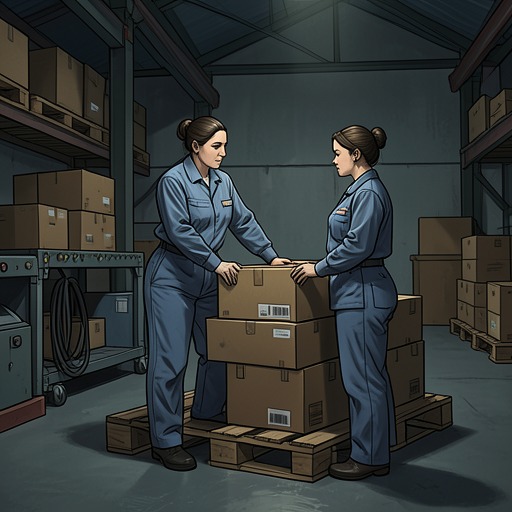
Linda May and Silvianne Delmars
NomadlandLinda May and Silvianne Delmars were friends who became campground-host coworkers, joining forces for a season at Hanna Flat Campground. Their partnership linked two women who had already met in precarious warehouse work and were now making mobile lives through seasonal employment. At Hanna Flat, friendship took a practical form: they shared a work territory, routines, and the strain of a job whose hours and boundaries were not secure.
From warehouse coworkers to campground partners
Linda and Silvianne first met about a year and a half before their campground season, when both were night-shift temporary workers at an Amazon warehouse and Linda injured her wrist. Silvianne, then sixty, had worked across several fields, including corporate healthcare, waitressing, retail, acupuncture, and catering; she also read tarot. She understood the events that had led her into van life as a spiritual redirection toward a nomadic path. The two women’s connection therefore began not in a settled home or a long-standing workplace, but amid temporary employment and changing circumstances.
When Linda prepared to host a campground, she counted the days until Silvianne could join her. Silvianne had never been a campground host, but she was eager to try. She described Linda as a companion whose presence made difficult work feel manageable. By then, Silvianne was living in a 1990 Ford E350 Econoline Super Club Wagon she had bought after a series of setbacks, including a stolen car, a broken wrist, and a house in New Mexico she could not sell. Once used as a transit van for older people and a work vehicle for convict labor crews, it still bore the faint traces of painted-over lettering. She had named it the Queen María Esmeralda and filled its interior with scarves, pillows, Christmas lights, and a small altar. This was the home she brought to their shared job.
Reuniting at Hanna Flat
When Linda arrived at Hanna Flat, Silvianne was still two hours south, parked outside a friend’s condominium in Escondido. She was using the driveway for access to laundry and hot baths, and had only $40 while waiting for a credit card to arrive by mail. The circumstances made their reunion more than a social visit: both women were relying on work and improvised arrangements to sustain life on the road. When Silvianne reached the campground, she hugged Linda, looked inside the small Squeeze Inn, and remarked that it looked bigger in the pictures. Linda explained that she liked living there, though she missed the shower and toilet from her former RV; she had replaced the toilet with a bucket.
Their first days together established a working rhythm. For their first shift they wore matching brown pants and khaki windbreakers bearing a mountaintop logo, and set out in a golf cart loaded with cleaning supplies and tools. Silvianne, newly taught to drive it, took the wheel while Linda rode beside her. Their different levels of experience were visible in the tasks: Linda already knew small efficiencies that made campground maintenance easier, from protecting toilet paper while disinfecting to tying a replacement trash-bag liner so it would stay in place. Silvianne joined the rounds and learned the job in practice, with Linda’s accumulated know-how close at hand.
Shared work and unequal security
Twice a week, the pair were responsible for all of Hanna Flat; on the other three days, they divided the territory with another host. Their work covered eighteen toilets and eighty-eight campsites, as well as checking in campers, collecting fees, placing reservation tags, offering hiking advice, resolving minor disputes, clearing fire pits, and completing paperwork. They also dealt with visitors who left a fire burning. Linda and Silvianne took turns pouring water onto the embers, then stirred the ashes to make sure the fire could not restart. When the campers returned and tried to revive the soaked pit, Linda explained the safety rule patiently. The exchange shows the two women working together not just to clean the site but to prevent a careless mistake from becoming a danger.
The workday did not reliably end when their assigned tasks did. Camp hosts were expected to respond when campers needed help, including at night; on one occasion, late-arriving visitors woke Silvianne to check them in. The job also blurred the boundary between paid hours and availability. Halfway through the season, a supervisor told them that falling reservations required a temporary cut to a three-quarter schedule. Linda’s weekly pay dropped below $290, and Silvianne earned even less because she had not received returning-worker raises. Neither woman complained in the account, but the reduced hours made plain how little security their shared position offered. Their friendship did not remove the economic pressure; it meant they faced the same abrupt change alongside one another.
Companionship amid scarcity
Silvianne’s arrival mattered to Linda before the daily work began: the prospect of a friend joining her was something she had been counting down to. Their companionship was set against the isolation of a small trailer and a job that could demand attention at any hour. When the narrator later prepared to leave, the women built a campfire and used old daily arrival reports as kindling. Asked what message the smoke might carry, Linda answered, “We went camping! We had a great time! The bathrooms were immaculate!” The joke turned the job’s least glamorous labor into a shared account of accomplishment: their work had left the bathrooms clean, and their time together could still be described as a camping adventure.
That farewell also took place against the immediate facts of limited money and provisions. The narrator left groceries, most of them for Linda because Silvianne followed a restricted diet. Linda said she was down to $10 until payday. The food came from the departing narrator, not from an exchange between the two women, but the scene makes the conditions of their companionship concrete: their time together unfolded inside a life where a small amount of food or a delayed paycheck mattered. The evidence presents no dramatic reconciliation or permanent arrangement between them. Instead, it records a season of friendship made tangible through shared work, everyday closeness, and the effort to keep going under unstable conditions.