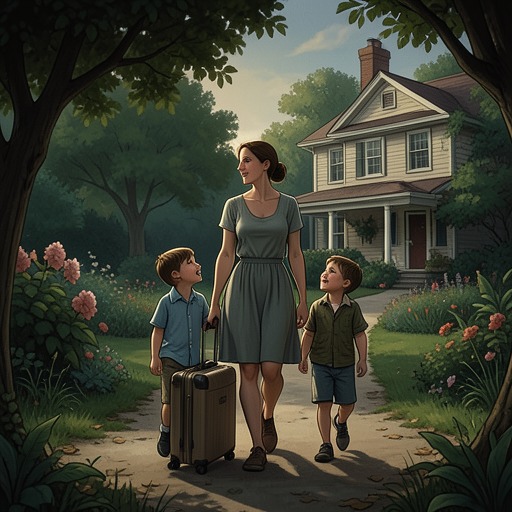
Linda May and her daughter Audra’s mother-daughter relationship
NomadlandLinda May and her daughter Audra’s mother-daughter relationship moves between closeness and the need for independence. Linda loves her family, but she also wants a home and life of her own; when crisis later puts Audra’s household at risk, Linda offers the motorhome that once carried her from job to job. Their bond is therefore expressed not as uninterrupted domestic harmony but through practical care, difficult limits, and repeated efforts to remain connected across generations.
Family, dependence, and independence
Linda raised two daughters mostly on her own and built a working life across many kinds of jobs. Years later, after her Jeep was immobilized in a repair shop, she stayed with Audra, son-in-law Collin, and their three teenage children in Mission Viejo. The rented house was already crowded: one grandson slept in a dining area without a door, while Linda had the couch near the front entrance. She adored her family, but the arrangement left her feeling stranded. When the others went out, they had to pass her couch on the way to the door, a small daily reminder that she was living in someone else’s home and could not simply set off on her own.
Linda missed her autonomy and worried that her presence made family outings awkward. Her attachment to Audra did not erase her desire to manage her own space and decisions. The Squeeze Inn, a small trailer she hoped to occupy and improve, offered a way to imagine independence again. But a repetitive-motion injury from an earlier Amazon warehouse job kept her from returning to that work, while money was short and her family was already under strain. The tension was not a lack of affection: it was the difficulty of needing support from a household whose members also had urgent needs of their own.
Care moving between generations
The pressure on Audra’s household was both emotional and financial. Her daughter Gabbi had been weak and intermittently bedridden for years before testing positive for Sjogren’s syndrome; her son Julian managed type 1 diabetes; Audra had arthritis; and Collin’s severe migraines and vertigo had forced him out of his office job. Those circumstances limited the room the family had to support Linda, even as she was living under their roof. Their situation makes the couch more than a domestic detail: several generations were trying to manage illness, lost income, and cramped housing at once.
Linda’s concerns about aging and economic security also sit within a longer history of women’s care work. She had raised her children largely alone and later lived with and helped her own mother, who developed an aggressive brain cancer. The book places Linda’s modest Social Security income and uncertain work prospects alongside the wider disadvantages facing older women, including lower lifetime earnings and unpaid caregiving responsibilities. That context does not reduce her relationship with Audra to economics; it clarifies why family care could be deeply meaningful and still feel precarious, with no easy separation between affection, housing, work, and financial necessity.
Care in moments of crisis
Their connection appears in small acts of response as well as in major decisions. During Linda’s drive toward a campground job in Mammoth Lakes, her dog Coco had a seizure while they were stopped for the night. Linda tried to revive and comfort Coco, then called Audra. Audra, who had studied essential oils, recommended frankincense; Linda applied it to Coco’s paws and stayed up monitoring the dog. The episode shows Audra as someone Linda could turn to for practical advice while on the road, even though their lives were physically separated.
The relationship also carries the meaning of Linda’s long sobriety. On the anniversary of her recovery, Audra publicly thanked her for standing up to addiction and bringing awareness to a disease that had affected their family for generations. The response connected Linda’s personal achievement to her role as a mother and grandmother: her sobriety had been part of the family’s life over time, not simply a private milestone. The affectionate support around the anniversary gave visible form to that shared history.
Eviction, reciprocal help, and separation
The balance of help shifted sharply when Audra and Collin lost their rental home. Collin’s short-term disability benefits ended, the family could not pay rent, and Linda gave them her old twenty-eight-foot El Dorado motorhome, which had been in storage. She had nearly sold it earlier that year, but the sale had fallen through. Now the vehicle was a possible shelter for Audra, Collin, and their three teenagers, along with four dogs. The proposed sleeping arrangements placed the adults in the bedroom, Julian in the loft over the cab, and the two granddaughters on the fold-out dinette, with the dogs wherever they could fit.
The family sold possessions from the two-thousand-square-foot house and garage, trying to reduce their belongings to what could be carried forward. Each teenager received a storage tub for the things they most wanted to keep. Julian parted with most of his musical equipment, including an accordion he loved; Jordan gave up much of her wardrobe. Two weekends of yard sales brought in $1,000. Linda helped organize the sales, but the prolonged emergency wore her down, and she acknowledged that she was still helping while also pulling back. The strain was real, as was her effort to make the motorhome available.
In late December, LaVonne came to Mission Viejo and helped get Audra’s family settled in the RV. Linda then prepared to return to the road. The family was sad that she would not be there for Christmas, and Audra cried. The departure was not a repudiation of the family: Linda had just transferred a substantial resource to help them, but remaining with them was not the life she could sustain indefinitely. Their relationship ends this stretch of the narrative with that double movement—Linda’s material support going to her daughter’s household, and Linda herself setting out again. Later, news that the grandchildren were sleeping in a tent beside the RV, where a storm soaked them and damaged the tent, underscored how limited the family’s refuge remained. The help had mattered, but it could not by itself remove the housing insecurity surrounding them.