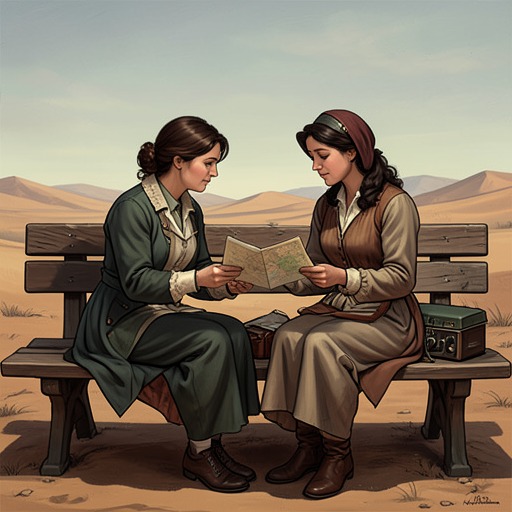
Linda May—LaVonne Ellis friendship
NomadlandLinda May and LaVonne Ellis’s friendship grew through the shared uncertainties of nomadic work and came to include a concrete project: helping Linda establish a greenhouse on her land near Douglas, Arizona. Their relationship linked the itinerant life they already knew to Linda’s effort to build a more lasting home, while LaVonne’s support also appeared in her writing and plans for the future.
A Friendship in a Mobile Community
Linda and LaVonne’s connection developed among people whose working lives depended on seasonal jobs, travel, and mutual help. The book presents that setting through extended reporting: its author moved beyond brief interviews, spent weeks with workampers across five states, camped in Quartzsite, and eventually lived in a self-contained van during reporting trips. That immersion made the recurring practical ties among nomads—sharing resources, skills, and care—part of the context in which the friendship becomes visible.
At the Rubber Tramp Rendezvous, the community’s generosity took tangible forms. People shared food and useful skills, offered excess solar power, and taught repairs; Linda valued what she learned and later used those skills while camp hosting. The gatherings also created occasions for people to travel and spend time together. On one outing, Linda joined a caravan led by Swankie to see petroglyphs, and the group helped pull a stranded vehicle from a ditch. These scenes describe a wider network rather than a service performed specifically by LaVonne, but they show the social world in which Linda and LaVonne’s own companionship took root.
Work, Travel, and Shared Commitments
The friendship was tested against the insecurity of seasonal employment. Linda and LaVonne were looking for workamping jobs for the spring when Linda believed she had secured another camp-hosting position with California Land Management. As the author prepared to leave the Rubber Tramp Rendezvous, Linda received word that the job had been eliminated. The lost position brought their shared economic uncertainty into focus: work and housing were intertwined, and a vanished job could disrupt the plans around which their mobile lives were organized.
LaVonne’s own path included both activism and creative work. After a two-week stay at Standing Rock protests against the Dakota Access Pipeline, she returned to Ehrenberg and worked through writer’s block to finish a short memoir about her childhood, The Red-Feather Christmas Tree, which she published on Amazon. In its acknowledgments, she wrote that Linda May had never doubted her. The dedication records a form of confidence and encouragement that LaVonne associated with Linda, extending their friendship beyond travel and work into the making of LaVonne’s book.
Building a Future Together
Linda’s search for a home eventually changed the direction of their shared plans. After finding five acres near Douglas, Arizona, she began preparing to build an Earthship, a project she had imagined for years. The land would require practical groundwork, including securing water during construction, surveying elevations, and learning the county’s setback and zoning requirements. Linda planned to begin after the Rubber Tramp Rendezvous, and Gary Fallon had agreed to return to the property with her.
LaVonne agreed to go as well. The first joint undertaking was to build a greenhouse, which would support organic farming and protect the project from the elements while Linda’s home was under construction. Their friendship thus took architectural form: it was not only a bond within a traveling community but also a commitment to help create the conditions for a more settled life. Linda imagined the Earthship as a home made with her own hands and the help of friends who had become family; LaVonne’s promised participation made that collective future part of the plan.
Significance
The relationship joins the book’s recurring contrast between precarious mobility and chosen interdependence. Linda and LaVonne faced uncertain jobs and a life organized around movement, but their friendship offered practical cooperation rather than a guarantee of security. Searching for work together and preparing to build a greenhouse gave their connection concrete consequences, while LaVonne’s acknowledgment of Linda’s faith in her preserved its emotional dimension. The planned greenhouse marks the clearest expression of their partnership: a shared first step toward turning a nomadic friendship into support for a home.