Egypt
OrientalismEgypt occupies a central place in Edward Said’s account of Orientalism: it is not merely a territory described by Western scholars and administrators, but a testing ground where knowledge and imperial authority reinforce one another. From the scholarly apparatus accompanying Napoleon’s invasion to British rule and later academic accounts of Egyptian society, representations of Egypt repeatedly claim explanatory authority while displacing local histories, political demands, and voices.
Strategic Territory and Colonial Rule
In 1910, Arthur James Balfour addressed the House of Commons about the problems of governing Egypt, at a moment when Egyptian nationalism was making the British occupation harder to defend. His authority rested on a long political career and extensive involvement in imperial affairs, but Said emphasizes how the speech made knowledge itself a justification for supremacy. Balfour claimed that Britain knew Egyptian civilization more intimately than it knew any other, and treated that historical knowledge as grounds for directing the country. In this account, Egypt became an object that Britain could survey across time and therefore claim authority over; Egyptian autonomy was denied in the very act of describing British knowledge as comprehensive.
Balfour’s argument portrayed Western self-government as a capacity absent from the history of “Orientals,” while treating their past achievements as compatible with despotism. The claim that this was simply a statement of fact obscured the political conclusion: the people being described could not be trusted to govern themselves. Balfour spoke for Britain, the West, and the supposedly beneficial interests of Egyptians, imagining that Egyptians, if asked, would confirm their dependence on foreign rule. Said identifies this substitution of imperial interpretation for local political agency as a defining operation of Orientalist authority.
Egypt also served as what Balfour called a vindication of Western imperialism. Britain occupied the country in 1882 and suppressed the nationalist rebellion led by Colonel Arabi. From 1882 to 1907, Evelyn Baring, Lord Cromer, was Britain’s representative and effective ruler there. In 1907 Balfour supported a £50,000 retirement award for Cromer, praising the prosperity he had supposedly brought about. Yet Said notes that Balfour did not explain how Egypt’s alleged moral prosperity was measured. British exports to Egypt, comparable in value to British exports to the whole of Africa, offered a clearer measure of the material interests bound up with claims of improvement.
For Said, the governing theory behind Balfour’s defense and Cromer’s administration was stark: Westerners rule, while “Orientals” are to be ruled, their territory occupied and internal affairs controlled. The theory’s effectiveness, rather than its humanity, made it powerful. Cromer opposed Egyptian nationalism and rejected demands for self-sustaining sovereignty, arguing instead for an enlarged cosmopolitanism. His premise that people classified as Oriental were essentially alike made their administration seem transferable from one setting to another. Knowledge of a supposedly fixed character thus became a practical technology of control, while control in turn encouraged the accumulation of further knowledge.
Knowledge, Description, and Historical Displacement
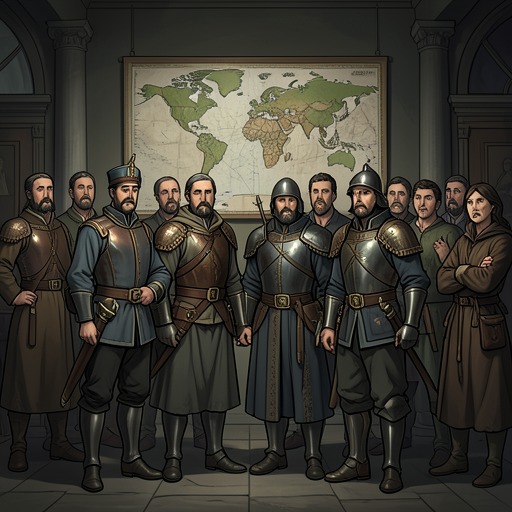
Said connects this British project to the wider modern history of Orientalism that began with Napoleon’s invasion of Egypt in 1798. Napoleon presented the expedition as a means of offering the Orient a European example and the benefits of civilization, while the project’s arts and sciences gave political domination an imposing scholarly form. The Description de l’Égypte classified, recorded, and organized what its authors observed, turning particular details into general laws about Oriental nature and society. Egypt was made into a field of specialized knowledge at the same time that it was subjected to military and administrative power.
The effect was not simply to add a European account to Egyptian history. Said argues that the Description displaced histories with their own coherence and identity, substituting a record that presented Egypt as part of world history understood largely as European history. To preserve an event from oblivion, in this framework, was also to make the country a stage for Western representation. The language of scientific description could therefore appear to rescue Egypt from obscurity even as it subordinated Egyptian historical meaning to European categories and purposes.
Napoleon’s occupation failed militarily, but Said distinguishes that failure from the lasting force of the knowledge system it helped establish. Its institutions and publications, including the Institut and the Description, made Egypt foundational to a modern Western discourse about the Orient. The occupation’s scholarly legacy outlived its immediate political success: other European powers, especially Britain, competed over the same claimed civilizing mission. In Said’s account, Egypt’s place in European knowledge was therefore inseparable from the historical contest to control and interpret it.
The imbalance between imperial record and local testimony is especially visible in Said’s comparison of the Description with the chronicles of Abdal-Rahman al-Jabarti, who described the French invasion from the standpoint of the invaded. The Description’s immense, systematic volumes were produced by a corps of scholars supported by a modern conquering army; al-Jabarti’s three volumes recorded the experience from a position of vulnerability. The contrast does not make one account simply objective and the other merely personal. It reveals how the standpoint of power shapes what can be presented as objective knowledge, and why an account that ignores the invaded author cannot stand for the whole historical experience.
Scholarship, Residence, and the Making of Egyptian Society
Edward William Lane’s An Account of the Manners and Customs of the Modern Egyptians (1836) acquired authority through both his experience in Egypt and the scholarly institutions that organized the work. Lane lived there in 1825–1828 and again in 1833–1835. He first went to study Arabic; after making notes about modern Egypt, he was encouraged by a committee of the Society for the Diffusion of Useful Knowledge to turn his observations into a systematic account of the country and its inhabitants. What began as notes thus became a work of “useful knowledge,” arranged to give readers accessible essentials about a foreign society.
Said stresses that Lane’s presentation of direct, neutral description concealed a process of selection and editing: the work he wrote was not identical to the book he published. His preface also asserted his authority in relation to earlier accounts. He criticized the Description de l’Égypte as too philosophically general and careless, and rejected Jacob Burckhardt’s study as a collection of proverbial wisdom. In contrast, Lane claimed that he had immersed himself in Egyptian life, conformed to local habits, and avoided arousing suspicion as an intruder. Yet, in Said’s reading, claims of proximity and accuracy did not remove the power involved in turning lived experience into an ordered account for European readers.
Lane’s influence also depended on how his book could be taken up by Orientalist scholarship. He was cited as an authority on Egypt and Arabia, while travelers such as Richard Francis Burton and novelists such as Gustave Flaubert were read in part for what their accounts revealed about themselves. Lane’s individual authorial identity was, to a greater degree, absorbed into a professional field that circulated and institutionalized his work. His standing therefore arose not only from what he said, but from the way his account could be adapted to the discipline’s expectations and claims to knowledge.
Said further describes the shaping of Egypt through Lane’s treatment of its temporal, spatial, and social differences. In the book, practices that seemed strange to European readers were reorganized as detailed items in normative European prose. Said argues that this process edited Egypt as well as defined it: elements that might unsettle European sensibilities were excised or recast. In particular, Lane represented Egyptian life as troubling European ideas of sexual propriety, hygiene, and domestic order. The resulting account made a complex society more manageable for its audience by narrowing what could be seen and how it could be understood.
Travel, Gender, and the Limits of Representation
For English-speaking travelers, the Orient was materially connected to British possessions, especially India. Passing through the Near East could mean traveling toward a major colony, and writing about Egypt, Syria, or Turkey could become an engagement with territory already imagined through political management and imperial possession. The British traveler’s imaginative freedom was therefore constrained by an empire that could be understood as extending from the Mediterranean to India. In Said’s contrast, French travelers encountered a different political situation: France lacked Britain’s sovereign presence in the region, and its Oriental projects were more often schemes imagined from afar than descriptions of territory under its direct rule.
Travel did not simply overturn scholarly preconceptions. Nineteenth-century European pilgrims came through Biblical lands and encountered an Orient already shaped by scholarship, religion, and earlier European histories. Some sought a fresh account that might escape the archive, but Said observes that such efforts commonly reproduced Orientalist reductions. Lane’s response was especially instructive: he reorganized his experience through the conventions of a systematic book. The travel account could thus present itself as immediate contact while continuing to domesticate the place in European categories.
Gustave Flaubert’s encounter with Kuchuk Hanem, an Egyptian dancer and courtesan whom he met in Wadi Haifa, makes the unequal power involved in representation particularly clear. Flaubert had read Lane’s discussions of dancers, but Kuchuk’s identity and experience did not enter the record in her own words. Said argues that Flaubert’s account turned her into a widely influential model of the Oriental woman: Flaubert spoke for her, assigning meaning to her character and presenting her to readers as representative. His comparative wealth, foreignness, and gender gave him a position of strength that Kuchuk did not share. The encounter therefore illustrates not simply a traveler’s personal perception but a broader pattern in which Western writers acquired the authority to describe Eastern people who were denied equivalent power to represent themselves.
Flaubert’s experience also shows how travel could confirm rather than dispel an imagined Orient. He wrote to his mother that what he found exceeded his prior conception and made things once vague appear clearly delineated. Said places this response within a literary search for a visionary alternative to provincial French life: the Orient promised color, spectacle, and mystery. Yet the place encountered in travel seemed decrepit and aging, prompting Flaubert to reconstruct and revive it through learned writing. His works about the Orient drew heavily on reading, including Western sources on religion, warfare, ritual, and society; memories of travel were then shaped into theatrical literary scenes. The account’s power came not from unmediated access to Egypt but from the transformation of experience into aesthetic representation.
Changing Histories and Continuing Stakes
Said’s account does not claim that there is a single authentic or “real” Orient concealed behind Western representations. Instead, he expresses respect for the people of the region and their struggle to shape their own futures, while arguing that the histories and cultures gathered under the label have been repeatedly simplified. Contemporary criticism of Arab and Muslim societies for alleged backwardness, lack of democracy, or failure to protect women can treat contested political ideas as if they were straightforward measures of a society. Said objects to the certainty with which foreign-policy commentators speak for people whose languages and actual lives they do not know, and to the use of such claims to prepare an imagined landscape for American power and imposed models of democracy.
This argument also shapes Said’s criticism of later scholarship on Islam and Egypt. He observes that Arabists and Islamologists continued to rely on fixed ideas of an Islamic society, an Arab mind, or an Oriental psyche, sometimes using religious texts to explain every feature of contemporary Egyptian or Algerian life. Such accounts could treat Islam as a single, timeless force while underplaying colonialism, imperialism, and ordinary politics. In his criticism of a history of Islam, Said notes that its treatment of modern Arab lands neglects revolutionary developments, anti-colonial politics, and the regional connections represented by Bandung and the wider Third World. Egypt’s history, in this view, cannot be adequately understood when change is reduced to Western-led modernization and other political histories are left outside the frame.
The difference Said draws is between studying other peoples and periods with care for their own sake, and producing knowledge as part of self-affirmation, hostility, or war. Historical inquiry can enlarge the possibility of coexistence; imperial knowledge seeks control and external dominion. Egypt brings that distinction into focus across several moments: the Description’s scholarly classification, Balfour’s claim that British knowledge entitled Britain to rule, Cromer’s rejection of Egyptian sovereignty, Lane’s conversion of residence and observation into a professional account, and Flaubert’s power to make Kuchuk Hanem signify an entire imagined type. Together these episodes show how representation can have material consequences, and why restoring the histories and political agency it excludes is essential to understanding Egypt.