The Occident
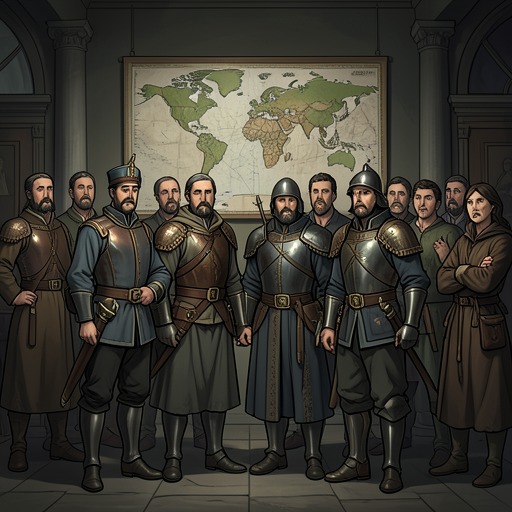
OrientalismThe Occident in Edward Said’s analysis is both a geographical designation and a historically produced idea of Western identity. Defined in contrast to the Orient, it becomes a position from which the West describes, studies, and governs other peoples. Its significance lies not only in where it is placed on a map, but in the authority attached to the contrast: a flexible Western superiority that makes the Orient available as an object of knowledge and control.
A Constructed Geographical and Cultural Idea
Said rejects the notion that the Occident, any more than the Orient, is simply present as an inert fact of nature. Following Giambattista Vico’s observation that people make their own history, he extends the principle to geography: regions such as East and West are also made through human thought and action. The Occident acquires a history, vocabulary, and imagery that give it a particular reality and presence in Western consciousness. The two imagined geographical entities support and, to some extent, reflect one another.
This account does not mean that the Orient is merely an idea without a corresponding reality. Cultures and nations located in the East have lives, histories, and customs whose reality exceeds Western descriptions of them. Said’s concern is instead with the internal consistency of Orientalism: the organized body of ideas about the Orient that can persist beyond any correspondence with actual people and circumstances. The Occident is formed in relation to that body of ideas, as the supposedly coherent Western counterpart to an equally generalized East.
Identity Through Contrast and Cultural Authority
Orientalism begins, in one of its central senses, from an ontological and epistemological distinction between the Orient and the Occident. Writers from different fields—including poets, novelists, philosophers, political theorists, economists, and imperial administrators—could take that distinction as the basis for accounts of Eastern peoples, customs, character, and destiny. The resulting opposition did not merely describe difference. It established a framework in which Western identity appeared coherent and superior against an Eastern other.
Said connects that framework to cultural hegemony. The idea of Europe identifies Europeans as a collective “us” in opposition to non-Europeans, while European ideas about the Orient reiterate Western superiority over what they portray as Oriental backwardness. Such assumptions can override the possibility that an independent or skeptical thinker might see the matter differently. Their influence is not confined to direct political commands: cultural forms and institutions help make some ideas predominant through consent, embedding the contrast in the broader life of Western society.
The opposition also acquires force through learned habits of classification. General categories such as language, race, type, color, and mentality are not neutral labels in Said’s account; they carry evaluative meanings. The repeated division between “ours” and “theirs” makes Western cultural membership feel inclusive to those within it while excluding outsiders. An imposing European tradition of scholarship and culture could thus define itself against colonized peoples, the poor, and other groups represented as constitutionally unsuited to its values.
Knowledge, Position, and Imperial Power
The Occident’s authority over the Orient is institutional as well as imaginative. Said describes Orientalism as a Western style for dominating, restructuring, and claiming authority over the Orient: it makes statements about Eastern societies, authorizes views of them, teaches them, and participates in settling and ruling them. Academic study and imaginative representation continually interact, while imperial power gives the distinction practical consequences. The Orient is made available for study in the academy, display in the museum, reconstruction in the colonial office, and use in theories about society, history, and human difference.
This relationship is not, in Said’s formulation, a matter of imagination alone. To say that the Orient was Orientalized is not to say that it was created simply by fantasy; it was also made subject to being represented in the terms available to Western power. Flaubert’s encounter with Kuchuk Hanem illustrates how that imbalance could operate at the level of an individual representation. She did not speak for herself in the account described by Said: Flaubert spoke for her and presented her to readers as typically Oriental. His position as a foreign, comparatively wealthy man gave him an advantage that enabled him both to possess her and to define her in writing. Said treats this encounter as representative of a broader pattern in which Western strength enabled discourse about the East.
Said calls the strategic advantage that the Westerner retains across many different encounters positional superiority. A scientist, scholar, missionary, trader, or soldier could approach the Orient from a position in which he could be there, or think about it, with little resistance from the people being described. The knowledge produced under that umbrella made the Orient legible for multiple Western purposes, while the observer’s authority and centrality remained largely unquestioned. The West could therefore occupy many roles in relation to the East without surrendering its relative upper hand.
The Effects of the East–West Division
When Western analysis, research, and public policy treat “Oriental” and “Western” as both the starting point and the final explanation, the categories tend to harden. The Oriental becomes more Oriental in the account, and the Westerner more Western; distinctions between societies and traditions then narrow the possibilities for human encounter. The division channels thought into an East or West compartment and allows Western power to appear as scientific truth rather than as a historically situated claim.
Said’s analysis of Ernest Renan’s philological work shows one way scholarly authority can reinforce that structure. The philological laboratory gave Renan’s statements confidence, apparent precision, and continuity, while lending Oriental subject matter a scholarly coherence. It also helped make Renan an Occidental cultural figure. Rather than guaranteeing disinterested objectivity, this arrangement linked scholarship to power through the authority of the institution and the categories it produced.
The same comparative habits could turn linguistic study into a basis for broad claims about race, mind, character, and temperament. Said notes that Renan incorporated work by Gobineau into later editions of his general history. In this setting, comparison between the Orient and Occident came to stand for an apparent inequality between them. The Orient could first be valued for qualities such as spirituality or longevity, then judged underhumanized, antidemocratic, or backward. These reversals did not dissolve the hierarchy; they helped sustain a profession built around restriction, restructuring, and the scholarly treatment of the Orient.
A Contested, Durable Order
For Said, the Occident’s distinction from the Orient persists not because it is a simple truth about two internally uniform worlds, but because ideas, institutions, and political arrangements reinforce one another. Orientalism’s durability rests in its close connection to social, economic, and political structures, and in continued material investment in its knowledge. The resulting system can enter academies, books, congresses, universities, foreign-service institutes, and general culture, where its claims are repeatedly taught and circulated.
Said also distinguishes between knowledge pursued through careful study and an effort to understand other peoples for the sake of coexistence and humanistic enlargement, on the one hand, and knowledge enlisted in self-affirmation, belligerence, and war, on the other. He rejects the idea that there is a single “real” Orient for which his analysis can simply substitute. Instead, he affirms the capacities of people in Arab and Muslim societies to struggle for their own visions of what they are and wish to become. His criticism of the Occident’s authority is therefore not a denial of Western scholarship as such; it is a challenge to knowledge that converts a relation of power into an unquestioned account of cultural difference.