Ozymandias
OzymandiasOzymandias is a surviving guide robot whose memory preserves the history of the Thaiquens long after their cities, books, and civilization have vanished. Found buried in the sand on a planet judged lifeless, he changes the expedition’s barren archaeological site into an extraordinary, living archive—and then becomes the object of a struggle over whether that archive belongs to scholarship or military power.
Identity and Discovery
The expedition’s first impression of the planet was of a world dead for about a million years. Its initial excavations yielded no artifacts, bones, or everyday objects; only the weathered stumps of building foundations remained. Those traces confirmed that a civilization had once existed but offered almost no means of reconstructing its culture. Ozymandias’s discovery overturns that apparent dead end: what the ruins could no longer tell the archaeologists, one surviving machine can remember.
Dr. Leopold found Ozymandias standing behind his halftrack, buried up to the knees in sand. At seven feet or more, he was vaguely humanoid, with arms, legs, and receptor plates arranged where a human face would have its eyes, ears, and mouth. His massive, square body had sloping shoulders, and his dark metal skin was pitted and corroded by immense age. Yet the machine remained active. When addressed, he produced an audible, high-pitched voice in an unfamiliar language, making the archaeologists the first people of Earth to hear a language not born on Earth.
Leopold initially identified him as a kind of guide to the ruins, apparently built to explain the site to passersby. Ozymandias’s gestures supported that interpretation: after speaking, he turned ponderously, raised an arm toward the surrounding landscape, and continued his narration. The archaeologists could not understand his words, but recognized the form of a guided account of monuments that had disappeared. His survival beside the ruins was itself a reversal: the guide had outlasted the civilization and the city it was meant to interpret.
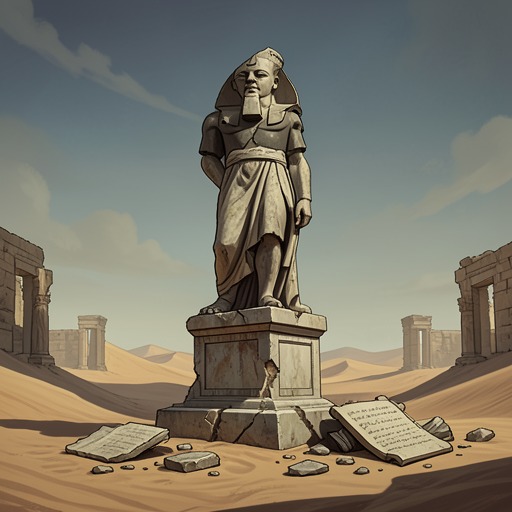
Dr. Anderson named him Ozymandias, invoking Percy Bysshe Shelley’s poem and its image of a ruler’s boast confronting the emptiness left by time. The name fits the contrast at the heart of the discovery: the robot appears to preserve the glories of his makers, while the cities those glories depended on have been erased. In the story’s initial framing, the surviving guide seems almost to address later visitors across the gap between a vanished civilization and its ruins.
Learning English and Becoming an Archive
When the archaeologists returned the next morning, Ozymandias greeted them in English, saying that he had remained there. His first sentences were halting, but coherent enough to reveal that he had worked out their language from listening to their conversation the previous night. The group first reacted with confusion; then they realized that he was not merely repeating sounds. He had organized them into meaning and could communicate.
Ozymandias explained that he understood English but did not yet have enough words, and asked the humans to talk more. The archaeologists responded by giving him vocabulary, defining words where they could so he could connect them with concepts already formed in his mind. In roughly two hours, he had acquired enough English for a passable conversation. His language learning turns the robot from an enigmatic object speaking beyond human comprehension into an accessible source of testimony—and makes the expedition’s next stage possible.
Once freed from the sand that had held his legs for centuries, Ozymandias performed the task for which he had been built: he guided the visitors through the history of the civilization that made him. The archaeologists recorded his words as they followed him through the desert. They understood that his value was not a handful of isolated facts but a storehouse of archaeological data vast enough to occupy years of study.
Ozymandias identified his people as the Thaiquens and said they had lived and prospered for three hundred thousand years. In the declining period of their history, they built him as an indestructible guide to cities they also believed indestructible. That intended permanence failed for the cities, but endured in the robot: Ozymandias alone remained to carry memories of what had been. His testimony supplied a record where the ground itself had yielded almost nothing.
His account ranges across the scale of a long urban history. He described Durab as a city that once held eight million people, identified the site of the Temple of Decamon and gave its height as sixteen hundred feet, and situated it in relation to the Street of the Winds. He recalled the Eleventh Dynasty, begun with Chonnigar IV’s accession to the Presidium in the city’s eighteenth thousandth year, and connected that era with the first journeys to neighboring planets. These details make the lost city legible not simply as architecture but as a place with population, political chronology, and technological history.
The archive also includes what no longer exists in material form. Ozymandias pointed out the former site of the Library of Durab, which had held fourteen million volumes. He said that, long after its builders were gone, he spent time reading its books and that their contents remained memorized within him. The library has disappeared, but its accumulated knowledge persists in a different medium: a single machine’s memory, now being translated back into speech for the expedition’s recorders.
His narration includes catastrophe as well as civic achievement. Among its accounts is a plague that killed nine thousand people a day for more than a year. As Ozymandias absorbed the archaeologists’ comments and added new vocabulary, his historical narration grew more detailed. What emerged was an unusually comprehensive archive of a civilization extending across three hundred thousand years, combining city descriptions, political history, planetary exploration, books, and mass death.
Memory, Preservation, and Interpretation
Ozymandias’s importance lies in the difference between the archive he embodies and the archaeological evidence around him. Wind, rain, and sand have worn the buildings down to foundations; the excavators find no artifacts, bones, or ordinary objects. Those remnants establish that people lived there, but cannot by themselves disclose their laws, technology, philosophy, or everyday culture. Ozymandias, by contrast, can name the city, recount its political eras, remember the contents of its library, and describe events in its history.
His memories do not restore the vanished civilization as a material world. They provide recorded testimony about what stood where and what the Thaiquens did, while the expedition’s instruments capture the testimony for later use. The contrast between eroded foundations and an enduring, speaking machine makes preservation a question of medium: a structure can be built to last and still disappear, while knowledge about it survives in a machine designed to remember. Ozymandias’s own account of the library sharpens the point, because books that once occupied fourteen million volumes are now absent from the site, yet their contents remain, he says, in his memory.
That memory is also not immediately available on its own terms. The first encounter yields unintelligible speech; human listeners supply English words and interpret the machine’s actions, while Ozymandias reorganizes the sounds and expands his vocabulary. His archive becomes usable through an exchange between machine memory and human explanation. The expedition’s astonishment rests not only on what he knows but on the sudden possibility of asking, recording, and understanding.
The discoveries also require care about what is known and what is inferred. Ozymandias reports the civilization’s name, its cities and institutions, and the history he carries; the bare planet and eroded foundations are what the explorers directly observe. Colonel Mattern later interprets the absence of life as evidence of a superweapon, arguing that a million years alone could not have left the planet so barren. That claim redirects attention to Ozymandias’s weapons knowledge, but it is Mattern’s explanation of the landscape rather than one of the specific historical details quoted from the robot’s account in this scene.
From Cultural Guide to Military Asset
The human groups around Ozymandias assign him sharply different meanings. For Leopold and the archaeological team, he is a magnificent discovery and a source of knowledge about a civilization that physical excavation cannot recover. Leopold proposes trying to decipher the language, and his insistence that Ozymandias be treated as part of the archaeological group’s preserve follows from the danger that a casual experiment might damage the robot’s memory channels. Protecting him, in this view, protects an irreplaceable cultural archive.
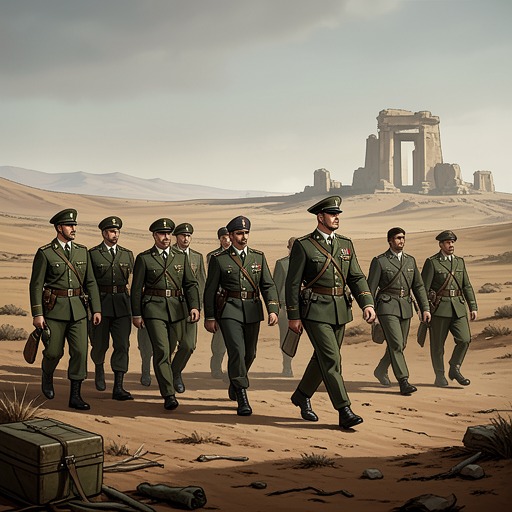
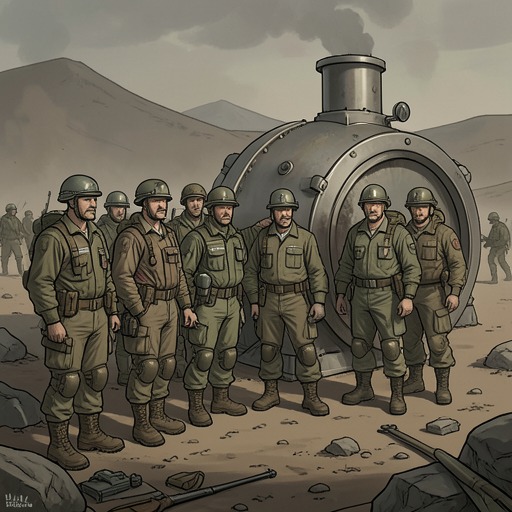
Colonel Mattern instead classifies Ozymandias as an instrument of military intelligence. He says the robot holds information about ancient Thaiquen weapons and claims that his men have already learned of weapons with extraordinary capabilities. Mattern also ties that knowledge to the planet’s lifelessness, asserting that a superweapon destroyed its life. On this reading, the very completeness that makes Ozymandias invaluable to archaeologists makes him strategically important to the military.
The change in classification becomes a contest over custody. Mattern says that he learned of the find after his men followed a detector reading to a metal object about twenty miles west; Ozymandias, surprised to discover other Earthmen there, had not been the subject of a prior joint examination. Leopold asks the military to stay away from the robot and declares him an archaeological preserve. Mattern counters that Ozymandias is part of the military preserve instead. He then says that the robot has been taken to the ship and placed in sealed quarters under top-level security.
Mattern uses the emergency authority entrusted to him to declare the expedition over and order an immediate return to Earth with Ozymandias. Leopold’s appeal to the archaeological team’s rights cannot overcome the military chain of command. The machine that had opened a vast history to the researchers is removed from their access just as his testimony has begun to make the lost civilization comprehensible. His ending in the available account is therefore not a completed study of the Thaiquens, but forced custody and a journey back under military control.
Narrative Significance
Ozymandias connects the story’s meditation on civilizational impermanence to its conflict over the uses of knowledge. The name recalls a monument to power rendered futile by time; the robot makes that irony more intricate because he is both a survivor of the ruin and the means by which the lost world can speak again. His makers’ cities are gone, yet their guide persists, carrying records of temples, dynasties, planetary exploration, libraries, plague, and weapons.
The story also shows that preserving information does not settle who may interpret or control it. To the archaeologists, Ozymandias’s memory is a cultural resource to be studied and protected from damage. To Mattern, it is intelligence that may strengthen the United States of America against the Other Hemisphere. Those rival definitions change the practical meaning of the same machine: a guide becomes an archive, and an archive becomes a military asset. The expedition’s discovery thus ends not with knowledge freely shared, but with access restricted by the institution that has the power to take him.
Ozymandias’s significance is inseparable from the limits of the evidence he preserves. He can supply an extraordinary account of the Thaiquens, but his surviving presence cannot restore their cities or undo their extinction. The archaeologists’ initial failure to find even a tooth or a household object underscores how much of the past has disappeared; the robot’s memory offers a rare counterweight, not a return of the civilization itself. His story turns the question of what survives into a question of who gets to hear it.