Gerhardt
OzymandiasGerhardt is a field member of the expedition to a planet whose civilization has vanished beneath a million years of sand. A watchful, initially skeptical presence, he voices doubts about Colonel Mattern and asks practical questions about the ancient robot the crew discovers. His responses help mark the changing limits of the expedition’s knowledge: what first looks like an empty world becomes a lost civilization’s archive, and that archive becomes the object of a conflict between archaeological inquiry and military control.
Identity and Background
The narrator describes Gerhardt as a small, scrunchy man with untidy brown hair that falls into eyes set a little too close together. He has a degree from the University of Kansas and has worked with its field staff; the narrator qualifies the account of his distinction by noting that this is what Gerhardt’s references said. The portrait combines a specific professional credential with a slightly comic physical description, but does not establish his precise specialty or formal rank in the expedition.
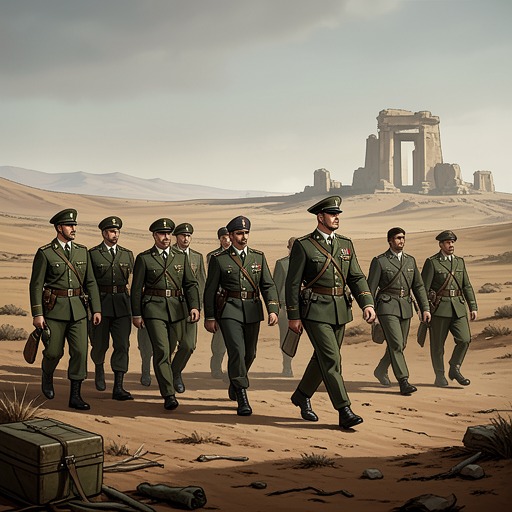
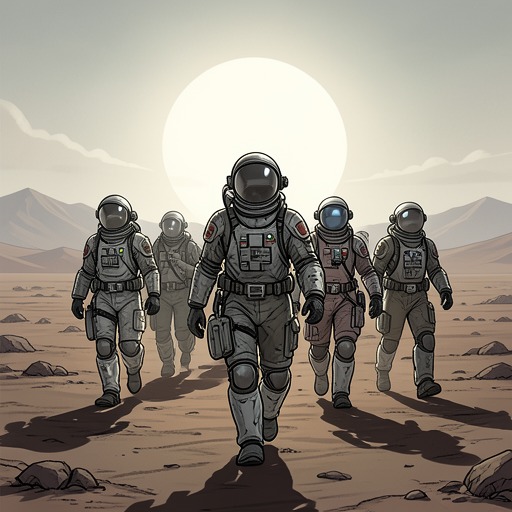
Gerhardt works alongside the narrator in a halftrack as the crew surveys the planet. Their first days offer little to reward that work. The world appears to have been dead for about a million years, and the archaeologists’ digging turns up no artifacts, bones, teeth, utensils, or toys. Weathered building foundations are nearly all that remains. Against that setting of material absence, Gerhardt’s watchfulness becomes one of the human signals that the expedition’s apparent purpose and its actual risks may not align.
Suspicion of Mattern
During the northern survey, Gerhardt breaks a long silence to say that he hopes the ship will still be at base when the two men return. When the narrator asks what he means, Gerhardt says he does not trust Mattern and believes the colonel hates the archaeological team. This establishes Gerhardt’s suspicion before the discovery of Ozymandias makes the division between the expedition’s military and scientific aims explicit.
His concern is not confirmed in that exchange as a specific plan or threat. Instead, it functions as an alert to the narrator—and to the reader—that the team’s internal situation may be precarious. The armed forces have supplied most of the mission’s budget and expect useful results, especially weapons and strategic materials; the archaeologists’ search for knowledge sits uneasily within those priorities. Gerhardt senses antagonism, while the later confrontation over the robot supplies its concrete form.
The Robot and the Limits of Knowledge
When the crew first hears the robot speak, Gerhardt asks whether it understands what Leopold is saying. Leopold answers cautiously: he thinks it has not yet understood, although addressing it directly makes it produce speech. He suspects it is a guide to the ruins, built by the ancient inhabitants to inform visitors. Gerhardt’s question captures the uncertainty of the moment: the machine speaks an alien language, but neither its comprehension nor its purpose is yet established.
The narrator names the robot Ozymandias, invoking the contrast between a monument intended to preserve a civilization’s glory and the vanished cities around it. Gerhardt is present as the first reaction gives way to interpretation, but the evidence does not assign him the allusion itself. The distinction matters: his role is not to supply the discovery’s literary framing, but to register the questions the team must answer before it can know what the machine is.
At the next encounter, Gerhardt joins the group’s astonishment when Ozymandias speaks in English. The robot says it has deciphered the language and describes itself as a kind of guide; the team recognizes that its words are not merely fragments repeated back, but coherent communication. Gerhardt’s earlier question about comprehension has therefore been answered by a change in the evidence, not by a guess: Ozymandias has listened to the humans and learned enough to address them.
From Bystander to Witness
The five explorers spend two hours supplying words and explanations. By the end, Ozymandias can hold a passable conversation, frees its legs from the sand that bound it for centuries, and performs the guiding function for which it was built. It leads the team through the remains of the civilization that made it. Gerhardt is part of this shared encounter, in which tentative interpretation turns into direct access to an immense historical record.
Through Ozymandias, the expedition learns that its makers called themselves the Thaiquens and had lived and thrived for three hundred thousand years. In their declining era they built the robot as an indestructible guide to cities they believed would also endure. The cities have since crumbled, leaving Ozymandias as the bearer of their memories. Its testimony ranges from urban and political history to a library of fourteen million volumes, whose books no longer exist but whose contents the robot says it memorized, as well as an account of a plague that killed thousands daily for more than a year. The contrast between the bare, eroded foundations and the archive held in one machine transforms the meaning of the archaeologists’ fruitless digging.
Gerhardt also asks whether Ozymandias might walk away. Leopold agrees that it can move, but expects it to remain; if it leaves, the team can track it by radar. This exchange gives the discovery a practical complication: the find is not simply an artifact to be excavated and carried, but a mobile being whose intentions and possible movements the humans do not fully control. The robot remains beside the expedition as the halftracks depart, turning its thick arm in a salute.
Conflict and Narrative Role
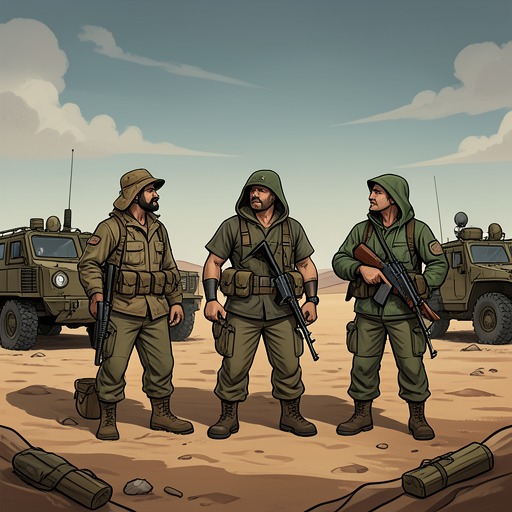
Gerhardt’s early distrust of Mattern gains force when the colonel reveals that he has found Ozymandias and taken it to the ship. Mattern says his men followed the archaeological team’s behavior to the area, detected a metal object about twenty miles west, and encountered the robot, which was surprised to learn that other Earthmen were present. Leopold objects that Ozymandias is an archaeological treasure and asks Mattern to keep his men away from it; Mattern answers that it has military value and declares the expedition over.
Gerhardt is among those whom Leopold looks to for support after Mattern announces that the robot has been placed in sealed quarters and will be returned to Earth. The narrator says that he and the others remain silent. The moment does not show Gerhardt changing sides or making an argument of his own; it shows the limits of his position within a mission whose military command has the authority to overrule its archaeologists. Mattern’s stated rationale is that Ozymandias holds details of Thaiquen weapons, including a superweapon he claims explains why the planet has no life. That claim reframes the discovery from a repository of general knowledge into a strategic asset—and confirms the institutional danger Gerhardt had anticipated, though the evidence does not establish that he knew what Mattern would do in advance.
Gerhardt’s narrative importance lies in this sequence of questions and observations. He voices mistrust before it is substantiated, asks whether an alien machine understands human speech before it demonstrably does, and tests whether its new mobility might make it leave. These are modest interventions rather than a separate arc, but each marks a boundary in what the crew knows. As the expedition’s purpose shifts from excavation to the struggle over who controls the discovery, Gerhardt remains part of the collective witness: alert to the danger, astonished by the archive, and finally silent when military authority carries the day.