Dr. Leopold
OzymandiasDr. Leopold is the leader of the expedition’s non-military archaeological group, a scientist whose determination to study dead civilizations brings him into direct conflict with the military purpose of the mission. His discovery of Ozymandias, a surviving guide to the lost Thaiquen civilization, briefly promises an almost inexhaustible historical record; the military’s seizure of the robot instead makes Leopold’s defeat the story’s clearest demonstration of how strategic power can claim scientific knowledge and restrict its use.
Role and Conditions of the Expedition
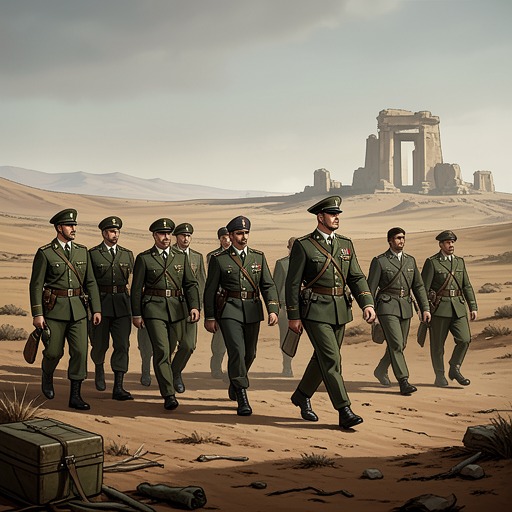
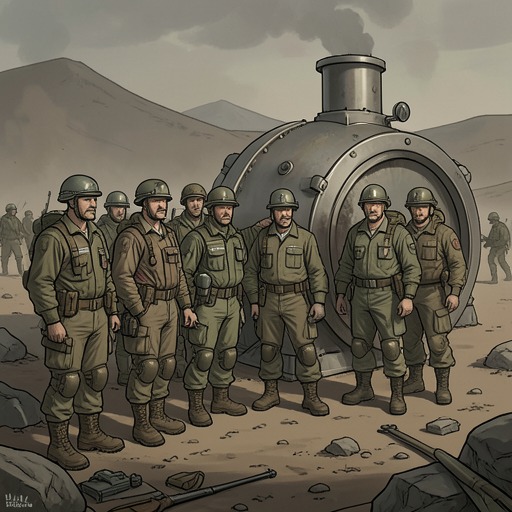
The expedition had been sent to investigate worlds near the Galactic Rim that an earlier survey had passed over after finding no signs of present life. Its charter divided the work: Leopold’s group was to conduct archaeological research on extinct civilizations, while Colonel Mattern’s men searched for fissionable material, alien weapons, and resources useful for fusion and national security. Leopold headed the five archaeologists, a small contingent included partly to answer public suspicion of purely military expeditions. The armed forces had supplied most of the funding, and Mattern treated his own personnel as the mission’s essential members, with the archaeologists little more than ballast.
The pressure behind this imbalance was not confined to the expedition. Earth remained divided, and the narrator notes the possibility that the Other Hemisphere might resume space activity after a century of quiescence. Any discovery of military value might therefore be treated as an advantage to secure before a rival could find it. Leopold’s archaeological work operated inside a mission whose wider political rationale ranked strategic advantage above general knowledge.
When Colonel Mattern judged the first planet barren and wanted to leave, Leopold invoked the expedition’s limiting clause. He insisted that since the crew had already reached the planet at considerable expense, it should spend the minimum time allotted for scientific research. The clause gave the archaeological group a limited but real procedural right: Mattern, despite the military’s dominant financial stake, did not have absolute authority over the expedition’s affairs. Leopold’s insistence was not a rejection of the charter’s military work; it was a demand that its scientific obligation be honored too.
From Apparent Failure to Discovery
The planet initially appeared to confirm Mattern’s judgment. It had been dead for about a million years, and an excavation yielded no artifacts, bones, teeth, or everyday objects. Only the weathered stumps of building foundations remained, too meager to disclose the vanished society’s laws, technology, or philosophy. Leopold’s research group had encountered the sharp limit of archaeology based on a nearly erased material record.
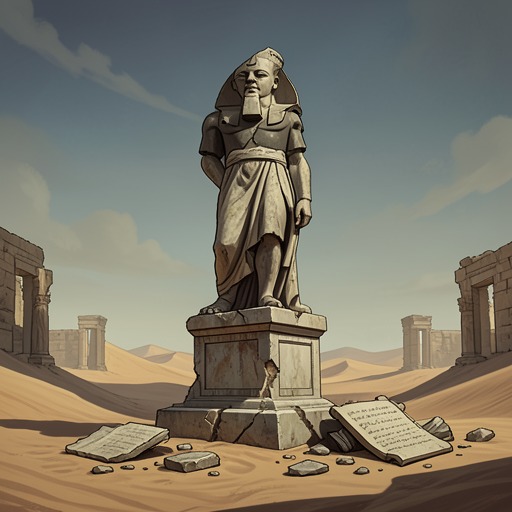
That judgment changed when Leopold found an object too heavy to handle alone. Rather than explain his discovery over the communicator, he asked both groups to come to his coordinates and said he wanted to return to base by nightfall. The object was Ozymandias, a massive, ancient robot that spoke an unfamiliar language when Leopold addressed it. Leopold hypothesized that it had been built as a guide to the ruins, meant to inform visitors about the civilization that made it. Its extraordinary sturdiness appeared to have preserved it after the cities and nearly every other trace of that civilization had disappeared.
The robot’s speech transformed a find into a research opportunity. Leopold proposed trying to decipher its language and recognized the discovery as magnificent, although at first he did not grasp Dr. Anderson’s comparison of the surviving guide to the ruined works it described. The allusion gave the scene an irony that the physical evidence alone could not: the guide had endured to proclaim its builders’ greatness, while their cities had vanished and the desert stretched empty around it.
A Living Archive
When the crew returned, Ozymandias spoke in English. He explained that he had deciphered the language and seemed to be describing his function as a guide. The change followed a night in which he had listened to the humans talking; afterward, he had apparently organized their sounds into meaning. The archaeologists spent two hours supplying vocabulary and explaining words, and Ozymandias rapidly became capable of a passable conversation. He then freed his legs from the sand that had held them for centuries and took the group on a guided tour of the civilization that had built him.
Ozymandias supplied what the excavated foundations could not. He identified his people as the Thaiquens and told the archaeologists that they had lived and thrived for three hundred thousand years. In their declining era, they had built him as an indestructible guide to their cities, which they had also considered indestructible. The cities had crumbled; Ozymandias alone remained, carrying memories of what had been. Leopold recognized the scale of the resource: the robot was a storehouse of archaeological data from which the group could draw for years.
For Leopold, then, the robot’s value lay in its power to restore historical knowledge after ordinary material evidence had disappeared. Its first apparent purpose—as a guide for visitors to ancient ruins—became a means by which the archaeologists could recover the history of a whole civilization. The discovery also altered the expedition’s earlier judgment: the planet was not devoid of useful evidence, but its most important record was a durable machine rather than a collection of artifacts in the soil.
Competing Claims and the Military Seizure
The promise of long study quickly became a dispute over access and ownership. Colonel Mattern later confronted Leopold about not being told of the robot. Leopold said he had intended to disclose the find before departure. Mattern replied that he had sent his men to investigate after Leopold’s conduct the previous night led them to the area; their detectors had registered a metal object about twenty miles to the west. Ozymandias, Mattern added, had been surprised to discover that other Earthmen were present.
Leopold asked Mattern and his men to keep away from the robot. He feared that an experiment might short-circuit its memory channels and appealed to the archaeological group’s rights, declaring Ozymandias part of its preserve and off limits to the military. Mattern answered by reversing Leopold’s claim: the robot, he declared, belonged to the military preserve and was off limits to the archaeologists. The argument was not simply about who had found the machine. Leopold emphasized the risk to a fragile archive and its value for research; Mattern asserted the priority of security and strategic use.
Mattern had already removed Ozymandias to the ship and placed him in sealed quarters under top-level security. He then used the authority entrusted to him for emergencies to declare the expedition over and order an immediate return to Earth. He justified the seizure by claiming that Ozymandias held extensive information about ancient Thaiquen weapons. He also argued that the planet’s absence of life could not be explained by a million years of weathering alone and attributed its lifelessness to a Thaiquen superweapon. That explanation, along with the assertion that the robot knew every detail of the weapons, was Mattern’s account of the find’s military significance; it was precisely enough to make the archaeological discovery a strategic asset in his eyes.
Defeat and Narrative Significance
Leopold could not prevent the order. He conceded that there was nothing he could do to stop Mattern, then left the mess hall without touching his food. The narrator describes him as beaten and suddenly old, and says the scene made him feel sick. The ending is a personal defeat, but its cause is institutional: the archaeological group’s limited charter rights could secure time for research, not control of a discovery once the military classified it as useful for war.
Leopold’s trajectory joins the story’s two reversals. First, the barren planet yields an archive more valuable than its ruins; then the archive’s promise of historical recovery is overtaken by its possible military application. What the archaeologists saw as evidence of the Thaiquens’ lives and culture, Mattern saw as knowledge that might make America impregnable against the Other Hemisphere. The same machine therefore changes status from guide, to historical record, to military intelligence, according to the interests of those seeking control over it.
The contrast sharpens the expedition’s original compromise. Archaeologists had been added to a fundamentally militaristic mission, and their work had depended on a clause ensuring some time for research. That safeguard could not resolve the deeper conflict between making knowledge available for understanding and taking it for strategic advantage. Leopold’s insistence protects the possibility of archaeology for a time; his final surrender shows how little authority it has when the military turns a recovered past into a weapon’s dossier.