Thaiquens
OzymandiasThe Thaiquens were a civilization that flourished for three hundred thousand years on a world that had been dead for about a million. Their cities collapsed and almost every physical trace vanished, but an indestructible guide robot preserved their history in memory. Through its account, the Thaiquens emerge both as builders of immense cities and as the makers of weapons believed to have destroyed all life on their planet; their surviving record becomes, in the present, a prize claimed by military power.
Identity and Historical Record
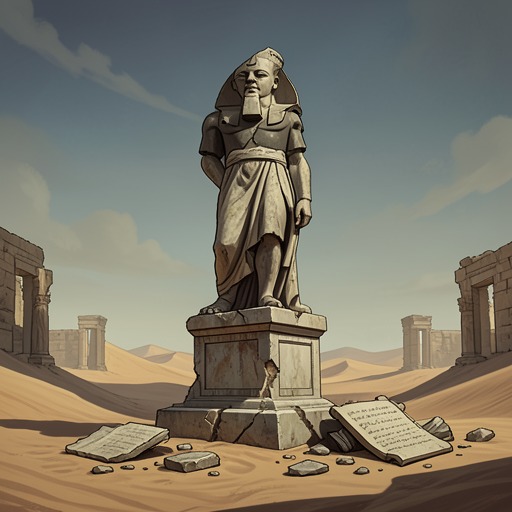
The expedition first encounters the Thaiquens not as living people but as the absent builders of a dead world. From orbit, the planet appears sere and brown, and the initial impression of total death proves correct: Earth has circled the Sun a million times since its last living being breathed. The ruins offer almost nothing to recover. Sand, wind, and rain have worn buildings down to stumps; there are no artifacts, bones, teeth, or ordinary household objects. The exposed foundations confirm that a civilization existed, but cannot by themselves disclose its laws, technology, or philosophy.
The surviving account comes from Ozymandias, a massive, sturdy robot built in the Thaiquens’ declining period as a guide to their cities. At first it speaks an unfamiliar language, and the humans can only infer that it is narrating the history of the ruined landscape. After two hours of teaching it words and defining them through context, the archaeologists can hold a passable conversation with it. Ozymandias frees its legs from the sand that had held it for centuries and resumes the purpose for which it was made: leading visitors through the civilization that built it.
Ozymandias identifies its people as the Thaiquens, or a name sounding like that, and says they lived and thrived for 300,000 years. They built the robot as an indestructible guide to cities they, too, considered indestructible. The contrast is stark: the cities crumbled, while their guide remained, carrying memories of the world that had made it. The machine’s durability does not preserve the civilization physically; it preserves a record of it in a form that can outlast its monuments.
Cities, Institutions, and Long Duration
The robot’s testimony gives the ruined landscape names, dimensions, and civic history that the archaeological remains alone cannot supply. It describes Durab as a city that once held eight million people. Where Ozymandias stands had been the Temple of Decamon, sixteen hundred feet high by human measurement, facing the Street of the Winds. The scale of the remembered city is set against the bare desert through which the robot now moves, making the account an itinerary through absence as much as a description of former grandeur.
The Thaiquens’ political chronology reaches across immense spans of time. Ozymandias recalls the beginning of the Eleventh Dynasty with the accession of Chonnigar IV to the Presidium, in the eighteenth thousandth year of the city. During that dynasty, the Thaiquens first reached neighboring planets. This detail places their history beyond the life of one city: the robot’s narration encompasses dynastic change and expansion beyond the home world, while the ruins offer no surviving objects to corroborate those events directly.
The civilization also possessed a vast written culture. The Library of Durab contained fourteen million volumes, none of which exist in the present. Ozymandias says it spent time reading the books after their builders were gone and memorized them. Its recollection thus extends beyond a guide’s descriptions of monuments: the robot presents itself as a repository for vanished texts as well as for public history. The expedition’s recorders capture its account, but the information is already held within the machine, which the archaeologists believe could be studied for years without exhausting it.
The testimony includes catastrophe as well as civic achievement. Ozymandias reports that a plague killed nine thousand people a day for more than a year. It also describes a long, complex history that grows more detailed as the robot takes in the visitors’ comments and adds words to its vocabulary. The resulting narration is likened to a cyclopean newsreel: not a fragmentary artifact from which scholars must reconstruct a whole, but a continuous account whose contents exceed what the expedition can absorb at once.
Weapons and Extinction
The Thaiquens’ history reaches the expedition through a crucial distinction between what the archaeologists observe and what the military infers. The planet is visibly barren, and the physical remains are almost wholly erased. Colonel Mattern, responsible for seeking weapons and strategic materials, argues that the planet is useless; Dr. Leopold insists on archaeological research. Later, Mattern claims that a million years of weather could not explain the absence of even a blade of grass and attributes the lifeless state to a Thaiquen superweapon.
Mattern’s explanation rests on what he says Ozymandias knows: details of ancient Thaiquen weapons. He declares the robot a military resource and says his men have already learned things from it whose scope is astonishing. The narrator likewise concludes that the Thaiquen science culminated in magnificent weapons that succeeded in destroying all life on the world. The story therefore presents the weapon-driven extinction as a conclusion drawn from the robot’s archive and the planet’s condition, rather than as a directly witnessed event or a surviving weapon displayed among the ruins.
That distinction sharpens the irony of the discovery. The expedition has found not the usable weapons themselves, but a machine capable of disclosing their designs and the science behind them. A civilization whose cities, books, and population have disappeared may still pass its knowledge onward through the one device built to endure. The Thaiquens’ legacy can consequently be read in two opposite ways: as a record of a long and sophisticated culture, and as a storehouse of recipes for death.
Afterlife and Significance
The Thaiquens have no direct presence in the expedition’s present except through Ozymandias and the empty world around it. Their endurance is therefore archival rather than material. The robot’s accounts of Durab, its temple, dynasty, planetary reach, library, and plague restore detail to a history that the desert’s scattered foundations could not reveal. Yet even this restoration is incomplete in a different sense: the surviving machine can give the humans an immense body of information, but the civilization itself cannot answer questions or contest how that information will be used.
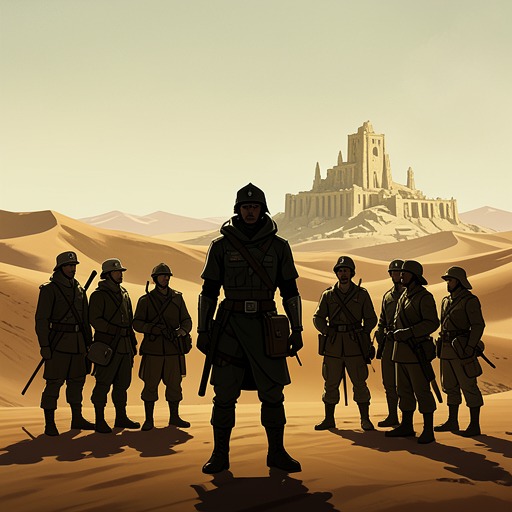
The human expedition’s competing priorities make the Thaiquen past an immediate political problem. The mission’s military segment seeks new weapons and strategic resources for the United States of America, while Leopold’s archaeological group seeks knowledge of dead civilizations. Once Mattern claims that Ozymandias contains military information, the robot is removed from the archaeologists’ control, sealed aboard the ship, and the expedition is ended so it can be taken back to Earth. The Thaiquens’ archive thus passes from an archaeological encounter into military custody before the scholars can explore it at length.
The resulting inheritance is a pointed reversal: the same archive that promises to recover a lost civilization also threatens to make its most destructive knowledge available to another divided world. Mattern frames that knowledge as a means of making America impregnable; the narrator sees the Thaiquens’ self-destruction as a heritage of death handed down to the living. Their story makes the contrast between cultural memory and military utility inseparable. The civilization survives in Ozymandias, but the circumstances of that survival place its past in the hands of people prepared to turn the record into a weapon.