Colonel Mattern
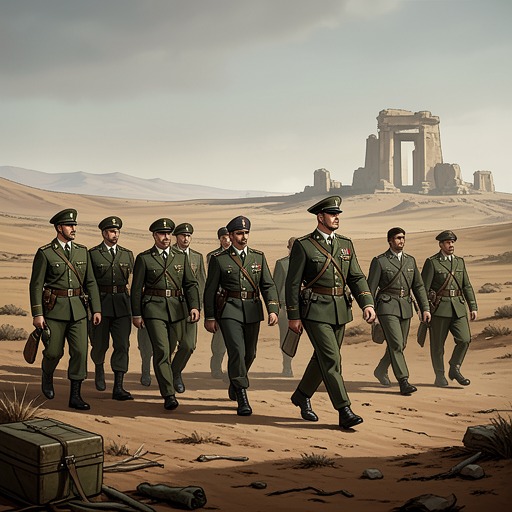
OzymandiasColonel Mattern is the military commander of an expedition sent to investigate worlds near the Galactic Rim, and the force behind its decisive reversal: when the archaeologists uncover Ozymandias, he claims the machine for military use and orders the crew home. His actions expose how the expedition’s official research charter and its military funding pull knowledge toward competing ends.
Identity and Mission
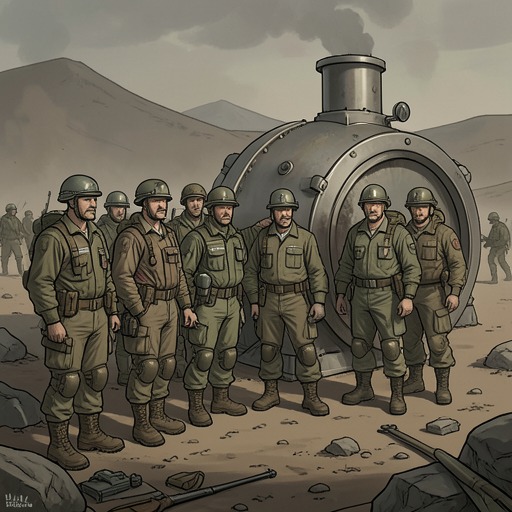
Mattern leads the expedition’s military contingent, while Dr. Leopold heads its non-military, archaeological group. Their assignments reflect the expedition’s divided purpose: Leopold’s team is to study dead civilizations, whereas Mattern’s men search for fissionable material, alien weapons, and resources such as lithium and tritium that could serve military needs.
The General Staff of the Armed Forces of the United States of America supplied 70 percent of the expedition’s budget and expected practical returns in weapons and strategic materials. Mattern’s urgency is therefore presented as service to his employers, not as an isolated personal whim. The expedition also operates amid renewed tension between Earth’s rival hemispheres, with the crew aware that any useful discovery might be sought by the Other Hemisphere.
Conflict with the Archaeologists
When the expedition reaches a planet that has been lifeless for about a million years, Mattern calls it a dead world with nothing useful to offer and urges the crew to move on. His judgment initially appears to fit the material evidence: sand and weather have reduced buildings to stumps, and the excavators find no artifacts, bones, or everyday objects. Even the narrator concedes that the surviving foundations reveal little about the lost civilization.
Mattern’s contempt for archaeological work also reflects the expedition’s hierarchy. He makes clear that he regards the military personnel as its truly important members and the archaeologists as ballast. The narrator acknowledges the practical force of that imbalance: the archaeologists have been included partly because public opinion in America disfavors purely military expeditions, while the mission’s central institutional purpose remains the search for strategic advantage.
Ozymandias and the Change in Stakes
The discovery of Ozymandias overturns the assumption that the planet has yielded nothing. At first, the machine appears to be an exceptionally durable guide to ruins, built to explain the monuments of its creators. After listening to the archaeologists speak, it begins to learn English; within two hours it can converse and lead them on a tour of the vanished civilization.
Ozymandias proves to be a vast storehouse of Thaiquen history. The Thaiquens had flourished for three hundred thousand years, and their guide preserves accounts of cities, political eras, disasters, and cultural records. It remembers, among other things, that the Library of Durab held fourteen million volumes, whose contents it had read and memorized after the builders were gone. What the archaeologists could not recover from eroded foundations survives in the machine’s memory.
Mattern’s view of the discovery changes when he sees its military implications. He argues that Ozymandias contains detailed knowledge of Thaiquen weapons, including a superweapon that he identifies as the cause of the planet’s lifeless condition. The weapon account is Mattern’s explanation of the barren world, and he treats the machine’s preserved information as a strategic resource that the United States cannot afford to leave under archaeological control.
Seizure and Significance
Leopold tries to protect Ozymandias by declaring it part of the archaeological group’s preserve, warning that a military experiment could damage its memory. Mattern counters that the machine belongs to his group’s preserve instead. He says the military has already brought it aboard the ship and placed it in sealed quarters under top-level security; invoking his emergency authority, he declares the expedition over and orders an immediate return to Earth with Ozymandias.
The seizure makes Mattern’s priorities concrete. The machine’s function has shifted from guide to cultural archive to military intelligence, not because its accumulated history has changed, but because the expedition’s commanding institution has taken control of it and assigned that knowledge a strategic value. Leopold recognizes that the expedition was fundamentally militaristic, and he concedes that he cannot stop Mattern. The archaeologists’ discovery thus becomes the very kind of weapon-related result that their expedition was designed to obtain, while the broader historical record risks being subordinated to its military contents.