Anderson
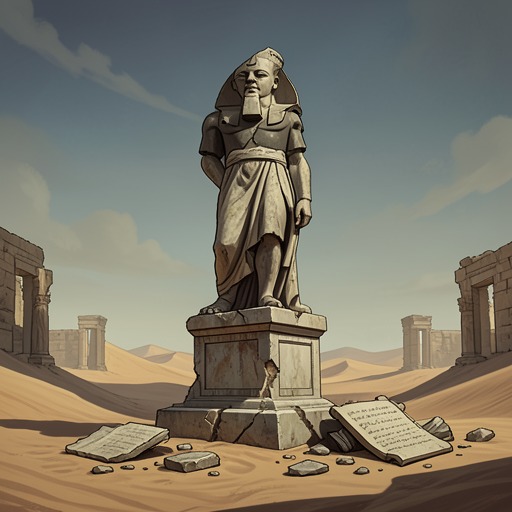
OzymandiasAnderson is the expedition’s first-person narrator, an archaeologist whose judgments shift as evidence transforms an apparently empty world into a repository of lost knowledge—and then into a military asset. His naming of Ozymandias gives the discovery its defining irony: the guide survives to proclaim a civilization whose cities have vanished, while the knowledge it preserves is claimed by a new power for strategic use.
Identity and First Impressions
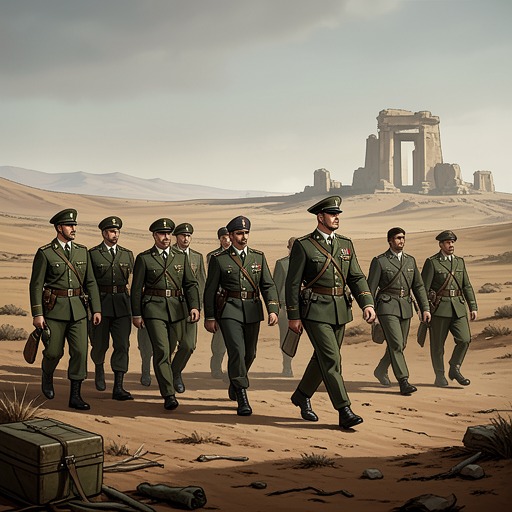
Anderson is part of Dr. Leopold’s archaeological group aboard an expedition whose larger purpose is military. Early in the search, he shares the group’s bleak encounter with the ruins: after moving thousands of cubic yards of soil, the excavators have found no artifacts, bones, or ordinary objects. The weathered foundations offer scant evidence beyond the fact that a civilization once stood there. Anderson ruefully concedes that Colonel Mattern’s contempt for the planet’s archaeological promise seemed justified; bare foundations cannot readily disclose a people’s laws, technology, or philosophy.
That initial failure establishes the limits of Anderson’s knowledge. The absence of objects appears to make the past inaccessible, and his assessment follows what the excavation has actually yielded. The discovery of a functioning machine will overturn that conclusion—not by producing another fragment from the ground, but by revealing that a surviving witness can carry an entire historical record.
Discovery and Naming of Ozymandias
When Dr. Leopold radios the trucks to report a find, Anderson is riding in Number Three with Gerhardt driving. He reaches across Gerhardt to key the response channel and identifies himself and Gerhardt to Leopold. The brief exchange places Anderson within the expedition’s practical, collective work before the discovery changes its stakes.
At the ruins, Anderson hears the machine produce an alien language through its mouth-receptors. Dr. Leopold speculates that it is a guide built to provide information to passersby, and that it has outlasted both the ancient people and their monuments. The machine’s gestures and apparent narration support the guide interpretation, but its words remain unintelligible. Anderson’s understanding is still provisional: the robot seems to be describing lost monuments, yet the team cannot decipher what it says.
Anderson breaks into laughter at the contrast between the ruined cities and their surviving guide. When Dr. Leopold asks what is funny, Anderson names the robot Ozymandias and connects it to the poem’s image of a ruler’s proclaimed greatness surviving only as a warning. The name is more than a label: it frames the machine as a speaker left behind by the civilization that made it, surrounded by the absence of the works it was designed to explain. Anderson’s allusion also gives the scene its central irony before the team knows just how much the robot remembers.
Learning and Revising His Judgment
Dr. Leopold proposes that the team try to decipher the robot’s language, calling it a magnificent find. Anderson’s amusement gives way to attentive interpretation as the machine’s behavior becomes evidence: it appears to be doing what its builders intended, offering a guide to a vanished world. At this stage, however, the guide’s value is a hypothesis; the team cannot yet understand its account.
The next change comes when Ozymandias speaks in English. It first says that it has remained there, then explains that it deciphered the language and is acting as a guide. The expedition members initially react in confusion, and Marshall suggests that the robot is repeating fragments of their conversation. Anderson rejects that reading: the words form coherent ideas, he says, and Ozymandias is speaking to them. His response marks a movement from interpreting gestures and sounds to recognizing an exchange of meaning.
The conversation quickly confirms the scale of the discovery. The expedition members feed Ozymandias words and define them so it can connect them with what it has learned; within two hours, it can sustain a passable conversation. It frees its legs from the sand and takes the group on a tour. Anderson recognizes it as a storehouse of archaeological data that could occupy researchers for years. The robot’s history fills the void left by the vanished artifacts: its people called themselves the Thaiquens, had flourished for three hundred thousand years, and built it in their declining era as a guide to cities they had intended to endure. Ozymandias alone remains, carrying memories of what those cities had been.
Conflict over the Discovery
Anderson is present when Colonel Mattern confronts Dr. Leopold over the robot. Mattern says that Leopold concealed the find, and explains that his men came to investigate after the expedition’s manner the previous night led them to the area. Detectors registered a metal object about twenty miles to the west; Ozymandias, Mattern adds, was surprised to find other Earthmen there. The information reveals how the archaeological discovery has already become entangled with the military party’s independent search.
Dr. Leopold asks Mattern and his men to stay away from Ozymandias, apologizes for not disclosing the find, and invokes the archaeological group’s right to declare the robot part of its preserve. Anderson witnesses the scientific claim take institutional form: Leopold argues that casual experiments could damage the robot’s memory channels and destroy an irreplaceable resource. Mattern refuses, saying Leopold cannot invoke that right now.
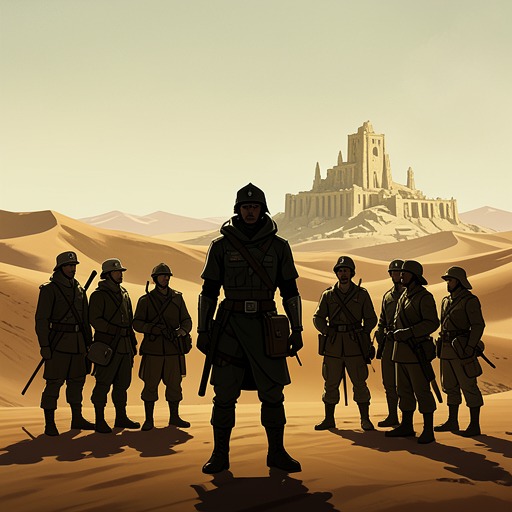
Mattern declares Ozymandias a matter of security, says the robot has been taken to the ship and placed in sealed quarters, and ends the expedition with an order to return to Earth at once. He claims that Ozymandias contains detailed knowledge of ancient Thaiquen weapons, including the superweapon responsible for the planet’s lifeless condition. The explanation changes the meaning of the ruins and the robot at once: what had seemed a guide to cultural history is also, in Mattern’s account, a storehouse of military intelligence. Anderson and the others have no reply as Leopold looks to them for support.
Ending and Narrative Significance
Anderson’s final response is inward. Gray-faced and no longer hungry, he leaves the table after Mattern announces that the ship will blast off in an hour. He hardly hears the order to prepare his things. Instead, he thinks of Ozymandias as a deadly cargo, eager to disclose its knowledge, and imagines what will happen when scientists on Earth begin learning from it. His concern is not that the robot’s history has been disproved, but that its knowledge will pass into hands prepared to use it as military power.
The closing return to the poem completes the significance of the name Anderson supplied. He thinks that the Thaiquens’ works now belong to the expedition’s human world and recalls the poet’s line, “Look on my works, ye mighty—and despair.” The allusion has shifted: first it described the mismatch between a surviving guide and absent monuments; now it shadows the transfer of ancient weapons knowledge to a divided Earth engaged in strategic rivalry with the Other Hemisphere. Anderson’s perspective binds the story’s stages together—first the apparent emptiness of the planet, then the recovery of a civilization through its machine, and finally the danger that historical knowledge will be valued chiefly for what it can do in war.