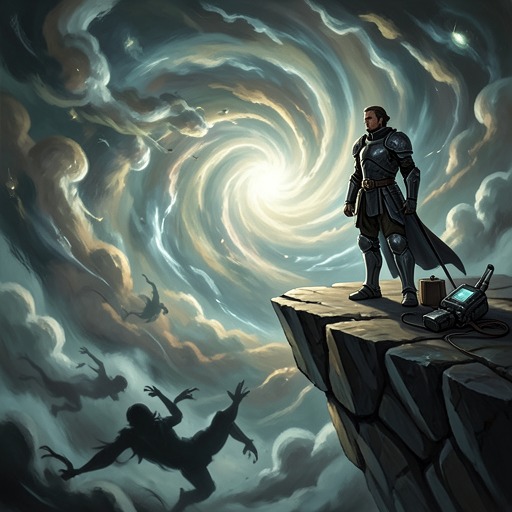
Dreamscape Ban on Harmful or Selfish Uses
PleasureThe Dreamscape Ban on Harmful or Selfish Uses is a Sanctuary religious law that forbids using the Dreamscape to harm others or advance selfish purposes. The prohibition treats the realm not as a consequence-free fantasy but as a place where actions can wound, where religious judgment may apply even when ordinary law offers no provable charge, and where the boundary between dreaming and waking cannot be trusted to protect a victim.
The Prohibition and Its Authority
The rule is explicit: no one may use the Dreamscape for harmful or selfish purposes, and its violation ranks among the gravest sins. Its reach differs from that of common law. Magnus recognizes that Acadian might not have committed an offense provable in court, but religious law gives him a distinct basis to seek penance. As a penance priest, he can pursue her as a Sinner, demand repentance, and impose final judgment if she refuses.
That authority depends on both religious office and the offender’s use of the realm. Acadian’s anonymity protects her in other planes, but even minimal use of the Dreamscape can reveal her to Magnus once he is watching for it. His ability to detect that use is a difficult skill particular to penance priests. The rule therefore has an enforcement mechanism as well as a moral command: the very transgression that makes Acadian liable can also make her detectable.
Why Dreamscape Harm Counts
The danger is not confined to a dreamer’s physical body. When Daenaira is asleep, Magnus initially argues that the Dreamscape cannot truly hurt her unless she is in Fade and that any pain should disappear when she wakes. Guin counters that the realm can injure the mind, carrying pain into waking life. He invokes the case of a dream rapist whose assaults left women nearly comatose with shock in Realscape after they awoke. The rule’s practical premise is thus demonstrated through consequences: an experience occurring in sleep can produce suffering that persists beyond it.
Acadian’s attack on Daenaira makes that danger intimate and immediate. Daenaira’s vision of Acadian’s artificial steel claws on Guin’s back shows the Dreamscape’s capacity to stage deliberate terror, while the later aftermath reveals Daenaira’s profound distress and fear of returning to sleep. Acadian’s conduct is not treated as harmless merely because it takes place in a dream. The harm reaches into Daenaira’s waking life and, in the broader attack, culminates in the loss of Magnus and Daenaira’s child. The rule gives religious language and jurisdiction to a violation whose consequences are devastatingly real.
Enforcement, Penance, and the Cost of Violation
After Daenaira’s ordeal, Magnus keeps a guard at his quarters while Acadian remains at large. He longs to make her answer for her actions, but cannot hunt her through the Dreamscape until she uses it again. That constraint turns enforcement into a tense watch: her concealment can hold in other planes, but the prohibited realm may expose her presence. Magnus’s patience is also tested by grief. Daenaira struggles to sleep, remains physically weakened after the miscarriage, and blames herself for having killed Nicoya and thereby drawing Acadian’s revenge. Magnus rejects that self-accusation and places responsibility on Acadian, whose use of the Dreamscape belongs to a larger course of deliberate harm.
The rule’s importance lies in its refusal to let the word “dream” erase responsibility. It distinguishes the apparent unreality of an attack from the pain it leaves behind, and it establishes a religious route to accountability where common-law proof may be unavailable. Its severity also places power in the hands of the penance priest: Magnus can pursue repentance and judgment, but he must first sense Acadian’s return to the realm. The prohibition is therefore both a protection for vulnerable dreamers and a source of conflict over who may enforce justice, by what authority, and at what cost.