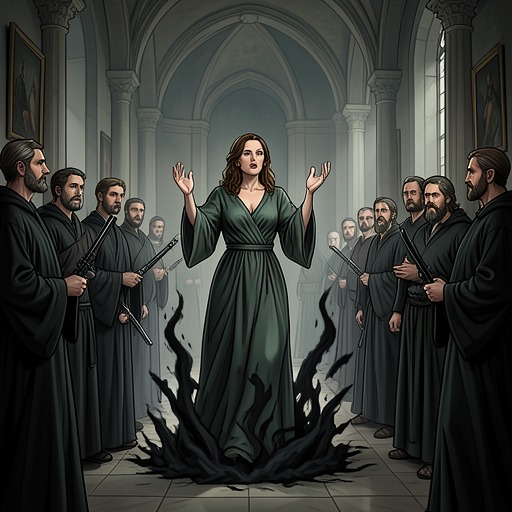
Nightwalker Policy for Dealing with Necromancers
PleasureThe Nightwalker Policy for Dealing with Necromancers is an entrenched practice of lethal hostility toward human magic-users, grounded in a history of black magic, torture, and danger. Valera’s survival outside that pattern challenges the assumption that every magic-user is irredeemably corrupt: her case forces Sagan and Magnus to consider whether a policy built around destruction might leave room for recognition, teaching, and reclamation.
Definition and Enforcement
The conflict is described in categorical terms: Nightwalkers and human magic-users are mortal enemies. Demons, Vampires, and other breeds kill those they call necromancers with what the narrative characterizes as punitive unanimity. This is presented as a collective practice and a settled presumption, not as a quoted statute or a detailed legal procedure. The breadth of the response matters: necromancers are treated not as individuals whose actions must first be judged, but as members of a feared class against whom lethal force is considered justified.
The policy’s severity is reinforced by the fact that necromancers are not merely a social threat. Their power gives them a terrible advantage over Shadowdwellers, and calling that power can emit brilliant blue light that may hurt them like other light. Sagan understands that this danger is real, even as Valera’s particular abilities complicate any attempt to treat her as interchangeable with the practitioners he has been taught to fear. The threat therefore has both a physical basis and a categorical form: danger helps explain the hostility, but does not establish that every person who can use magic intends harm.
The Grounds for Fear
Black magic is depicted as a corruption that can be detected as well as morally judged. To a Nightwalker, its presence is foul enough to smell from a distance; it is compared to gasoline and fetid garbage. Necromancers are associated with souls stained by that magic and with power capable of killing their enemies. Sagan’s understanding is that evil magic can become addictive, corrupting a person from the first taste and drawing them further into it.
Valera has seen the conduct that gives this fear its force. Before understanding the difference between her own nature and that of necromancers, she was relieved to find people like herself. She then witnessed them capture Demons and stake Vampires without proof that their victims had committed crimes. In her view, they inflicted suffering for its own sake. The capture of a Demon made the contrast especially stark: while her former associates treated its tortured transformation as evidence of its evil, Valera saw that the process itself could not be called righteous. What horrified her was not only the imprisoned creature’s transformation but the avarice of the magic-users waiting to exploit its power.
These experiences explain why Valera fled and why she fears becoming like those she left. She has tried to resist using magic because she believes the blackness that overcame them could overtake her too. The policy thus answers genuine atrocities and a genuine danger, but its collective reach risks reproducing the same refusal to distinguish among individuals that Valera found abhorrent in the necromancers themselves.
Valera as an Exception
Valera does not fit the category that Sagan expects. She had been among necromancers a decade earlier and had recently used what he regarded as a dark art, yet he finds no stain on her. He recognizes that she deliberately left the group after learning what its members did and that she had resisted the pull of magic powerful enough to become addictive. Her moral recoil from the torture of other beings is evidence of a difference the prevailing understanding has not allowed for.
That difference does not make her power harmless. Valera explains that light accompanies only certain spells, usually aggressive ones, and Sagan understands that invoking her power could injure him. Her case therefore complicates the policy without erasing the danger on which it rests. She is frightened that Sagan will discover what she is and hurt her; he, in turn, must confront the possibility that a magic-user can be both dangerous and unwilling to do harm. Her existence challenges the equation between magical ability, black-magic corruption, and moral evil.
A Proposed Change in Approach
Magnus sees Valera’s exceptional status as a reason to reconsider what the wider Nightwalker world believes possible. He argues that she could not simply be left alone: others would want to study an unusual human, and the courts would need evidence before accepting that a good magic-user existed. He also expects that Valera would want to help other Natural-Born Witches rather than remain isolated. In his view, she could teach, offer hope that necromancers’ stained souls might be reclaimed, and become a gift to Nightwalker peoples at war with them.
Magnus’s response is a proposal, not evidence that the existing policy has already been overturned. He urges Sagan to resign, return to Valera free of the rules he has broken, and bring her to the Nightwalker courts. He intends to involve the Chancellors in making an offer to the other Cultures. The proposed circuit would turn one frightening exception into something the courts could encounter and assess directly. The policy’s central tension consequently shifts from whether necromancers are dangerous to whether danger and past corruption justify treating every magic-user as beyond redemption. Valera’s life supplies no guaranteed answer, but it makes a purely unanimous one harder to sustain.