Fordyce's Sermons
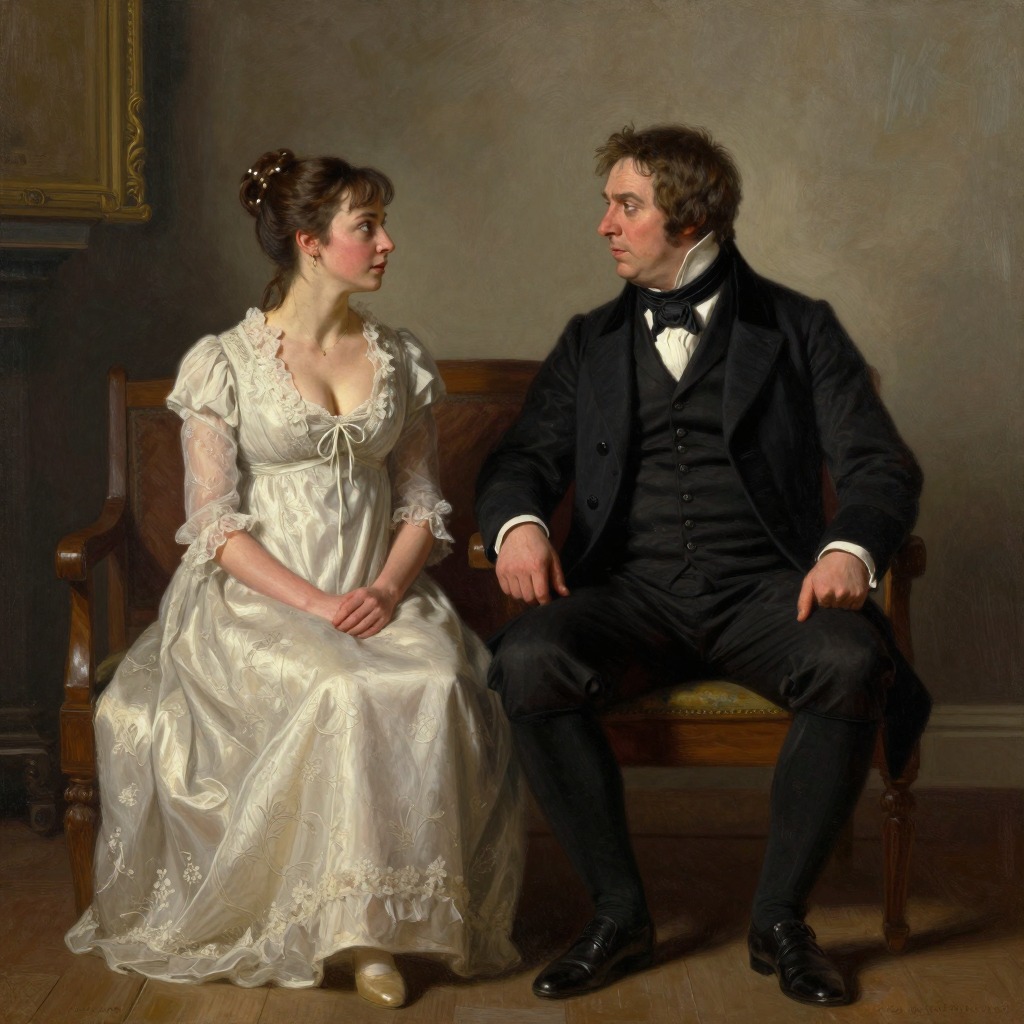
Fordyce's Sermons, a collection of moral and religious discourses by the Scottish Presbyterian minister James Fordyce, appears in Pride and Prejudice as a prop that crystallizes the comic and thematic tensions of the novel's early chapters. When Mr. Collins, during his inaugural visit to Longbourn, is invited by Mr. Bennet to read aloud to the ladies, he seizes upon a book from the circulating library—only to recoil in horror, protesting that he never reads novels. After Kitty stares and Lydia exclaims, other books are produced, and Mr. Collins, after some deliberation, chooses Fordyce's Sermons. The choice is a perfect expression of his character: pompous, self-consciously clerical, and utterly out of touch with the lively dispositions of his young cousins. Lydia gapes as he opens the volume, and before he has, with very monotonous solemnity, read three pages, she interrupts him with a piece of local gossip about her uncle Phillips turning away a servant. Mr. Collins, much offended, lays aside his book and delivers a reproachful observation on how little young ladies are interested by books of a serious stamp, though written solely for their benefit. The scene is a small masterpiece of social comedy, in which the solemnity of the sermon form is deflated by the irrepressible vitality of the youngest Bennet sister, and Mr. Collins's pretensions to moral authority are exposed as hollow and self-regarding.
The Sermon as a Marker of Character
Mr. Collins's choice of Fordyce's Sermons is not incidental but deeply diagnostic. The narrator has already established that Mr. Collins is not a sensible man, that his education and society have done little to remedy the deficiencies of nature, and that he is a mixture of pride and obsequiousness, self-importance and humility. His preference for a volume of sermons over a novel—indeed, his very protestation that he never reads novels—aligns him with a strain of eighteenth-century moralism that viewed fiction as frivolous or corrupting. The irony is that Mr. Collins himself is a figure of unconscious absurdity, and his attempt to impose a regimen of moral improvement on the Bennet household only underscores his own lack of self-knowledge. The sermon form, intended to instruct and edify, becomes in his hands an instrument of tedium and self-display. His reading is described as having a very monotonous solemnity, a phrase that captures both the lifelessness of his delivery and the rigidity of his conception of virtue.
Lydia's Interruption and the Defeat of Didacticism
Lydia's interruption is the crucial event of the scene. She does not merely break the silence; she breaks the entire framework of moral instruction that Mr. Collins represents. Her question about her uncle Phillips and the servant Richard is a piece of trivial, worldly intelligence, the very opposite of the spiritual nourishment Fordyce's Sermons are meant to provide. Mr. Collins's offended reaction—laying aside his book and delivering a set speech on the indifference of young ladies to serious literature—is a comic failure of pastoral care. He cannot adapt to his audience; he can only retreat into injured dignity. The narrator notes that Mrs. Bennet and her daughters apologised most civilly for Lydia's interruption and promised that it should not occur again, if he would resume his book, but Mr. Collins, after assuring them that he bore his young cousin no ill-will, seated himself at another table with Mr. Bennet to play backgammon. The sermon is thus abandoned, and the moral lesson is never delivered. The scene enacts a small but decisive victory of spontaneous life over mechanical piety.
Thematic Resonance: Pride, Prejudice, and the Limits of Moral Authority
The episode with Fordyce's Sermons resonates with the novel's larger themes of pride and prejudice. Mr. Collins's pride in his clerical office and his chosen text blinds him to the actual needs and dispositions of his hearers. He is, in his own way, as prejudiced as Elizabeth will later be shown to be: he assumes that a book of sermons is inherently superior to a novel, and that his audience ought to receive it with deference. The novel, by contrast, is itself a novel—a form that Fordyce and his ilk had condemned—and it implicitly vindicates the value of fiction as a vehicle for moral and social understanding. The scene also anticipates the later, more serious failures of moral authority in the novel: Mr. Collins's letter of condolence after Lydia's elopement, in which he advises Mr. Bennet to throw off his unworthy child from his affection for ever, is a direct extension of the same rigid, unforgiving piety that Fordyce's Sermons represent. The sermon, in the world of Pride and Prejudice, is not a source of wisdom but a symptom of spiritual and social blindness.