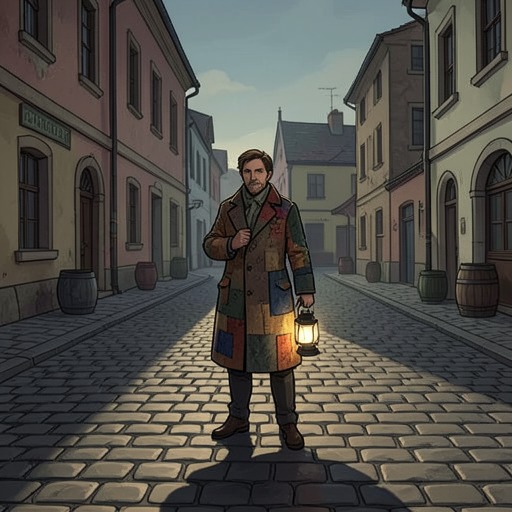
Le kaléidoscope de la Grébiche
SatanThe kaleidoscope La Grébiche gives Loïc is at once a child’s toy, a private token of tenderness, and a figure for the unstable images through which people try to hold on to a passing world. Their meeting takes place at the dump, where Loïc has strayed into La Grébiche’s orbit while playing at being a knight. The object first enchants him through its immediate visual effects; later, as an adult, he sees in its changing patterns a connection between her collection of discarded things and the increasingly transient images of modern media.
The Encounter at the Dump
Loïc is eight or nine, and has spent a rainy summer afternoon absorbed in Ivanhoe. When the rain stops, he goes outside still imagining himself as the English knight. Carrying a wooden sword, he runs through fields behind the houses, attacking imagined enemies in the service of Richard Cœur de Lion. A dented old pot lid becomes the shield he needs. A snake uncoils from beneath it, startling and repelling him, but he takes the lid anyway and continues his play.
Behind the house where he was born, the game acquires a more personal edge. Loïc imagines dueling the obscure forces that have worked against him and his family since his birth. By the time he reaches the dump, he is striking and flattening old tin cans, crying out against traitors. His make-believe battle brings him, without his intending it, into contact with La Grébiche, who has been rummaging there among the things she compulsively collects.
La Grébiche watches him and praises his fighting, calling him a true knight who will remain one. Her unusual tenderness changes the encounter: rather than scolding or sending him away, she invites him to come closer and says she has something for him. Loïc hesitates because he knows his parents would disapprove of his spending time with her. Nevertheless, he follows her to the shed beside her cabin, a crowded storehouse of odds and ends.
The Gift and Its Secret
With cats pressing around them, La Grébiche searches through the clutter and produces a small, tube-shaped object. She asks Loïc to look through it. At first wary but curious, he puts it to his eye and sees colored glimmers and geometric forms shifting at every slight movement of the device. The toy offers no fixed picture to inspect: its appeal lies in the rapid transformation of one arrangement into another.
La Grébiche tells him the object’s name slowly, syllable by syllable: a kaleidoscope. Loïc repeats the word, delighted. He will never forget it; in his memory, the name itself retains something magical. The gift is also accompanied by a request for secrecy. La Grébiche suddenly turns away, tears rising in her eyes. The narration connects that moment to the affection and love she has been unable either to give or to receive, though Loïc appears too absorbed in the toy to notice her distress. The secret makes the small instrument more than an entertaining novelty: it marks a brief, private bond between the child and a woman from whom his family would otherwise keep him apart.
A Toy Among the Discarded Things
The gift takes on a further meaning because of where La Grébiche finds it and who she is. Her compulsive accumulation has turned the dump and the crowded shed into a world of things others have discarded. Loïc later considers the kaleidoscope alongside her collection: the shifting images resemble successive waves of fashion, while the objects she hoards preserve traces of small, passing happiness. A thing may be negligible to everyone else and still hold a moment of lived experience.
In that retrospective reading, La Grébiche’s gathering also expresses a wish to stop what cannot be stopped. Her discarded objects suggest an effort to arrest time, the ceaseless movement of things, and the material decay that eventually overtakes them. The kaleidoscope provides a counter-image: it does not preserve one arrangement but continually rearranges its visible forms. Set beside the collection, it makes the tension between keeping and change perceptible. La Grébiche tries to hold on to remnants; the toy can show Loïc only patterns that shift as he moves it.
Memory and the Future of Images
Loïc eventually loses the kaleidoscope over the years and through successive moves, but the loss does not erase its place in his memory. Much later, he understands the toy as a symbolic anticipation of the image-saturated media that would come to dominate everyday life. Cinema and then television multiply images that flash past; the internet, in his reflection, takes that power of illusion to its extreme, making cyberspace an expansive kaleidoscope of seemingly unlimited creation and projection.
The comparison is not that the toy literally predicts a technology. Rather, Loïc recognizes a shared structure: in both, images can proliferate, change form, and offer fantasy or simulacra in place of the real. The childhood device thus links an intimate encounter in a village dump to a broader meditation on modern images. Its remembered magic comes from motion and possibility, but that same instability raises the question of what remains when experience is transformed into an endless succession of pictures.