Le camée du Fondateur
SatanLe camée du Fondateur is the carved stone recovered from the opened grave of Élie D’Anjou, founder of Touladi, after the 1944 earthquake. Passed down as a family relic, it is also a material clue whose damaged image and uncertain chain of ownership lead from a village cemetery to European aristocratic collections and back to the Founder’s beginnings in Missouri. The family’s research identifies it as one of a pair depicting Castor and Pollux, but the surviving evidence does not finally settle whether the stone preserved by the D’Anjous is the authentic missing Castor cameo.
Discovery and Family Relic
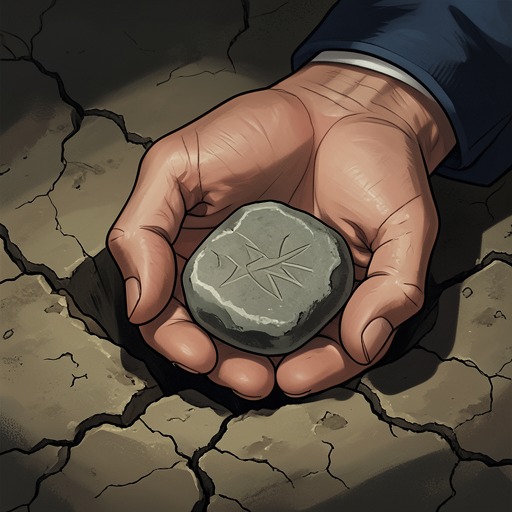
When the earthquake exposed Élie D’Anjou’s grave, the disturbance brought bones, decayed clothing, and fragments of wood back to the surface. Among them, Guillaume D’Anjou noticed an unfamiliar glint. He drew out a cameo mounted in metal, turned it over in his hands, and gently rubbed it to reveal the contrast of pale stone and dark brown agate. The object’s appearance made an old family legend suddenly tangible: this was a valuable jewel that Élie had taken into the grave.
The recovery happened in a public and unsettled scene. The village priest was trying to keep people out of the damaged cemetery, while a crowd gathered around the exposed remains. Grébiche, who was understood to have known the Founder and to have occult ties to his family, urged that the grave be closed again. After Guillaume put the cameo in his pocket and left, she followed him, warning that it was the Devil’s stone and that disturbing the dead would bring misfortune. The warnings gave the object a fearful local name as well as a family history, though Guillaume’s immediate response was to carry it away rather than return it to the grave.
On November 18, 1944, Guillaume displayed the jewel to roughly twenty D’Anjous gathered around a long oak table. Its emergence unsettled the family’s heroic account of Élie, the pioneer who was said to have crossed the lakes and rivers and cleared the land. Why had he kept a fine jewel secret, and why had he been buried with it? The cameo made the Founder’s origins seem newly uncertain, lending physical weight to rumors that he might not have been born into the family whose name he carried.
Image, Material, and Identification
At the family gathering, Régis D’Anjou examined the cameo with a large magnifying glass. Guillaume had carefully removed oxidation from its setting. Régis identified the stone as onyx and read the carved figure as a mythological rider: the outline of a horse, a lance, and the ancient style of the clothing suggested one of the twins Castor or Pollux. The identification was initially tentative. An old scratch had damaged the carving, and the people around the table were unfamiliar with the classical figures; Régis’s explanation transformed an obscure heirloom into an object of exceptional artistic and historical interest.
The damage shaped the investigation that followed. Under magnification, Régis could make out fragments of mythological attributes, clothing, and carving style, but the worn area prevented a confident identification from the image alone. He studied lapidary art systematically and consulted European specialists while presenting himself as a gem enthusiast, without disclosing that the object belonged to his family. Their assessments led him to date the work to at least the eighteenth century, perhaps the seventeenth, and to identify its workmanship as Italian. He became convinced that the figure was one of the mythological twins and reasoned that the stone must once have belonged to a pair.
A visit to the Bibliothèque nationale de France in the 1960s supplied a documentary lead. In an eighteenth-century catalogue, Régis found a brief record of a pair of cameos depicting Castor and Pollux in the collection of the Duke of Orléans, later the Regent. The catalogue did not establish what happened to them after the Regent’s death in 1724. Nor did the Revolutionary-era inventory of royal property list them. Régis considered whether the jewels had passed to members of the royal family who fled France, or to other émigrés, but the trail remained incomplete.
The Pair and Its Provenance
Régis’s search advanced when he attended a private exhibition organized by Christie’s in Paris alongside an auction of antique jewelry. Among photographs of aristocratic cameos whose whereabouts had been lost, he recognized one that resembled the family relic. Beside it was an old engraving of the cameo said to have disappeared: the Founder’s stone, shown without its scratch. Seeing the images together brought back his first examination of the jewel, freshly recovered from Élie’s grave.
The exhibition record described the paired stones as five-layer onyx, with a dark upper layer, and traced them to the Regent’s collection before their separation after the French Revolution. One cameo had entered the private collection of an unnamed family of the old French aristocracy; the other, identified as Castor, had disappeared in unknown circumstances, probably amid revolutionary upheaval. The images showed the Dioscuri standing opposite one another, each holding a horse by the bridle and a lance, and each wearing an oviform cap topped by a star. The account gave Régis a strong historical basis for tracing the D’Anjou stone to the missing member of a known pair, but it did not by itself prove the identity or uninterrupted ownership of the object in his family.
A separate discovery connected the Founder to a cameo much earlier in his life. Among Régis’s papers, Loïc found a copy of an old, weather-stained manuscript describing a living infant discovered near Saint Louis in 1842, in the arms of a young woman who had frozen to death beneath the snow. A silk purse containing a finely made cameo was pinned to the baby’s swaddling. The manuscript complemented a Missouri baptismal record for Élie D’Anjou, discovered in his safe and identifying Florissant as his birthplace. Together, the documents link the future Founder’s infancy to a cameo; they do not, on their own, close every gap in the stone’s later provenance.
New York, Photographs, and Unresolved Authenticity
The cameo’s uncertain history became entangled with the disappearance of Roger Bolduc after the September 11 attacks. Suspecting that the jewel might have been among the World Trade Center wreckage, Georges D’Anjou sent New York authorities detailed photographs and descriptions, along with information already supplied in the search for Roger. The search itself was likened to looking for a small stone in a mountain of rubble. Georges also sought to prevent news of the missing man and the family relic from becoming a public scandal.
Years later, Rodrigo Lerbier produced a small, blurry photograph from an old wallet and showed it to Loïc. The image seemed to show a cameo, but its lack of clarity meant that Loïc could only discern a troubling resemblance to the Founder’s stone. The photograph therefore prompted recognition without providing reliable authentication.
The uncertainty sharpened when Charles de C... examined a clear photograph sent by the D’Anjous. He recognized the old scratch on the supposed Castor cameo, but closer inspection showed that the mark was recent and had been imitated. The image matched a counterfeit that he had himself received from New York in 2003. He concluded that New York authorities had sent two false cameos in response to separate claims. That discovery reset rather than resolved the provenance question: the photographs established that the D’Anjous and Charles de C... had received the same apparent fake, while leaving open whether the stone preserved by Élie’s descendants was the genuine missing Castor.
Relic, Evidence, and Uncertainty
The object moves through the story in several competing registers. It is a tactile heirloom, handled first by Guillaume and then scrutinized under Régis’s magnifying glass; an art object whose layered onyx, Italian workmanship, paired design, and damaged surface invite close examination; and a family relic whose presence in Élie’s grave unsettles the public legend of the village’s founder. Grébiche’s warning gives it a supernatural reputation, while the family’s and Régis’s investigations treat it as evidence that must be tested against records, images, and expert judgment.
Its scratches and likenesses carry particular importance because resemblance is not proof. The damaged carving obscures the figure; an old engraving appears to match it; a blurry photograph suggests another match; and a later photograph reveals a copied scratch on a counterfeit. Each new image seems to bring the object closer to identification, yet also exposes how easily an imitation can repeat its visible features. By the end of the available account, the cameo has made the Founder’s origins more legible without making the stone’s own authenticity certain. Its force lies in that double role: it preserves a family’s material connection to its past and keeps the history of that connection open to question.