Camée Castor
SatanCamée Castor is the elusive counterpart to a paired ancient cameo of Pollux, a small onyx object whose uncertain origins bind together family history, aristocratic collections, theft, and supernatural dread. Its material identity is never entirely settled: historical records point to a lost original, photographs and replicas complicate recognition, and its eventual reunion with its twin ends in a fire that leaves both stones’ fate unresolved.
Physical Description and Early Investigation
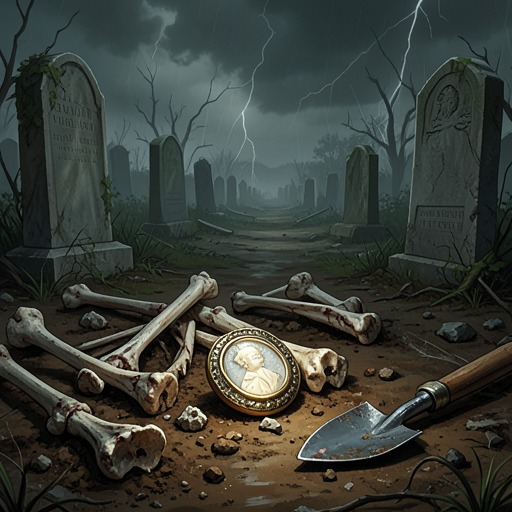
The stone’s worn surface made its central image difficult to identify. An old scratch obscured the engraved figure, leaving open whether it represented a mythological being or a real person. Close inspection through a magnifying glass nevertheless revealed fragments of mythological attributes, a suggestion of clothing, and a style that helped establish the cameo’s likely period and artistic origin.
Régis pursued the question systematically. He studied lapidary art and, during trips and stays in Europe, consulted specialists while presenting himself as an amateur gem enthusiast rather than disclosing the family’s connection to the object. Their assessments persuaded him that the cameo was Italian and dated at least to the eighteenth century, possibly the seventeenth. He came to believe that its figure was Castor, one of the mythological twins, and reasoned that it must once have belonged to a pair.
That hypothesis found a historical lead in an obscure eighteenth-century catalogue Régis consulted at the Bibliothèque nationale de France in the 1960s. The catalogue recorded a pair of cameos depicting Castor and Pollux in the collection of the Duke of Orléans, who became Regent after Louis XIV’s death in 1715. The record did not establish what happened to the stones afterward. Régis considered whether they had entered the royal collection, or whether members of Louis XVI’s family or other emigrant aristocrats had carried them out of France. The royal inventory compiled during the Revolution did not mention them, leaving the trail incomplete.
A Pair Recognized in Paris
Régis’s investigation advanced when an acquaintance invited him to an unpublicized exhibition of engraved stones in Paris, organized by Christie’s with private collections and museums in France and elsewhere in Europe. Among the displays and photographs of missing aristocratic cameos, he recognized an image resembling the family stone. Beside it was an old engraving of the Founder’s cameo, shown without its familiar scratch. Seeing the images together brought back Régis’s memory of examining that object when he was a young cleric and it had recently been exhumed from an ancestor’s tomb.
The exhibition materials supplied details that strengthened the identification. The two Dioscuri faced one another, each holding a horse by the bridle and carrying a spear, with an egg-shaped cap topped by a star. The stones were described as five-layer onyx with a dark upper layer. The catalogue said that the pair had once belonged to the Regent’s collection and had been separated after the Revolution: one was in the private collection of an unnamed family of the old French aristocracy, while the missing Castor was presumed lost during the revolutionary upheavals. The exhibition did not prove that the Founder’s stone was the genuine missing Castor, but it gave Régis a persuasive historical framework for his family’s object.
A second clue connected a cameo to the Founder’s beginnings in America. In Régis’s papers, Loïc later found a photocopy of a damaged manuscript describing a living infant discovered near St. Louis in 1842, held in the arms of a young woman who had frozen to death beneath the snow. A silk purse pinned to the baby’s swaddling clothes contained a finely made cameo. Régis’s journal linked the account to a copy of the Founder’s baptismal record from Florissant, Missouri, also dated 1842. Together, these documents offered a possible route by which a European jewel might have reached the Founder, though they did not by themselves settle whether that cameo was the authentic Castor.
Theft, Replicas, and the Uncertain Trail
The object’s later history grows harder to disentangle. In March 2003, Rodrigo Lerbier discovered that the cameo had been stolen from a modest Yoruba temple in Cárdenas. He had brought it from the capital that morning and left it at the temple before dawn; in retrospect, he thought a thief might have followed him inside while the streets were still dark. He wondered whether the theft had been motivated by the stone’s value, or by someone who knew his movements and the events surrounding Ramondo Cardoso’s mysterious death.
Years later, Aurelio reappeared and confessed to Rodrigo that he had taken the cameo. He said he had acted for a newly established Cuban Masonic lodge, whose members claimed that the stone carried malignant forces and had to be neutralized for the good of humanity. The lodge promised advantages, including the possibility of travel abroad, and eventually arranged Aurelio’s passage to the United States. There, he said, he was drawn into secretive rituals and a darker religious practice. The confession explains the shrine theft, but it does not make the cameo’s subsequent route transparent.
Loïc interprets the object’s passage through these networks as shaped by occult forces. He reasons that if the FBI had intercepted it before it left the United States, it would not have reached the satanist sect in Florida. Rodrigo, in turn, connects the cameo’s path to his discovery of relatives in Quebec and to his own entanglement in the stone’s harmful influence. These are the characters’ explanations of a baffling chain of events, not a documented account of every transfer.
The question of authenticity remains central to that chain. Charles de Castelmont had received a cameo from New York in 2003 and believed it might be the lost Castor. Later, after examining a clear photograph, he recognized the old scratch but concluded that it had been recently imitated. He reasoned that both his own stone and the one claimed by the D’Anjou family were replicas, apparently supplied after the original had been discovered and removed. His conclusion renewed his pursuit of the genuine object, while leaving open whether the Founder’s cameo had ever been authentic.
Recovery, Reunion, and the Fire at Barzac
Charles’s recovery operation was delayed when Jeff discovered that the cameo was no longer in Miami. He suspected that it might have been moved to a related lodge in Washington, but the operation required caution and reconnaissance, and years passed. In April 2019, John Robbart used concealed electronic devices to check that a building was empty, disabled its alarm, entered, and took the cameo, substituting a counterfeit supplied by Charles. Jeff and Maggie kept watch nearby.
When Jeff delivered the stone to Charles at the Ritz, Charles recognized it as the authentic Castor he had sought for more than twenty years. He arranged to display it with Pollux at Barzac on July 7, at a celebration that also marked his fifty-ninth birthday. The two cameos were placed beneath spotlights in a reinforced display case while guests watched a grand sound-and-light presentation about the château and its estate. Their reunion was the object’s most triumphant public appearance—and its last confirmed one.
A massive fire broke out at the end of the night, destroying the château and killing Charles and six other victims, whose bodies were burned almost beyond recognition. A photograph accompanying the newspaper report showed Charles displaying both cameos. Loïc, who had arrived in the Lot the previous day, wondered whether the Castor in the photograph was the Founder’s stone and how Charles had acquired it. The fire’s force seemed inexplicable to him; he associated it with Cardoso’s combustion and with other strange episodes surrounding the cameo, while imagining that the paired stones might have released accumulated destructive energy. The narrative leaves that explanation as speculation rather than fact.
It is not known whether the cameos survived beneath the ruins. Loïc considers that they may have been pulverized or destroyed together, but also recalls that the stone had survived the collapse of the World Trade Center. Its possible survival preserves the pattern that has defined its history: each apparent recovery produces another uncertainty, and each supposed ending leaves open the prospect of its return.