Le premier téléviseur de Touladi
SatanLe premier téléviseur de Touladi is both a physical object and the instrument of a rapid cultural change: when it first lights up in the house of Le Fondateur, it makes distant places present in the village and begins to reorganize how Touladiens gather, spend Sundays, and receive authority. Its arrival is staged as a local spectacle, but its effects reach beyond the crowded salon. The television’s luminous eye becomes a new focus of attention, eventually competing with the church and reshaping everyday communal life.
Installation and First Reception
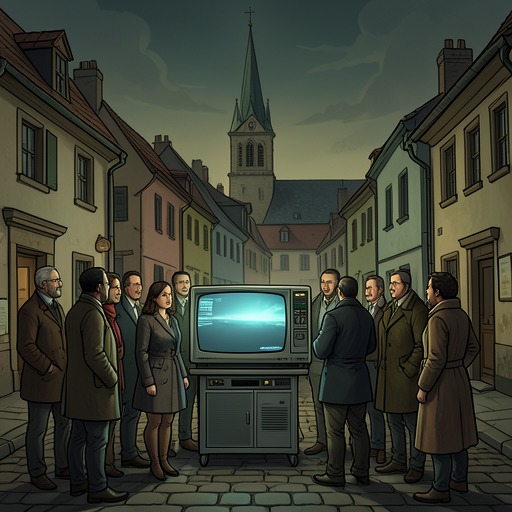
In the autumn of 1954, the house of Le Fondateur briefly became the first house in the village in a new sense: it would be the first to receive television. Guillaume D’Anjou wanted the D’Anjou family’s ancestral home to lead the way. Beside the house, he had a tall mast erected to carry a many-branched antenna, aimed due north to catch signals coming from Rimouski beyond the hills. Inside, he placed the varnished, bulky cube in an open corner at the back of the salon, to the right of the portrait of Le Fondateur. One face was a pane of glass, like a large open eye. The set’s location made it part of the room’s established arrangement while giving it a striking new presence beside the family’s portrait.
On Sunday, November 21, 1954, Loïc waited impatiently with his cousins for that eye to begin flickering. More than a hundred people came to the house, many arriving hours early. Those who could not fit inside stood outside at the windows. Their gathering transformed a private home into a public viewing space, with the audience assembled for a single anticipated event late on a Sunday afternoon. The day itself carried a change in meaning: Sunday, once reserved for the Lord, was now also organized around the arrival of a new form of spectacle.
At first, viewers stared at the image of an Indigenous person’s head on the screen, described in the narration as a symbol of the first inhabitants’ centuries without memory or representation. Then the picture began to move. Images from Montréal and elsewhere—faces, voices, gestures, scenes of lives—seemed to arrive instantaneously across hundreds or thousands of kilometres, beyond mountains, rivers, and forests, in a village in the Bas-Saint-Laurent. The contrast between the still opening image and the sudden animation makes the set’s novelty palpable: television did not merely supply something to watch; it altered the apparent distance between the village and the outside world.
A New Way of Seeing
The set’s effect depended on more than its images. Radio had already brought distant voices into local homes, but television made the people speaking seem bodily present. The narration stresses the unsettling force of seeing a person who was in Montréal, five hundred kilometres away, appear in the salon and speak face to face. Viewers could see clenched jaws, sweat on faces, and trembling lips. These bodily details mark a response that precedes easy familiarity: the new medium initially seemed disturbing, even frightening, because it brought visible human presence into the home without the person’s physical arrival.
The television is repeatedly figured as an eye, and its position in the salon gives that image a concrete counterpart: its glass face looks out from beside the portrait of Le Fondateur. The comparison also shifts as the set becomes familiar. What begins as an uncanny object under the collective gaze of a hundred villagers becomes a routine source of images and entertainment. The narrative describes the arrival of television as the Touladiens’ sudden entry into the global village, surrounded by electromagnetic waves that would carry them along, especially the children, with change accelerating from the 1960s. The set thus stands at the threshold between a first astonished encounter and a lasting transformation in habits.
From Collective Gathering to Private Habit
Television quickly changed the village’s rhythms. When popular serials were broadcast, the streets and the areas around houses emptied; they could be even more deserted than during Sunday high mass. In the beginning, people continued to visit one another to watch television together. That shared viewing, however, was transitional: once each family could acquire its own set, entertainment no longer required people to assemble in a group.
The change reached into ordinary evening sociability. Except for a few older holdouts, people gradually stopped meeting to play cards or checkers, or simply to talk. The television did not only replace one activity with another; it made gathering seem less necessary. The chronology matters: first the village gathered around a single screen, then private ownership dispersed viewers back into separate households. The communal audience that had filled the house of Le Fondateur therefore anticipated a medium whose eventual spread would weaken the very patterns of face-to-face association that had made its first arrival a village-wide event.
Authority and Narrative Significance
The set’s growing authority is measured against the church. As television’s appeal increased through the decade, the priest’s sermons increasingly reached distracted listeners, drawn instead to what the narrative presents as television’s democratic teachings. The screen becomes a modern pulpit, and its flickering eye supplants the eye of God, which is relegated to the status of an archaic belief unworthy of modern progress. This is not simply a contrast between religious and secular content: it describes a transfer of attention and influence from one institution to another.
The first television’s significance therefore lies in the chain of changes attached to its arrival. Guillaume D’Anjou’s effort to make the ancestral home the first to receive the set produces an extraordinary shared occasion; the images from Montréal collapse distance; repeated broadcasts draw people away from streets, visits, and games; and the screen competes with the church as a source of guidance. Le premier téléviseur de Touladi remains a single object in a salon, but the narrative gives it village-wide consequences. Its new eye first gathers the community before helping to disperse it.