Portugal
ShōgunPortugal matters in the novel not simply as Blackthorne’s description of a European country, but as the source of maritime expertise and commercial influence that helps determine who can travel, trade, and exert power in Japan. Its reach is carried by ships, secret sailing books, and missionaries who serve as interpreters between Asian states.
Political Identity and Conflict
When Blackthorne identifies Father Sebastio as Portuguese, he needles him by claiming Portugal and Spain are the same country because they share a king. Father Sebastio insists that Portugal remains a separate country and people, with its own flag and separate overseas possessions, despite having been taken by force under Philip. His protest places Portuguese identity within a larger struggle over sovereignty: political subjection has not erased the distinction he claims, or his expectation that Portugal will regain its own king.
That distinction matters in Japan, where Portuguese presence has acquired a protected position. Yabu differentiates the Portuguese from the newly arrived foreign sailors: the Taikō’s edict applies to Portuguese foreigners, while he regards Blackthorne’s crew as alien pirates outside that protection. His hostility also reflects resentment of foreign control over trade, rather than merely a dislike of unfamiliar customs.
Navigation and Maritime Knowledge
In Blackthorne’s account, Portugal and Spain possess the sailing knowledge needed for waters beyond Europe. English, Dutch, and French pilots have rutters for their own regions, but Portuguese and Spanish authorities guard guides to the wider world as national treasures. These small books collect practical observations—compass courses, depths, seabed, winds, currents, storms, anchorages, supplies, hazards, and the routes out and back. They make accumulated experience portable, but their usefulness depends on the reliability of pilots, copyists, printers, and translators; errors, whether accidental or deliberate, can make a guide unsafe until tested at sea.
That knowledge has exceptional value because charts remain vague and navigators cannot fix longitude. Blackthorne recalls his teacher Alban Caradoc’s lesson that a solution to longitude would make its discoverer extraordinarily wealthy, while a rutter offers a more immediate way to navigate beyond sight of land. The tension between uncertain global measurement and guarded route-by-route experience makes Portuguese navigational secrecy a form of strategic power: possession of a chart or rutter can open routes that rivals cannot confidently use.
Portuguese expertise also enters Japanese maritime practice as law. Rodrigues explains that the Taikō required the few Japanese ocean-going ships to carry Portuguese pilots, because Japanese sailors were experienced coastal navigators but feared the open sea. On the voyage down the east coast of the Izu Peninsula, Rodrigues leaves the coast near Cape Ito and steers west-southwest toward Cape Shinto, accepting exposure to open water to save time. The route shows how Portuguese piloting can make a Japanese political mission possible at sea, even when local sailors could manage a shorter coastal passage.
Trade and Religious Intermediaries
Portugal’s maritime position is bound to a commercial chain linking Japan and China. Because China and Japan are at war and direct trade is unavailable, Chinese silk reaches Japan through the Portuguese, who trade silver for silk from a base at Macao. The exchange prospers both countries and enriches the Portuguese intermediaries. The silk is not an ornamental luxury alone: it is important for enduring Japan’s hot, humid summers, so the trade touches the lives of samurai as well as merchants.
Jesuit priests become essential to this system because they are among the few people able to speak Chinese and Japanese and can therefore negotiate and interpret. Their usefulness makes the Portuguese and their religion difficult for Japanese rulers to exclude without risking the loss of trade. Christian daimyos and large numbers of converts, especially in Kyushu near Nagasaki, further embed the faith in Japanese political life. Commerce thus grants the missionaries a practical role that is also a source of religious and political influence.
The novel also shows the material infrastructure behind that religious presence. At Nagasaki, the Society of Jesus has a movable-type press brought from Goa, producing Japanese devotional works and language-learning texts. The collection includes a Portuguese-Japanese grammar and a Portuguese-Latin-Japanese dictionary, while Father Alvito has spent years compiling a more extensive work of his own. Translation, like navigation, is painstaking knowledge work: it enables communication across cultures and gives those who can perform it unusual access and authority.
Influence, Vulnerability, and Rivalry
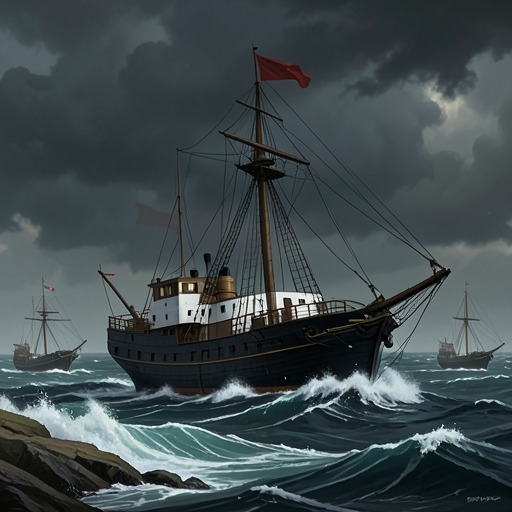
Portuguese influence is powerful but not absolute. At sea, a Portuguese frigate can move offshore in a hostile harbor, prime its cannon, issue muskets, and prepare grape, cannonball, and chain shot. Blackthorne recognizes both the ship’s tactical readiness and the reputation of Portuguese gunners as the galley approaches. The contrast between shore-bound Japanese power and armed European ships makes maritime force a potential instrument of intervention, not merely a means of carrying trade.
Yet Portuguese interests depend on permission, negotiation, and political calculation. When Toranaga seeks passage for his plans, the Jesuits and Portuguese weigh possible concessions and profit, including an offer involving ten thousand ducats of gold to be carried by the Black Ship to Goa for investment in India. Their proposed arrangement assumes that Toranaga may regain power or die before the ship returns. Portugal’s commercial network can therefore offer leverage, but its agents hedge their commitments against the instability of Japanese politics.
Taken together, the references to Portugal connect distant routes to local contests for power. Its protected traders, secret navigation guides, pilots, interpreters, and printing press form a network through which knowledge and goods travel; the same network also makes Portugal vulnerable to rulers who can restrict access, challenge its privileges, or redirect its ships. Portugal’s significance lies in that combination of reach and dependence: it can shape events in Japan, but only so long as Japanese authorities continue to tolerate its presence.