Izu
ShōgunIzu is a coastal province where local life is bound tightly to the ambitions of rival lords. Its fishing villages and fields suffer under Yabu’s rule, while its roads, passes, port, and fortified center make it valuable to Toranaga and Ishido alike. As control changes hands, Izu shifts from an exploited fief into a military corridor and a base for Toranaga’s plans at sea.
Setting and Local Life
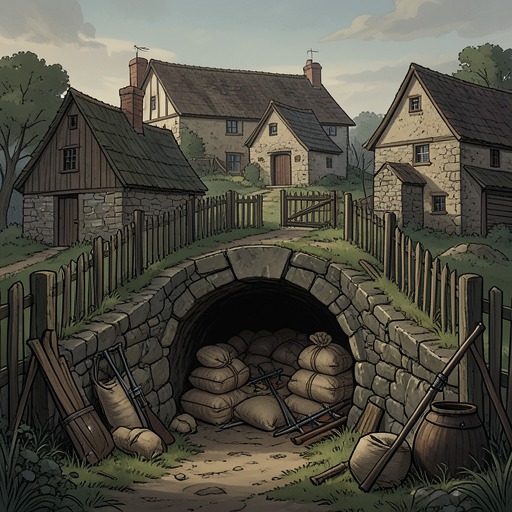
Izu lies on the southeastern coast of Honshu. Its villages include Anjiro, a fishing settlement whose headman, Mura, finds himself responsible for the foreign castaway Blackthorne in the first year after The Taikō’s death. Mura imagines that his part in receiving the unusual arrival will live on in village stories, but his private pride exists alongside a more immediate anxiety: Izu’s people are caught between powerful lords and exposed to the consequences of their decisions.
The province’s settlements are connected to a larger political landscape by the Tokaido, the Great Coastal Road linking Yedo, Toranaga’s capital, with Osaka, Ishido’s seat three hundred miles to the west. The road gives Izu significance beyond its local boundaries: armies moving between the rival capitals must reckon with the region and its approaches. Its northern city, Mishima, is the largest city in Izu and surrounds the province’s greatest castle, making it a center of both administration and military power.
Izu’s economy is also part of the story of rule. Mura thinks of Yabu as a cruel lord who cheats villages of their rightful shares of fish and crops. That grievance gives political subjection a material meaning: the contest between the great lords is not remote from the people who fish, farm, and prepare the roads. Their labor and resources are collected for a hierarchy whose decisions they cannot control.
Yabu’s Fief and the Burden of Rule
Yabu, daimyo of Izu and Kasigi Omi’s uncle, initially embodies the province’s local authority. Mura fears both Yabu’s cruelty and the uncertainty of his allegiance, wondering whether he will side with Ishido or Toranaga when war comes. This is more than speculation about a distant battlefield. If Izu’s lord chooses a side, the province itself becomes part of the conflict, while its inhabitants remain vulnerable to whichever power can reach them.
The strain becomes visible when Yabu’s forces prepare to receive him and Toranaga after their escape from Osaka. Kasigi Omi mobilizes Anjiro and the able-bodied men within twenty ri, spending heavily to ready the village. The shore is swept, boats and nets are arranged, and the villagers gather in their best clothes before a military force of three thousand samurai and five hundred cavalry. The meticulous welcome conveys the reach of lordly authority: even a fishing village is made into a stage for power, and its readiness is judged as Omi’s responsibility.
Izu’s military value is made explicit in a concealed plan for defense. After receiving word that Toranaga has escaped Osaka with Yabu, Omi orders a purported war exercise throughout the province. Within three days, roads and passes can be blocked, while a mock pirate fleet to the north can threaten ships sailing without an escort. Izu is not merely a possession to be defended; its terrain and coastline can be organized to restrict movement by land and sea.
A Contested Province in the Regency Crisis
Toranaga’s flight from Osaka and resignation from the Council of Regents alter the stakes for Izu. With the Council no longer convened, Omi argues that its orders lack their former legal force until it meets again. He urges Yabu to reject Ishido’s pressure and choose Toranaga, citing Toranaga’s interest in ships and trade, his record as a general, and the threat that Ishido will give Izu to his kinsman Ikawa Jikkyu. In Omi’s account, allegiance is also a question of who will preserve Yabu’s hereditary fief.
Yabu nevertheless fears that Toranaga has left him exposed. When he hears that Izu and the Kwanto are isolated, he believes Ishido has already won and that Toranaga has trapped him. Toranaga counters that Ishido does not yet possess the power Yabu assumes, and explains why he resigned. The exchange reveals how quickly Izu’s security can appear to change with the balance of authority in Osaka: the province is threatened not only by armies but by the legal and political consequences of decisions made far away.
Toranaga makes Yabu’s dilemma personal by setting out the possible costs of either choice. Going to Osaka could mean Yabu’s death, the loss of Izu, and the execution of the Kasigi family; staying could bring the Council’s order and the same danger. Yabu eventually declares that he will not go to Osaka before Toranaga and has mobilized all of Izu. He says that he has made a solemn bargain and that the Kasigi honor their bargains. His commitment turns the province’s military readiness into an expression of allegiance.
Grants, Reversals, and New Uses
Izu’s place in Toranaga’s political order is not simple possession. After Yabu proposes taking a dangerous sword out to sea and drowning it, Toranaga agrees; once it has sunk, he stabilizes the tax division at sixty parts for peasants and forty for their lords, and grants Yabu Izu as his fief. Yet the grant leaves Toranaga with the power to reclaim the province. Yabu receives formal authority, while Toranaga retains the superior political leverage—a distinction that helps explain Yabu’s later sense that Izu, his guns, and his honor have all been lost.
Yabu’s control remains vulnerable to negotiation and reversal. Ishido’s representatives later offer him Izu, Blackthorne, and Blackthorne’s ship if Yabu helps secure the chief enemy’s head, remains in Osaka, and swears allegiance. Yabu begins to bargain, pointing out that he is already overlord of Izu and has been promised Totomi and Suruga. The offer shows the province being treated as currency in a larger struggle, while Yabu tries to enlarge his power even from a trapped position.
After Ikawa Jikkyu’s death, Yabu sees a new military opportunity. He proposes an immediate attack along the Tokaido, arguing that Izu is safe and that Suruga and Totomi are exposed. Toranaga’s general Hiro-matsu answers with the conditions such an advance would require: securing the road and its bridges, crossing the Tenryu quickly, maintaining communications, and containing Zataki. Izu’s value here lies in its position at the opening of a possible route toward Osaka, but the plan depends on holding the connections beyond the province as well.
A Base for Toranaga’s Plans
As Toranaga’s plans develop, the administration of Izu changes again. He appoints Kasigi Omi commander of the Musket Regiment and head of the Kasigi family, granting him border lands from Atami in the east to Numazu in the west, including Mishima, with an annual income of thirty thousand koku. Omi is ordered to take Mishima Castle at once and report to Sudara. The appointments bind military command, family leadership, and territorial administration together, replacing Yabu’s position with a new arrangement under Toranaga.
Toranaga also assigns the fief Omi currently holds to Blackthorne, privately directing that Blackthorne return to Anjiro to build a new ship. Omi has already considered whether another ship can be built and where it could be constructed; he argues that Izu is a suitable choice because it will be easy to keep Ishido’s armies out. For Toranaga, the province thus serves two connected purposes: it is defensible territory on land and a setting for rebuilding naval power after Blackthorne’s ship is burned.
The choice extends beyond the coast. Omi recommends Yokosé as a mountain residence where a hatamoto could be entertained in the style his rank requires. Izu can therefore support both the practical demands of military and maritime planning and the formal privileges attached to status. Across its changing grants and uses, the province remains a place where power is made concrete—in taxes taken from villages, men assembled on the shore, routes prepared for armies, and a new ship imagined at Anjiro.