Osaka Castle
ShōgunOsaka Castle is Ishido’s fortress and seat of power, a layered stronghold whose defenses make the struggle for political freedom in Osaka a literal contest over gates, routes, and permission to leave. Its massed troops and deliberately confusing approaches embody Ishido’s control, while the castle’s proximity to the city streets and harbor gives military plans there consequences well beyond its walls.
Position and Approach
Toranaga and Ishido face one another from opposite ends of the country’s central political landscape: Toranaga rules the Kwanto, while Ishido commands from Osaka Castle. The Tokaido links Yedo, Toranaga’s capital, to Osaka, three hundred miles to the west. It is both a route between rival centers of power and the road along which their armies would have to march if the conflict became war. From a village caught between the two lords, the castle therefore signifies more than Ishido’s residence: it is the western anchor of a confrontation whose outcome remains uncertain.
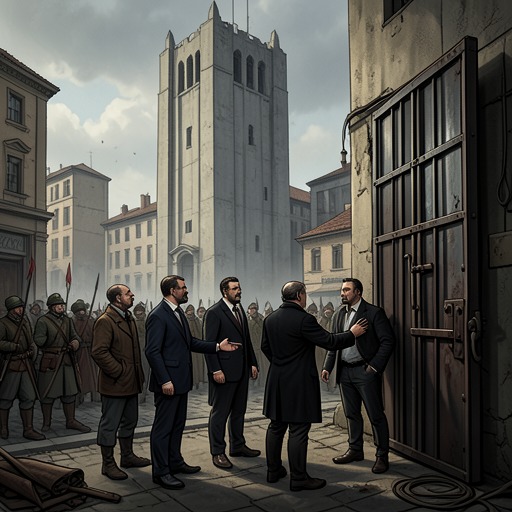
Blackthorne’s first approach reveals how access is controlled. A palanquin brings him to a gigantic stone gate set into a thirty-foot wall, with battlements, bastions, and outworks. Its iron-plated door stands open and its portcullis is raised, but openness does not mean freedom of passage. Beyond it, a wooden bridge twenty paces wide and two hundred long spans a moat and ends at an enormous drawbridge and another gate in a second wall. The route itself presents a succession of barriers, each capable of turning arrival into delay or exposure.
Defensive Design and Military Presence
The castle’s defenses are arranged in depth. Blackthorne considers what an attacker would face after taking the outer wall: defenders could still fire down from the battlements, while the next wall would resist bombardment even if siege guns could be brought into position. Damaging a gate would not solve the problem of crossing the vast moat. In his assessment, the stronghold could be impregnable if it had enough soldiers. The comparison that it made the Tower of London seem like a pigsty, with all of Hampton Court fitting into one corner, conveys the scale of his first impression rather than a measurement of the castle.
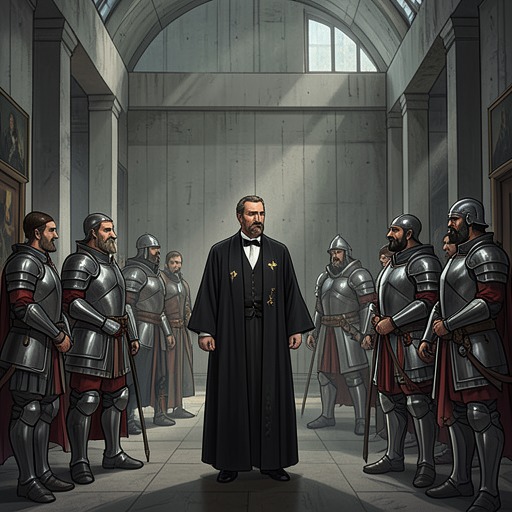
The route inward confirms that this is not one enclosure but a controlled maze. At another gate, papers are checked again; the road turns down a broad avenue lined with fortified houses behind successive walls, doubles back through steps and roads, and passes further gates, portcullises, and moats. Even Blackthorne, whose memory and sense of direction are exceptional, loses his bearings in the deliberately confusing layout. From ramparts, escarpments, bastions, and parapets, Ishido’s Gray Guards watch the procession. More soldiers patrol, march, train, and tend horses in open stables. Blackthorne sees them by the thousand, armed and meticulously clothed. The castle’s force lies in the combination of architecture, surveillance, and a visible, organized garrison.
Seat of Political Control
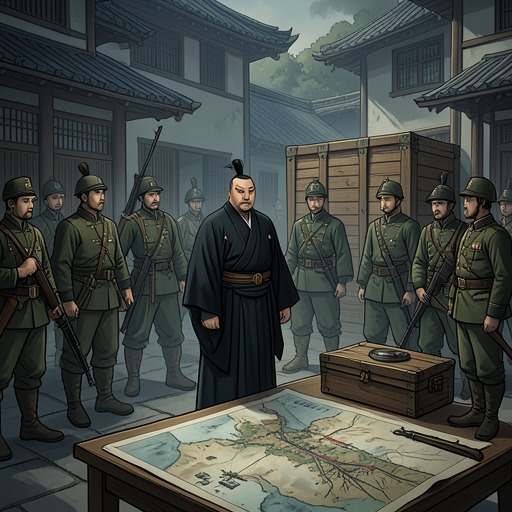
Ishido’s power at Osaka Castle is measured not only by its walls but by the number of soldiers around it. Yabu estimates that eighty thousand Samurai are in and around the castle, against the few hundred men with whom Toranaga has entered Osaka. That imbalance makes Toranaga’s presence appear almost recklessly dangerous to Yabu. The castle functions as the setting for a political trap: its strength can protect Ishido while making Toranaga vulnerable to confinement and coercion.
The interior also contains designated quarters for Toranaga’s household. After Blackthorne is brought back under Gray escort, he is taken to the part of the castle he had visited before, where Kiritsubo, Lady Sazuko, her child, and the remaining Samurai of Toranaga’s party are still lodged. He bathes and finds fresh clothes laid out, but asks whether Mariko is there and learns that she is not. The household’s continued presence gives the castle the character of a guarded residence as well as a military headquarters: people, family, and political leverage occupy the same enclosed space.
Routes, Harbor, and Escape
The castle’s control is connected to Osaka’s streets and waterfront. During Toranaga’s escape, he and his companions study a galley moored at a stone wharf one hundred yards out into the sea. A hundred Gray Guards wait near its gangway, across open ground where a surprise attack would be difficult. The wharf and harbor are not the castle’s walls, but they belong to the same contest over who can move through Osaka and by whose leave. Blackthorne’s knowledge of ships and maneuvering becomes valuable when a galley must contend with a faster frigate near the harbor mouth; the opposing vessels’ differing ability to tack and turn makes the narrow sea room a tactical problem rather than an uncomplicated route to safety.
The city’s vulnerability also shapes the choices made around the fortress. When Yabu proposes setting a street on fire as a diversion, a samurai objects that arson brings public burning for the guilty person’s entire family, across generations. The severity of that law reflects the danger of fire in a city built largely of wood and paper, where a blaze could spread from streets to warehouses and palaces. Yabu answers by weighing that danger against the possible death of Toranaga. The proposal shows how the castle crisis can push political actors to consider sacrificing the surrounding city to break a military predicament.
Mariko, the Hostage Crisis, and the Castle’s Vulnerability
The castle’s system of control is challenged when Mariko says she intends to leave Osaka with her liege lord’s ladies. Ishido invokes the Emperor’s invitation and the Regents’ welcome, but Mariko distinguishes an invitation to attend on a specified date from an order confining her in Osaka. Ishido finally acknowledges that she is not confined. The assembled ladies understand the consequence: if Mariko can go, perhaps they can go too. He then seeks a formal ruling from the Regents and requires her to remain ready to answer their questions. Her challenge turns a personal departure into a public test of whether Ishido’s authority can keep the castle’s other occupants in place.
Mariko’s eventual formal departure unfolds under the gaze of both sides. At noon she walks toward the gates with ten of Toranaga’s Brown Guard behind her. She wears a pale green kimono, white gloves, and a traveling hat; Gray Guards line the avenue and battlements, while Blackthorne and Yabu watch from the opposite side. The Browns in the forecourt wear ceremonial dress but have no armor or bows, only swords. The open gates frame a passage that is at once a route out and a confrontation staged before the castle’s assembled forces.
Later, the castle’s controlled spaces become the terrain of a covert attack. The first wave of ten Ninja crosses from the opposite battlements by grappling hooks, then descends toward verandas and infiltrates the compound. Yabu shouts an alarm as part of a diversion meant to draw the guards away from a secret entrance into the audience chamber, where the raiders intend to seize Mariko and remove her before anyone understands what is happening. The stratified architecture that once made the castle difficult to penetrate becomes a set of routes for attackers who exploit gaps in its guard arrangements.
Osaka Castle remains the center of the political reckoning even after its immediate crises. The Emperor’s advisers may welcome an excuse to delay a visit to Osaka, and Toranaga seeks to use that possibility to gain time. Later, word reaches him that Ishido has left the castle and that the Regents have formally declared him an outlaw. The fortress is therefore both Ishido’s base and a point from which power can be exercised or temporarily withdrawn. Its significance lies in that tension: the walls can shelter an immense army, but they cannot permanently settle who has the right to command the roads, the city, or the country.