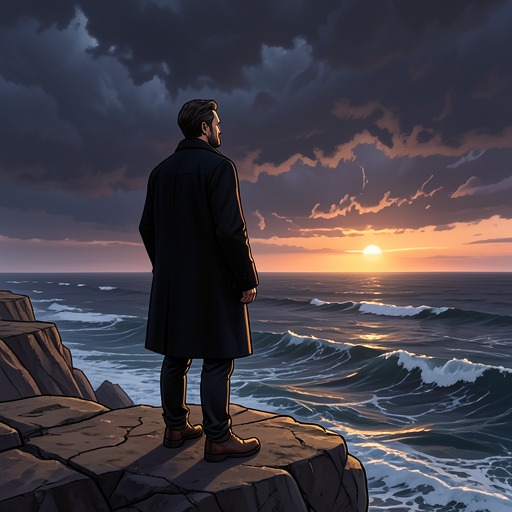
Pacific Ocean
ShōgunThe Pacific Ocean is more than a backdrop to the Erasmus’s voyage: it is the immense, poorly charted expanse that turns navigation into a struggle for survival and makes knowledge of routes a source of political and commercial power. For John Blackthorne, its scale offers the prospect of discovery and a passage home, but also reefs, isolation, and the possibility that the remaining ship and its weakened crew will never reach land.
Setting and scale
The Erasmus enters the Pacific after passing through the Strait of Magellan, a route the first Dutch expeditionary force has used to reach waters previously navigated by its Iberian rivals. Blackthorne’s last landfall was Chile; from there, the ship has spent 133 days crossing the ocean. By the time he searches the gray, angry sea, reefs and shoals have threatened the expedition for a month, yet no land has appeared. Not even seaweed or a change of color offers a hint of a shelf near shore.
Distance is measured against the possibility of disaster. Blackthorne reckons that the crew must make landfall within three days or die. Of the five ships that set out, the Erasmus is the sole survivor. Its own company has dwindled from 107 men to 28, and only ten can walk; food is gone, the remaining water is foul, and scurvy has left Blackthorne and the others weakened. The Pacific’s apparent emptiness is therefore not a peaceful absence but a pressing physical danger.
The Erasmus’s crossing
The Erasmus is a 260-ton, three-masted trader-warship from Rotterdam, armed with twenty cannon. It was one of five vessels in the Netherlands’ first expeditionary force sent to ravage Spanish and Portuguese possessions in the New World. The mission also sought permanent trading concessions, islands in the Pacific that could serve as bases, and territory to claim for the Netherlands. The fleet was meant to return home within three years; the survivors’ present condition makes that plan seem remote.
The crossing places Blackthorne’s professional ambition beside the losses required to pursue it. He is the first English pilot to pass through the Strait of Magellan and the first English pilot to sail these Asian waters. He imagines completing a circumnavigation and returning home, but counts the deaths incurred in reaching each new milestone. His confidence in his ability to master the sea persists even as the damaged ship is driven onward under bare poles and storm topsails, with reefs ahead and no land in sight.
Navigation and the rutter
The Pacific is difficult to cross not only because of its scale but because navigators lack reliable charts and cannot fix longitude. Blackthorne’s essential instrument is his rutter, a sea manual that records a pilot’s observations: compass courses between ports and headlands, soundings and water color, seabed, winds, currents, tides, storms, reefs, havens, places to take on water, and ways to make and retrace a voyage. Blackthorne plots his position in the book, using accumulated observations to make a precarious patch of ocean more legible.
That knowledge is valuable because it is scarce and politically guarded. English, Dutch, and French pilots have rutters for their own waters, while Portugal and Spain treat the sailing knowledge of the wider world as a national secret. Their records expose routes through the Strait of Magellan and around the Cape of Good Hope toward Asia, making them prizes for their enemies. Yet a rutter is not infallible: copying and translation can introduce errors, and a pilot cannot be certain of its accuracy until he has sailed the route himself. In the Pacific, written knowledge reduces uncertainty without abolishing it.
An ocean of strategic passages
The novel sets the Erasmus’s oceanic crossing against the limits of Japanese coastal navigation. During a later voyage along the east coast of the Izu Peninsula, the galley carrying Toranaga turns away from the coast and heads across open water toward Cape Shinto. Vasco Rodrigues explains that Japanese sailors are skilled coastal navigators and fighters but are frightened by deep water; the Taikō’s law therefore required the few Japanese ocean-going ships to carry Portuguese pilots. The episode makes the distinction between mastery of a familiar coastline and confidence on the open sea explicit.
Together, these journeys present the Pacific and its approaches as a network of passages controlled by ships, pilots, and navigational expertise. The Erasmus’s crossing depends on Blackthorne’s calculations and the information in his rutter; the Japanese galley’s route depends on Rodrigues’s piloting and its need to save time. The ocean connects distant political contests, but it does not make travel easy or neutral: whoever can navigate, supply, and command a vessel can turn distance into reach, while those without that knowledge remain dependent on others.